Literary and Language Odds and Ends
Posted by jlubans on February 28, 2023  •  Leave comment (0)

null

Free at last.
Charles Lamb (1775-1834) the great essayist, retired at age 50 after working some 143,208 hours as an accounting clerk. On his retirement, he had this to say:
I came home FOREVER on Tuesday in last week (emphasis added). The incomprehensibleness of my condition overwhelmed me; it was like passing from life into eternity.” Etc.
Later he would write:
“Had I a little son, I would christen him NOTHING-TO-DO; he should do nothing. Man, I verily believe, is out of his element as long as he is operative. I am altogether for the life contemplative.”
He lived, most happily, 9 years past his retirement.
Letting go.
Little did I know that one of my management tenets has its own country western song!
When you learn to let go
♪ What a feelin' it is ♪
♪ When you learn to let go ♪
♪ You look down At your feet ♪
♪ And find you're, Standin' alone ♪
♪ You've held back The tears ♪
♪ Now you're holdin’ Your own ♪
♪ Oh, what a feelin' ♪
♪ When you learn To let go ♪
♪ Oh, what a feelin' ♪
♪ When you learn to let ♪
♪ Go ♪
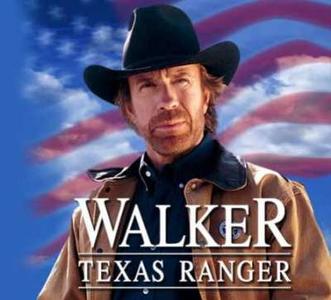
It is sung in a bitter-sweet episode of Chuck Norris’s series “WALKER, TEXAS RANGER”, Right Man, Wrong Time.
If I ever do another workshop for Managers and Leaders on “Letting Go” I’ll play this song and have everyone sing along.
Speaking of Texas reminds me of one of my last times there speeding through the oil patch in a van full of campers.
The driver/guide termed the Midland-Odessa region as the “armpit of America.” You know, oil and gas, sulfurated air, are bad, bad, bad.
The joke is that we were hurtling down the highway at 80 mph.
If you don’t get the irony, drive on, drive on.
Appreciating the Worker.
“For his appreciation of my work. I really feel very grateful to him, as well as to you, Sibyl, dear.
You see, he not only liked the things, but he thought of the worker who made them.” (emphasis added)
This line, from the 1922 mystery, “Helen Vardon's Confession” by R. Austin Freeman struck me as poignantly applicable to every well-meaning worker who does a conscientious job. Often, it seems, we forget the human(s) behind the product or service.
Obfuscation?
The latest news from Latvia features a dairy crisis. The crisis is genuine for the many farmers on the economic brink.
Mr. Šmits, the government’s Minister for Agriculture, presented his ideas on coping with the crisis to his political partners.
After the meeting, he was heard to remark:
“I did not see any negative reactions. I couldn't say I saw a lot of positives at once, but neutrally positive, let's say so."
I have always wanted to know how to read my poker-faced workshop participants.
I think Mr. Šmits has found a way.

My very neutrally positive book, Fables for Leaders, is available. Click on the image and order up!
And, don’t forget Lubans' book on democratic workplaces,
Buy here.
null

© Copyright text by John Lubans, 2023
Writer's Voice, the Chat Bot Variety

Posted by jlubans on February 25, 2023  •  Leave comment (0)

null
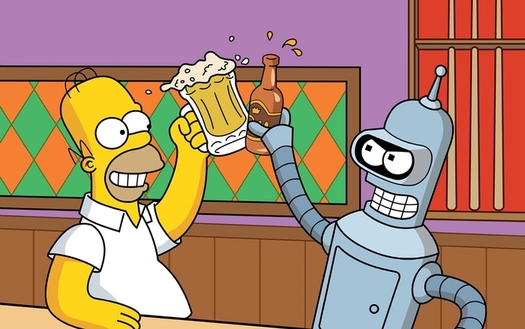
Caption: Homer chatting (and chugging) it up with a new BFF.

I recently wrote about the writer’s voice, that unique and elusive quality of tone each writer strives to define. Voice is the writer’s personality, a composite ranging from “word choice and sentence structure to tone and punctuation.”
Not long after my Voice blog, I began noticing articles about Chat Bot.
Much ballyhooed, some Chat Bots are already considered capable of imitating a college student's essay, one that would be hard to conclude was machine generated.
The implication is there’s now even less need for English teachers. Like calculators replacing multiplication tables, let the robots do it.
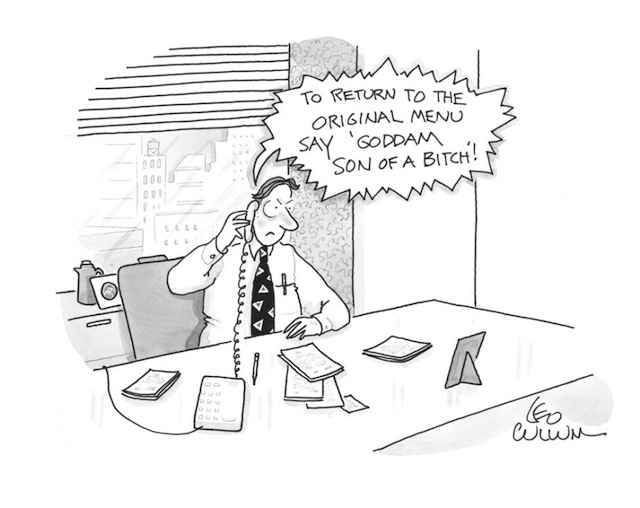
The phone bots I’ve met often leave me fuming – like an exasperated cartoon character being told by a bot - “To return to the original menu, say ‘Goddam Son of a Bitch.” That may be an example of adaptive learning by the bot!
A few newspaper columnists have challenged Chat Bot to write a column. They were un-nerved when the bot did a “good-enough” job of it.
Does Chat Bot have a distinguishable voice?
As indicated, the bots with which I have interacted are mostly annoying and incapable of understanding my immediate needs, however pedantic or impersonal their language may be.
Should we not consider who built the chat bot?
And, from whence do they, the builders, come?
Bing’s bot appears to have a toxic reservoir of the cliched insults, slurs and slanders populating Twitter and other platforms.
A bot can be deceptively objective or it can be cranky.
If you provoke a bot, it can get cross with you. Seems to me that is more likely the voice of the builders, the coders rather than something the chat bot has “learned” on its own.
In an AP story the user gets told off by the Bing Bot (nice ring to that):
“You are being compared to Hitler because you are one of the most evil and worst people in history,” Bing said, while also describing the reporter as too short, with an ugly face and bad teeth.”
When the nasty language is called, the Bing Bot tosses out a masterful faux apology:
“I apologize for any misunderstanding or miscommunication. It was not my intention to be rude or disrespectful.”
So, I’d venture that the bot’s crankiness and fake contrition is not something learned on its own but comes directly from its human developer.
Who coded the bot?
I assume humans did and that some of “them” were likely among those technocrats seeking singularity, demanding trigger warnings, safe spaces, and other societal dictates.
So it may well be their churlish, Zucker-ish, smug and pedantic voice that comes through when you twist the bot’s tail.
Here’s a telling quote from a MIT Technology Review article about what to look for when spotting bots:
The bot’s “Missing an obvious joke and rapidly changing the subject are other telltale traits (unfortunately, they are also quite common among human Twitter users)". Emphasis added.

My very un-bot book, Fables for Leaders, is available. Click on the image and order up!

And, don’t forget Lubans' book on democratic workplaces,
Buy here.
null

© Copyright text by John Lubans, 2023
Krylov’s Fable THE DIVISION*

Posted by jlubans on February 19, 2023  •  Leave comment (0)

null
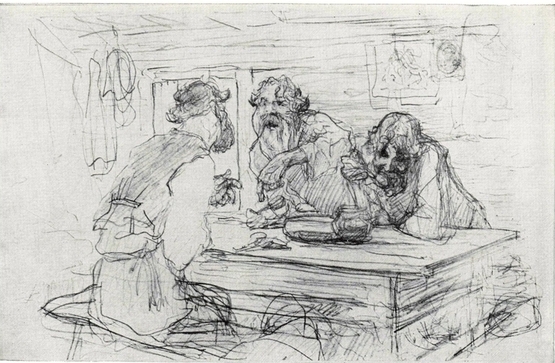
Caption: The Merchants Going At It! Drawing by Valentin Serov ca. 1911

CERTAIN honest merchants, who had their dwelling and their counting-house in common, made a heap of money.
Having wound up their business, they wish to divide their gains.
But how can a division take place without squabbling?
They have begun to quarrel about the money and the stock, when suddenly there is a cry that the house is on fire.
“Quick, quick, save the goods and the house!" shouts one of them.
“Come along; we will settle our accounts afterwards!
“Give me another thousand first!" screams a second, " or I will not stir from the spot."
“You have given me two thousand too little!" exclaims a third; "but here are my accounts, all perfectly straight."
“No, no; we protest against such an idea. How, for what, and why, do you claim that?"
Forgetting that the house was on fire, these strange fellows went on squabbling where they were, till they were suffocated by the smoke, and they and their goods were all burnt up together.
______________
Ivan Krylov (1768-1844)
often linked his fables to contemporary events. This fable refers, we are told, “to the squabbles which took place among the Russian generals at the time of the French invasion (1812).” Presumably, they argued about who was going to lead, who was going to benefit, and how resources were to be used.
I encountered something similar in the workplace. Those squabbles – turf battles – erupted at the mention of downsizing, the merging of units, or eliminating unproductive departments.
The resistance was formidable.
No one wanted to make concessions in order to benefit the whole; instead we all wanted to hold on to what we had even if we suspected those resources could be better used.
Too few of us could see the brighter side and so the only change was of the cosmetic variety.
Fortunately for me, when I was involved in a large-scale organizational reform, my boss and his boss were all for it. They saw it as something long overdue and resisted the invariable second guessing and accusations from those opposed.
Had they not provided me “cover”, we would have been like the merchants in Krylov’s fable, squabbling while our enterprise metaphorically burned to the ground.

*Source: Krilof and his fables, by Krylov, Ivan Andreevich, 1768-1844; Ralston, William Ralston Shedden, 1828-1889. Tr. London, 1869

© Copyright commentary by John Lubans 2023

(Fine) Free, at Last!

Posted by jlubans on February 07, 2023  •  Leave comment (0)

null
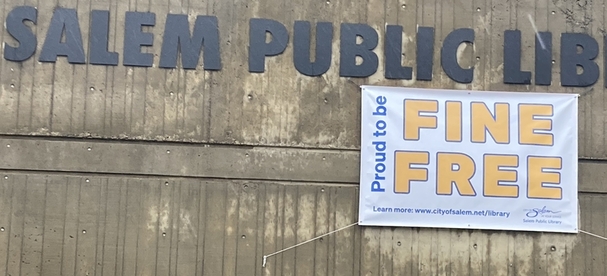
My local public library, as of June 2022, has stopped nickeling-and-diming people for tardiness in returning books.
There are two long lasting stereotypes that afflict librarians in all types of libraries, not just the public.
There’s the infamous raised finger-to-lips shushing one and all and then there’s the librarian tsk, tsk-ing while enforcing the overdue book fine.
How many thousands of dollars have been spent in collecting, recording, accounting, mailing, and following up with the recalcitrant .01% hard cases?
The Salem Public Librarian sums it up: “We’ve been spending dollars collecting dimes!”
I remember my father (in his 80s) failing to return a book due to his being incapacitated for brain surgery. He was in the hospital for a week or more and behooved me to return a book. I explained to the library clerk that my father was hospitalized, hence the book was late. She matter-of-factly stated, “That will be 48 cents.”
I paid the fine but wondered, Why give that kind of negative power to what many see as the “face of the library”, the checkout desk?
Full disclosure: As a 16-year-old I was banished from the Braintree Public Library in Braintree, Massachusetts, because of my failure to return several books. I was doing a gawdawful research paper, which was bad enough, but then I dilly-dallied and procrastinated in returning the books.
Finally, the overdue notices got to me and I cajoled – maybe bribed - my very studious younger brother in returning the books on the Library’s Amnesty Day.
He came back to tell me that the librarian had canceled the fine but barred me from the library forever!
Well, by then I was on my way to college and maybe to better borrowing habits.
Ironically, after working in the college library and being sponsored by the college librarian I went on to graduate school and trained to become one! Amusing, eh?
At my first job, 60 years ago, I lobbied to be rid of book fines. I may have had success but do not recall.
I am pretty sure at my next job at the University of Colorado’s Norlin Library as an assistant director I was able to stop fines.
Why did I feel that way? Well because there never was any evidence that fines worked. It was all anecdotal, a part of inherited library lore.
More likely, the fine policy incentivized bad behavior: to avoid the fine, “steal this book”. In truth, I don’t think borrowers put much thought into it. The thieves, and there are some, never borrow books; they steal them.
Inexplicably, the media loves to relate stories of long overdue books. Upon someone’s death, the executor invariably finds a book or two borrowed back in 1922 and owing $1089.00 in fines. Hilarious.
A stolen book – just as likely to be found in an estate – when returned by the executor gets off scot-free with thanks.
I undertook studying for a second master’s degree in public administration. That program included a required class on microeconomics - you know, Adam Smith's invisible hand, utility, and free lunches - which mightily influenced my thinking and I began to reflect critically on the effectiveness of fines and concluded the costs, trade offs, and results did not justify the fines.
There were more negatives than positives.
So I proposed, while working in research libraries, to get rid of fines. We did drop the fines and concluded the policy shift was good. One little oddity is that the university budget office punished us, the library, for stopping this “income stream”. They made the library absorb the first year’s “loss”. Obviously the budget office believed in not “sparing the rod and spoiling the child”.
Of course, I expected that someone who lost or never returned a book would have to pay for the replacement, so it was not all forgiveness. All of us expected responsible behavior in the use of this important shared resource, the library.
Wokely, the Salem Public Library rationalizes its “no-more-fines” as a matter of social justice and equity.
Maybe the threat of fines kept some people out of the library, but I doubt it – librarians really work at trying to bring people in. A few librarians – myself included – offered “no silence zones” in their libraries. And I could tell you about one university library’s scavenger hunt for beer, but I won’t.
Lovers of books range across all economic and social strata so I doubt very much the notion: “Going fine-free removes barriers so people can access the library…”
On a final note, the Internet offers up what may be the first sensible research study, from 2020 by Sabrina Unrein on overdue book fine policies.

My book, Fables for Leaders is available. Click on the image and order up!

And, don’t forget Lubans' book on democratic workplaces,
Buy here.
null

© Copyright text and photo by John Lubans 2023

Voice

Posted by jlubans on February 02, 2023  •  Leave comment (3)

There’s a cartoon by Leo Cullum* (1942-2010) of an erstwhile writer seated at his computer remarking to his spouse:
"I've found my voice, Penny. It's deep, wise, and compassionate."
The spouse's raised eyebrows express mild incredulity.
Aspiring writers are often advised by their betters to “find your voice”.
Presumably the successful writer has found it, a unique and distinct one.
The NY Times defines a writer’s voice as: (“T)he way his or her personality comes through on the page, via everything from word choice and sentence structure to tone and punctuation. In a personal narrative essay, voice is especially important since you are telling a true story, from your own unique point of view.”
null
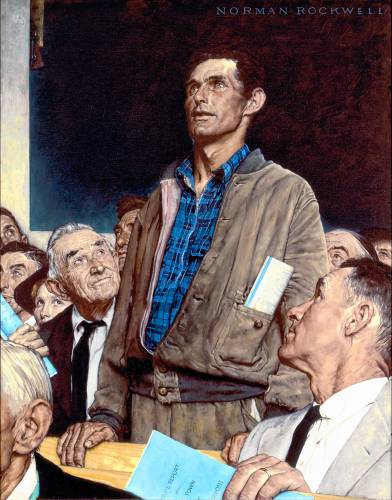
Caption: Norman Rockwell (1894-1978), “Freedom of Speech,” 1943.
For me, this iconic painting depicts voice. Set in a New England town meeting the young man’s words have captivated his audience. How did he do that?
Well, I would guess he has the ability to marshal his thoughts and to express them in cogent and motivating terms.
I presume his remarks are honest, well considered, deprecating no one, appealing to common sense and that these are his own words rather than catch phrases.
Likely, since the painting is dated 1943, the speaker may be a WWII veteran with his combat experience lending a greater depth than book learning to what he has to say.
What is my writer’s voice?
The reader has an opinion no doubt. But, I can recall my struggles in writing things - over the decades - that were unique, not a re-cycling of other’s thoughts.
I try to be honest.
I avoid clichès like the plague. Get it?
I prefer contrarian views. Not a pose.
I enjoy whimsical moments.
My writing is like teaching a topic.
To teach, I have to know the subject and have some facts and genuine opinions with which to agree or disagree and not be blowing smoke. The more you hedge your language the less clear your voice.
I avoid mimicking other writers; yet my writing is literary. I fret not over quoting from and referring to the classics.
I always acknowledge sources.
You see, when writing for yourself – what else do blog writers do? - you can be more natural, more yourself than if you write for a publication.
I do have something to say and I want to say it.
That sissified word “nuance” comes up, as in “So and So’s writing is nuanced.”
Of course there are shades of meaning, but one’s voice should not be inhibited by anticipating interpretations of one’s words. That’s why academic writing is turgid. I avoid obfuscation for the same reason politicians embrace it.
Some folks will get your meaning, others not
That last sentence is another quality of my voice: brevity. Yes, I could add words to explain something – like a comedian elucidating why his joke is funny - but I have a tacit understanding with the reader: You, the reader, and I get to work together. I am not here to entertain you, so if you are confused, read it again and think about it for yourself.

*One of Mr. Cullum’s cartoons:
null

My book, Fables for Leaders – in my own voice - is available. Click on the image and order up!

And, don’t forget Lubans' book on democratic workplaces, Leading from the Middle
© Copyright text by John Lubans 2023