(Fine) Free, at Last!
|
|
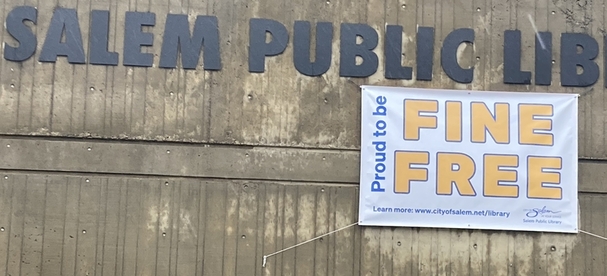
My local public library, as of June 2022, has stopped nickeling-and-diming people for tardiness in returning books.
There are two long lasting stereotypes that afflict librarians in all types of libraries, not just the public.
There’s the infamous raised finger-to-lips shushing one and all and then there’s the librarian tsk, tsk-ing while enforcing the overdue book fine.
How many thousands of dollars have been spent in collecting, recording, accounting, mailing, and following up with the recalcitrant .01% hard cases?
The Salem Public Librarian sums it up: “We’ve been spending dollars collecting dimes!”
I remember my father (in his 80s) failing to return a book due to his being incapacitated for brain surgery. He was in the hospital for a week or more and behooved me to return a book. I explained to the library clerk that my father was hospitalized, hence the book was late. She matter-of-factly stated, “That will be 48 cents.”
I paid the fine but wondered, Why give that kind of negative power to what many see as the “face of the library”, the checkout desk?
Full disclosure: As a 16-year-old I was banished from the Braintree Public Library in Braintree, Massachusetts, because of my failure to return several books. I was doing a gawdawful research paper, which was bad enough, but then I dilly-dallied and procrastinated in returning the books.
Finally, the overdue notices got to me and I cajoled – maybe bribed - my very studious younger brother in returning the books on the Library’s Amnesty Day.
He came back to tell me that the librarian had canceled the fine but barred me from the library forever!
Well, by then I was on my way to college and maybe to better borrowing habits.
Ironically, after working in the college library and being sponsored by the college librarian I went on to graduate school and trained to become one! Amusing, eh?
At my first job, 60 years ago, I lobbied to be rid of book fines. I may have had success but do not recall.
I am pretty sure at my next job at the University of Colorado’s Norlin Library as an assistant director I was able to stop fines.
Why did I feel that way? Well because there never was any evidence that fines worked. It was all anecdotal, a part of inherited library lore.
More likely, the fine policy incentivized bad behavior: to avoid the fine, “steal this book”. In truth, I don’t think borrowers put much thought into it. The thieves, and there are some, never borrow books; they steal them.
Inexplicably, the media loves to relate stories of long overdue books. Upon someone’s death, the executor invariably finds a book or two borrowed back in 1922 and owing $1089.00 in fines. Hilarious.
A stolen book – just as likely to be found in an estate – when returned by the executor gets off scot-free with thanks.
I undertook studying for a second master’s degree in public administration. That program included a required class on microeconomics - you know, Adam Smith's invisible hand, utility, and free lunches - which mightily influenced my thinking and I began to reflect critically on the effectiveness of fines and concluded the costs, trade offs, and results did not justify the fines.
There were more negatives than positives.
So I proposed, while working in research libraries, to get rid of fines. We did drop the fines and concluded the policy shift was good. One little oddity is that the university budget office punished us, the library, for stopping this “income stream”. They made the library absorb the first year’s “loss”. Obviously the budget office believed in not “sparing the rod and spoiling the child”.
Of course, I expected that someone who lost or never returned a book would have to pay for the replacement, so it was not all forgiveness. All of us expected responsible behavior in the use of this important shared resource, the library.
Wokely, the Salem Public Library rationalizes its “no-more-fines” as a matter of social justice and equity.
Maybe the threat of fines kept some people out of the library, but I doubt it – librarians really work at trying to bring people in. A few librarians – myself included – offered “no silence zones” in their libraries. And I could tell you about one university library’s scavenger hunt for beer, but I won’t.
Lovers of books range across all economic and social strata so I doubt very much the notion: “Going fine-free removes barriers so people can access the library…”
On a final note, the Internet offers up what may be the first sensible research study, from 2020 by Sabrina Unrein on overdue book fine policies.
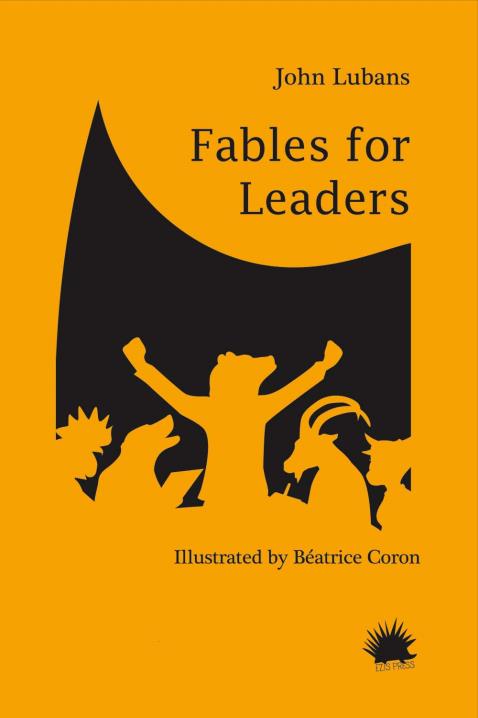
My book, Fables for Leaders is available. Click on the image and order up!
And, don’t forget Lubans' book on democratic workplaces,
Buy here.

© Copyright text and photo by John Lubans 2023
 John Lubans - portrait by WSJ