Voice
|
|
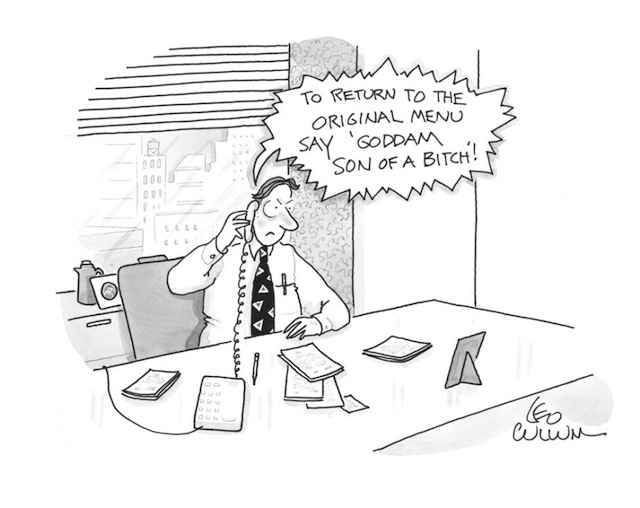
There’s a cartoon by Leo Cullum* (1942-2010) of an erstwhile writer seated at his computer remarking to his spouse:
"I've found my voice, Penny. It's deep, wise, and compassionate."
The spouse's raised eyebrows express mild incredulity.
Aspiring writers are often advised by their betters to “find your voice”.
Presumably the successful writer has found it, a unique and distinct one.
The NY Times defines a writer’s voice as: (“T)he way his or her personality comes through on the page, via everything from word choice and sentence structure to tone and punctuation. In a personal narrative essay, voice is especially important since you are telling a true story, from your own unique point of view.”
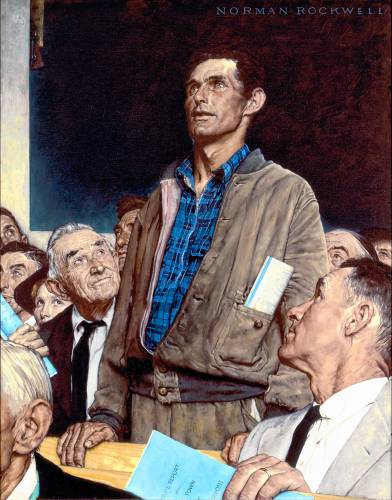
Caption: Norman Rockwell (1894-1978), “Freedom of Speech,” 1943.
For me, this iconic painting depicts voice. Set in a New England town meeting the young man’s words have captivated his audience. How did he do that?
Well, I would guess he has the ability to marshal his thoughts and to express them in cogent and motivating terms.
I presume his remarks are honest, well considered, deprecating no one, appealing to common sense and that these are his own words rather than catch phrases.
Likely, since the painting is dated 1943, the speaker may be a WWII veteran with his combat experience lending a greater depth than book learning to what he has to say.
What is my writer’s voice?
The reader has an opinion no doubt. But, I can recall my struggles in writing things - over the decades - that were unique, not a re-cycling of other’s thoughts.
I try to be honest.
I avoid clichès like the plague. Get it?
I prefer contrarian views. Not a pose.
I enjoy whimsical moments.
My writing is like teaching a topic.
To teach, I have to know the subject and have some facts and genuine opinions with which to agree or disagree and not be blowing smoke. The more you hedge your language the less clear your voice.
I avoid mimicking other writers; yet my writing is literary. I fret not over quoting from and referring to the classics.
I always acknowledge sources.
You see, when writing for yourself – what else do blog writers do? - you can be more natural, more yourself than if you write for a publication.
I do have something to say and I want to say it.
That sissified word “nuance” comes up, as in “So and So’s writing is nuanced.”
Of course there are shades of meaning, but one’s voice should not be inhibited by anticipating interpretations of one’s words. That’s why academic writing is turgid. I avoid obfuscation for the same reason politicians embrace it.
Some folks will get your meaning, others not
That last sentence is another quality of my voice: brevity. Yes, I could add words to explain something – like a comedian elucidating why his joke is funny - but I have a tacit understanding with the reader: You, the reader, and I get to work together. I am not here to entertain you, so if you are confused, read it again and think about it for yourself.
*One of Mr. Cullum’s cartoons:
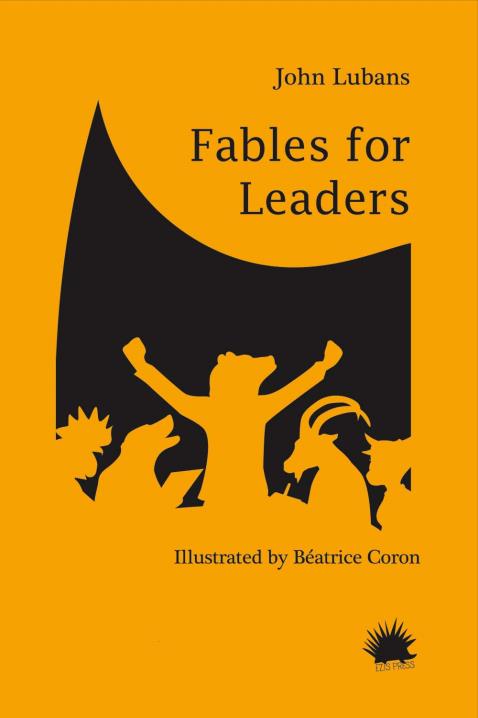
My book, Fables for Leaders – in my own voice - is available. Click on the image and order up!
And, don’t forget Lubans' book on democratic workplaces, Leading from the Middle
© Copyright text by John Lubans 2023
"I've found my voice, Penny. It's deep, wise, and compassionate."
The spouse's raised eyebrows express mild incredulity.
Aspiring writers are often advised by their betters to “find your voice”.
Presumably the successful writer has found it, a unique and distinct one.
The NY Times defines a writer’s voice as: (“T)he way his or her personality comes through on the page, via everything from word choice and sentence structure to tone and punctuation. In a personal narrative essay, voice is especially important since you are telling a true story, from your own unique point of view.”
Caption: Norman Rockwell (1894-1978), “Freedom of Speech,” 1943.
For me, this iconic painting depicts voice. Set in a New England town meeting the young man’s words have captivated his audience. How did he do that?
Well, I would guess he has the ability to marshal his thoughts and to express them in cogent and motivating terms.
I presume his remarks are honest, well considered, deprecating no one, appealing to common sense and that these are his own words rather than catch phrases.
Likely, since the painting is dated 1943, the speaker may be a WWII veteran with his combat experience lending a greater depth than book learning to what he has to say.
What is my writer’s voice?
The reader has an opinion no doubt. But, I can recall my struggles in writing things - over the decades - that were unique, not a re-cycling of other’s thoughts.
I try to be honest.
I avoid clichès like the plague. Get it?
I prefer contrarian views. Not a pose.
I enjoy whimsical moments.
My writing is like teaching a topic.
To teach, I have to know the subject and have some facts and genuine opinions with which to agree or disagree and not be blowing smoke. The more you hedge your language the less clear your voice.
I avoid mimicking other writers; yet my writing is literary. I fret not over quoting from and referring to the classics.
I always acknowledge sources.
You see, when writing for yourself – what else do blog writers do? - you can be more natural, more yourself than if you write for a publication.
I do have something to say and I want to say it.
That sissified word “nuance” comes up, as in “So and So’s writing is nuanced.”
Of course there are shades of meaning, but one’s voice should not be inhibited by anticipating interpretations of one’s words. That’s why academic writing is turgid. I avoid obfuscation for the same reason politicians embrace it.
Some folks will get your meaning, others not
That last sentence is another quality of my voice: brevity. Yes, I could add words to explain something – like a comedian elucidating why his joke is funny - but I have a tacit understanding with the reader: You, the reader, and I get to work together. I am not here to entertain you, so if you are confused, read it again and think about it for yourself.
*One of Mr. Cullum’s cartoons:
My book, Fables for Leaders – in my own voice - is available. Click on the image and order up!
And, don’t forget Lubans' book on democratic workplaces, Leading from the Middle
© Copyright text by John Lubans 2023
 John Lubans - portrait by WSJ