Grizzly or Teddy?
|
|

When reading the WSJ – especially its career advice - I often reflect on my own work experiences. Recently, “If Yelling Is Out at Work, Why Do These Bosses Still Shout?”
caught my attention.
Initially, I deemed it superficial and concluded that yelling is something long passé, at least since the 1980s.
But, a few days later I did dredge up some memories of yelling bosses, however few. And, the 139 responses to the WSJ article suggested maybe yelling is not so long gone.
Here are a just a few of the pointed reader comments:
“(O)utright yelling and screaming is the resort of the weak, the immature and the unfit.”
“I found that shouters and yellers were usually malevolent psychopaths who didn't really know very much. Instead, they covered up their ignorance with abuse.”
“An effective leader should be able to get their message across without resorting to either raising their voice or using a passive aggressive tone.”
“I learned a lot from one yelling boss, not because he yelled, but because he really knew the business.”
Some of the respondents said they preferred a yeller to a silent passive-aggressive boss.
One of my first jobs was as a soda jerk at a very busy ice cream stand. It was not a good fit. I could not remember the multiple customers verbal orders nor figure out which of three size scoops to use for the cones!
Nor did I like the lack of any training and the unfair – to me - requirement that we had to clean the store - off the payroll clock - after closing at 1AM!
Anyway, after a couple weeks, I quit.
When I told the boss I was quitting, he looked angry but said very little. Then, he walked into the freezer and started throwing things around. I guess this was how he dealt with his frustration at having to find a replacement.
I was glad to be gone.
Another P-A boss, I tagged the “Creeper”.
He took some sort of perverse delight in sneaking up on people and breaking into their reverie or personal zone.
You ask, “To what effect? Surely this was a mere puerile prank?”
Hardly!
The Creeper derived the same sadistic pleasure as a cat’s toying with a broken-winged bird.
But, enough about this P-A subspecies!
My best bosses never yelled nor took the P-A route.
They were encouraging, supportive. They listened and if there was feedback needed, I’d eventually get it.
Maybe because I was in a field where innovation and pro-action, i.o.w. CHANGE, was seen as something threatening. My bosses had a different viewpoint – they wanted to change the status quo and, as a result, they gave me leeway and had my back.
Instead of settling into the profession’s prevailing maintenance mode, they were on board with my streamlining and outreach ideas.
When I interviewed Andris Vilks, the director of Latvia’s national library, he brought up a grizzly vs. teddy bear comparison.
I asked Andris how the staff regards him. He told me, frankly, “Only an idiot thinks he is ideal.”
“Sometimes I would be happy if I were more patient – my reaction is not always best. I become too angry, not a teddy bear, sometimes a grizzly!”
However, he is “very fast to forgive, but it (his temper) is a weakness; a manager should always control behavior. On other hand they (the staff) know exactly what I think.”
Team sports can give us insights into the best kind of yelling along with some of the very worst!
I spent a considerable time with a head coach, Gail Goestenkoers, when I did a study of a woman’s collegiate basketball team
Throughout practices, locker room sessions, one-on-one meetings with individual players, coaches’ meetings, and in games, I observed Coach G’s respect, caring and fondness for the players. She was clear about roles and expectations, she was firm and demanding. And she would, on occasion, yell at players during practice.
But, the fiery feedback was always about what was lacking and what needed to be done for improvement.
Never did the yelling or other criticism turn into an unhinged f-bomb rant or a personal attack. Her criticism was always about something within the player’s control and team expectations – mutually shared by players and coaches.
Importantly, that constructive criticism - immediate, explicit and specific- was always softened with a ratio of four or five positive statements to the one negative.
Her players told me they expect to be held accountable: “If the coach is doing her job she has to yell at you.”
Players, when verbally blasted with “Your defense sucks”, forgive the vernacular and ratchet up their intensity in ferociously protecting the goal.
The study appears in my book, Leading from the Middle as Chapter 8: “More Than a Game: A Season with a Women’s Basketball Team”. (See link below.)
Yelling is the equivalent of a kick in the ass (KITA). And such external motivation does get you moving, but it is no substitute for the internal.
When I was a high school runner, there was no need for the coach’s yelling because my team mates and I were internally motivated to do our best.
I lived for track and was forever improving and seeking to get better.
Now, this same coach was my chemistry teacher.
Because I was not a serious student, he probably should have been yelling at me! Hence I have the most primitive knowledge of chemistry.
So, you see there is a role for both quiet encouragement and some loud and pointed demanding.
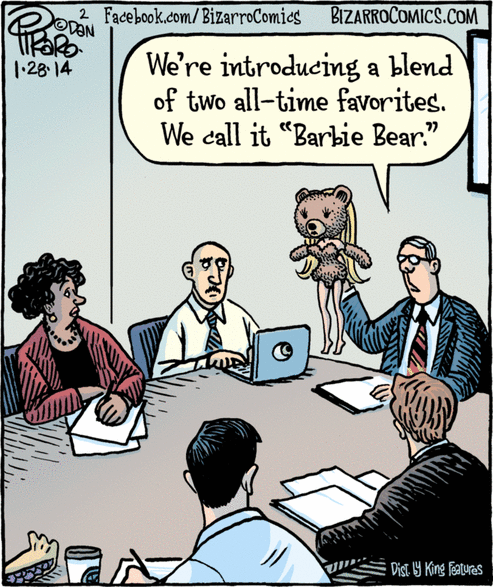
Caption: A bit of timely bear humor for only the hippest among us.
__________
ONLY a click away, classic and modern fables offer ways to engage, without yelling, difficult workplace situations:
And, my book on democratic workplaces offers non-yelling insights on leading and following Leading from the Middle, is available at Amazon.
© Copyright all text by John Lubans 2023
 John Lubans - portrait by WSJ