Jerk Introspection
|
|
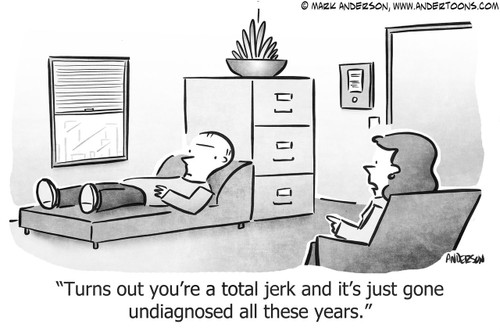
Over the years, I’ve devoted several blogs to Jerkiness; here are several:
“Fifty Shades of Jerkiness” (2016)
“Of Jerks, Bozos, Dorks, Fatheads, Nincompoops, Dunderheads, Twerps, Bamboozlers, Fakers, Hornswogglers, et al.”( 2015)
“’Boss-holes’ and Other Dour Denizens” 2017.
“Telling-off the Jerk Boss: Bad Idea?” (2015)
“How Jerks Happen” (2019)
and from the sports world an exploration of New Zealand’s “No Dickheads” rule in “Rugby in the Workplace” (2015).
Finally, perhaps an overly-optimistic take from 2022, “Jerks No More”.
These brief essays offer clues to how jerks come to be, their variety, and how to deal with them. Is there more to be said?
Enter introspection, as revealed in a WSJ article from June, How to Tell if You’re the Office Jerk.
The authors reveal a couple strategies for looking in the mirror and checking for telltale signs of jerkiness.
One approach is to ask others around you. They do know if you’re a jerk or not. The problem is getting them to tell you without high anxiety and potential rancour for both the teller and the listener.
In today’s avoidance society we need to take a different approach; perhaps a less direct and more oblique manner to permit the critic a way to offer constructive criticism instead of an uncomfortable silence or the appeasing, “No worries, you’re doing great!
Instead of bluntly asking, “Am I a jerk?”, put the question in a different and specific way.
For example, when dealing with a subordinate, “When I proposed that we should do X, I thought you were a bit hesitant. If that is right, can you suggest something different? I do want to hear your perspective.”
Then listen. And, then act on the suggestion if it really boosts your idea.
You will know.
Had I done that early on in multiple situations, there would be no suggestion of undiagnosed jerkiness on my part and I would have gotten to build on improved ideas.
In another case, if you as a leader are pretty sure about an idea, do not hesitate to get another perspective on your seemingly super idea.
Your asking for other views will result in two outcomes: your Jerk-o-meter reading will drop and your super idea will get better.
I recall developing a case study for a leadership workshop along the lines of something called “scenario writing”. I based my scenario on a recent experience. I’d finally unloaded some long delayed negative feedback on a subordinate for her numerous negative attitudes and actions.
My criticism was legitimate but, my subordinate was mortified and shocked.
In the case study I masked my identity as Jack and the subordinate as Jill and asked the workshop participants what advice they might have for Jack or Jill.
Who’s the jerk, Jack or Jill?
Was I surprised at the consensus response? Was I ever!
The workshop participants were strongly critical of Jack (me) and they prescribed much better ways to have had that uncomfortable conversation with Jill.
If you believe the workshop participants got it wrong and that Jill was only to blame, well, consider yourself a jerk.
Very likely you already know where you went wrong. Refusing to learn from that experience is being a jerk.
It does not have to be a case study. You can share with a few colleagues a real situation – without names. Just like in my workshop, those colleagues, not necessarily friends, will give you significant insights on what you should have done if you indeed messed up.
There’s value in the process of developing a quasi “case study”. Your shortcomings likely will become self-evident as you write it!.
Indeed, if you can be honest with yourself, you will see, as you write, what you might have done differently.
Not that you can repair the damage, although you should try.
Your efforts to repair, if sincere, may help assuage the bad feelings.
Interestingly, another tack for assessing one’s jerkitude: the lack of positive feedback even without explicit negative feedback may suggest there’s something wrong.
More than likely something is in the works.
Fairly or unfairly you may be seen as a jerk, when people only offer lukewarm support.
But by then, it may be too late to make changes. However, a comeuppance early in one’s career may point to what you could do differently to gain the level of support you desire in your next job.
__________
ONLY a click away, classic and modern fables suggest many ways of jerk avoidance, personal and profitable:

And, my book on democratic workplaces presents the anti-jerk way of leading and following Leading from the Middle, is available at Amazon.
© Copyright all text by John Lubans 2023
 John Lubans - portrait by WSJ