Too Much Fun (Books2Eat, Riga, Latvia).

Posted by jlubans on March 27, 2013  •  Leave comment (0)

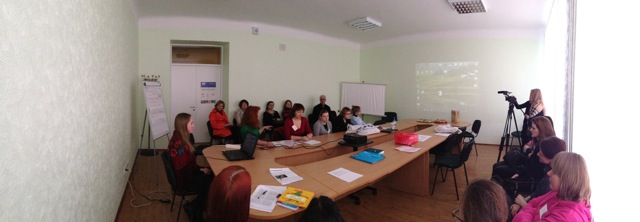
As the Trace Adkins song goes, “I Ain't Never Had Too Much Fun” and that applies to the good work by my students on their team projects, Books2Eat (B2E)*.
When we diagnosed how the four team projects went, it did cross my mind that when groups are having this much fun, it might get in the way of fully understanding the team theory, dynamics and development. It’s like you have to suffer a bit to really grasp the concept. Well, I’ll take fun over suffering. It is possible to learn while enjoying what you and your team are doing.

20130327-+joka song.jpeg
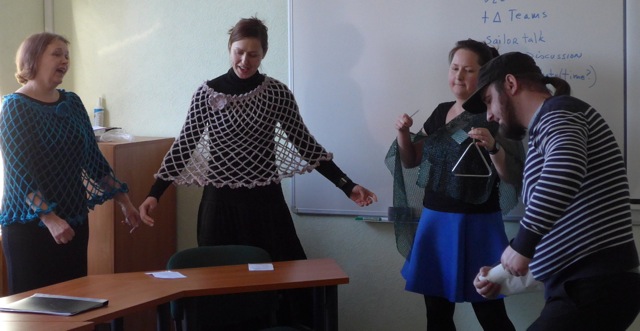
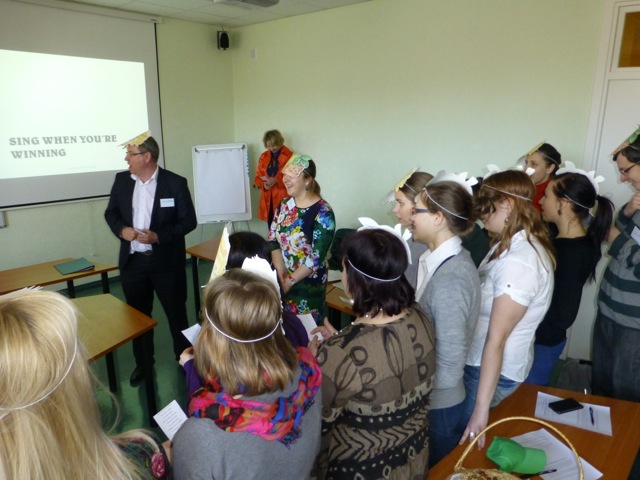
Caption: About to break into song after producing the torta! (Taken from their team's video production.)

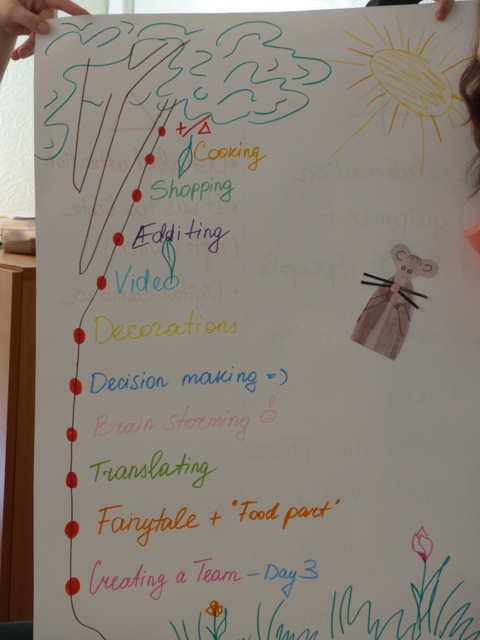
The team plus/deltas (What worked? What Could Have Gone Better?) were highly positive, with only a few suggestions for improvement. Along with the fun, it seems that extensive team building took place and that most, if not all, were well satisfied with their role and the result of the team effort. (I should note that on the B2E day, I kept the teams together on another, unrelated assignment. Their behavior was close knit, leaning in, everyone contributing, no one holding back. I would suggest that these dynamics were a carry-over from the B2E experience.)
This is my second time using the B2E process to teach team concepts in Latvia.**
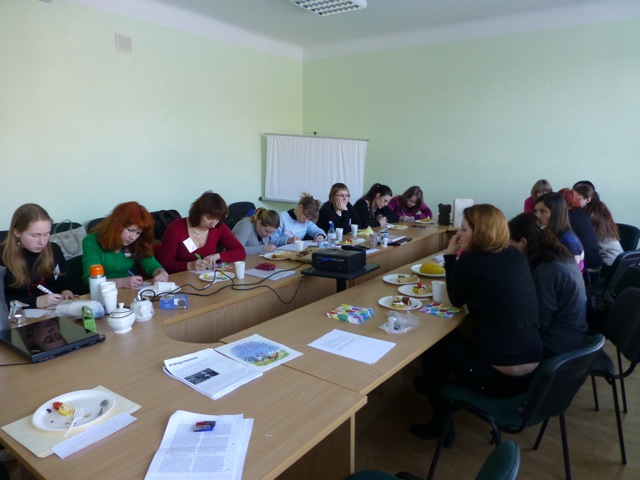
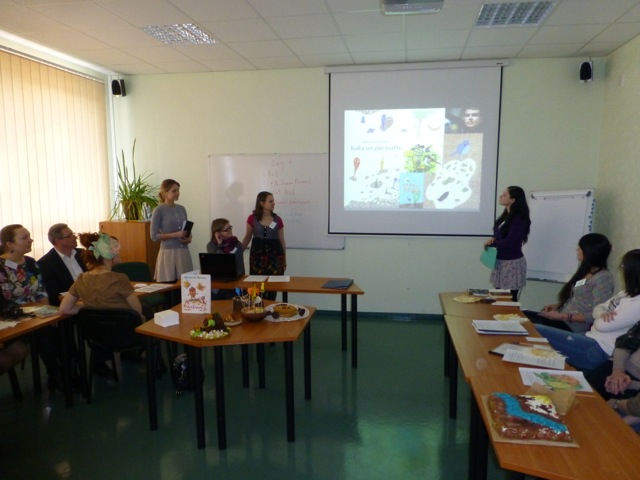
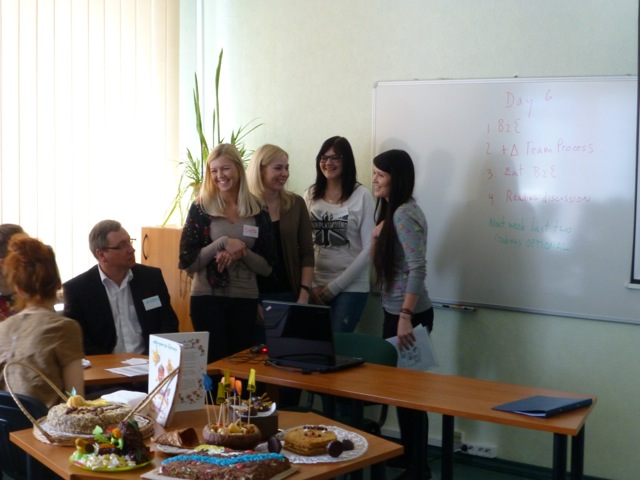
20130327-+plus:delta postprandial.jpeg
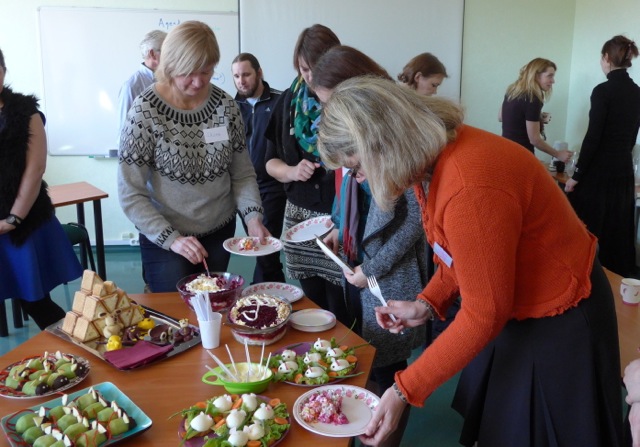
Caption: Students doing a post-prandial plus/delta
This year I added a personal plus/delta. These were somewhat more introspective than the team plus/deltas. I found the individual plus/delta valuable in helping the student diagnose just how she contributed and what she would do differently:
Most were quite pleased, even proud, with their contribution and accomplishemnt, e.g.. “Singing, what I rarely do.”
Here are some quotes from the What I would do differently side:
“Worry less.”
“Listen more to my team members.”
“I would maybe choose another team, because person needs to be able to work with different people and that is experience. “
“Speak up (more) in meeting.”
“Don’t speak when it isn’t necessary.”
“Don’t rely always on improvisation.”
“I would tell more about what I am going to do (to my team mates before doing it)”.

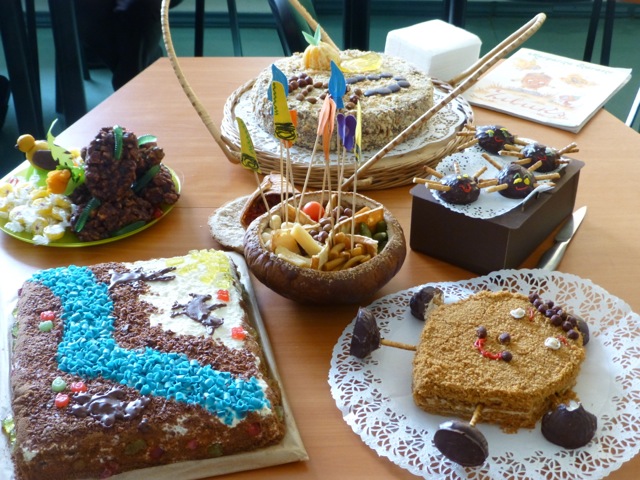
* The selected books and the B2E production:

20130327-+Ringla cover best.jpeg
Ēriks Ādamsons. Čigānmeitēns Ringla (Gypsy girl Ringla)
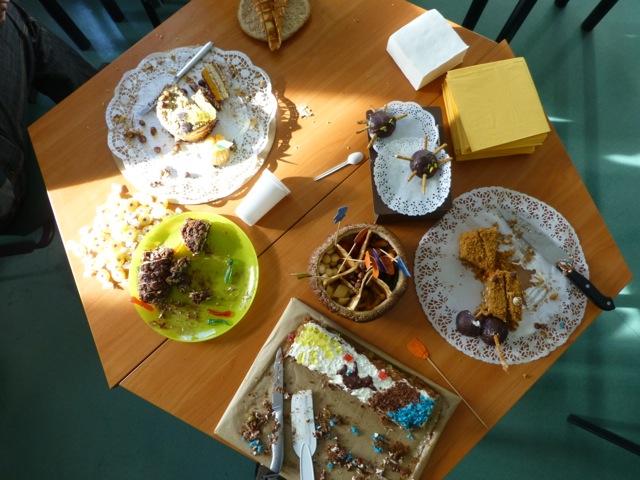
The product:
20130327-+Ringla kukas close.jpeg

20130329-panoramamaza.jpeg
Caption: Thematic analysis of the Gypsy Girl Ringla.

20130327-joka cover.jpeg
Joka pēc alfabēts (just for fun alphabet)
The product:
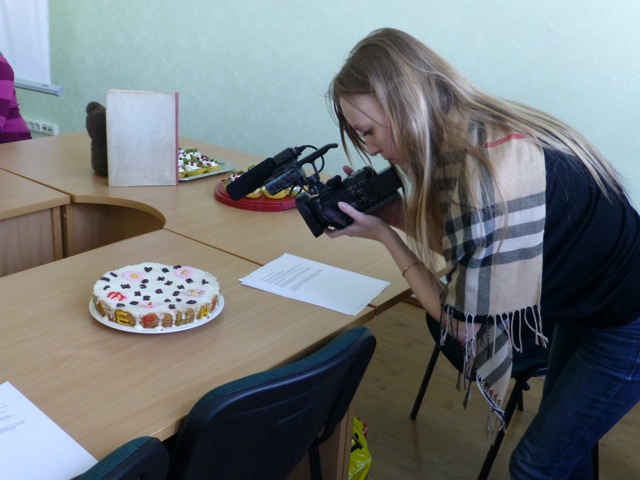
20130327-+filming.jpeg

20130327-+scared cover.jpeg
Dzidra Rinkule-Zemzare, "No kā visi izbijās" (Who Scared All?)
The product (A marzipan yellow balloon!):
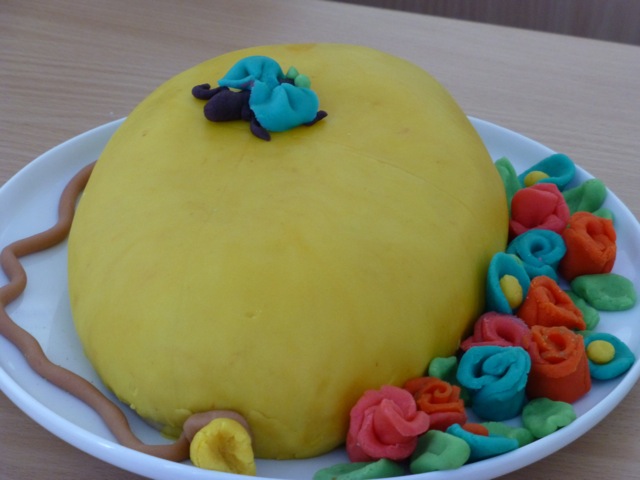
20130327-+scared balloon.jpeg
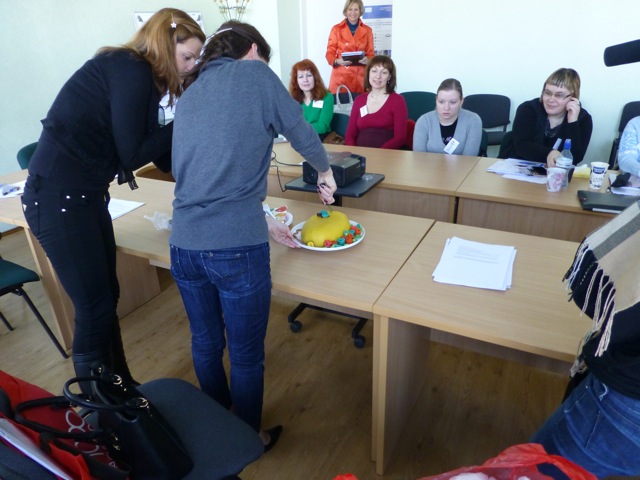
20130329-scared cutting.jpeg
Caption. No longer scary. About to be consumed!

20130327-+Ezis un kuka.jpeg
Hedgehog's Wand

20130329-zane un laura o. cutting up.jpeg
Caption: Like I said, there's no such thing as too much fun.

**The Assignment: Books2Eat Team Project
(A global bibliophilic and gustatory celebration of literature!)

Teams of 3 or 4 students will plan, produce, and present a Books2Eat entry representing a Latvian children’s book, folk tale or folk song.

Besides the creation of the baked and decorated item, the team will select the title, describe the chosen book or folk song – with a full English description of book/song and author – gather ideas from previous entries displayed on the Books2Eat “The Annual April 1 International Edible Book Festival”) website, design the cake or cookie, test the ingredients –– and, prepare the product. And, present the entry at our class on Day 6.

Each Books2Eat entry must display one or more of these qualities:
Cleverness in overcoming adversity.
Leadership by a least-likely follower.
The Golden Rule applied.
Collaboration, working with others to succeed.
Speaking up when others are too afraid to say anything.
Innovating.
Using resources wisely.

Teaching Self-management.

Posted by jlubans on September 14, 2011  •  Leave comment (0)

Can the concept of self-management in the workplace be taught successfully?
That was my question, during my Fulbright semester, when building the class agenda for a graduate level introduction to management at the University of Latvia. My conceptual model was the Orpheus Chamber Orchestra’s musicians coaching a student orchestra to perform a musical concert without a conductor.
Another question, once underway, could I leave the teams alone or would I need to intervene in conductorly ways, like I saw some Orpheus musician/coaches doing?
Besides a strong curricular emphasis on teamwork, I designed three projects over the semester for three different student teams. In other words, each student was part of three different teams. The third project was to be these students’ concert performance in which they put together all they had learned about teamwork and collaboration.

1. “Books2Eat” team
2. “Women as leaders” interview team
&
3. “Self-managing team” working on a team-selected topic.

In team project number 3, the self-managing teams (5 or 6 students each) presented their findings and recommendations on the last day of class in Riga on June 3. 20110914-picpresent1.jpegHere are their topics:

Team A. ”One library – equal possibilities for everybody.” They developed a submission ready grant proposal to create a “socially accessible environment for every inhabitant of our city.”
Team A’s product was a “funding ready” proposal for improving access for disabled library users.

Team B. (The “Garden of Eden” team!) Women in the profession – A look at economic and prestige aspects of librarianship. The team hypothesized that the “field’s feminization (female predominance in the sector), the traditional treatment of librarian as a secondary profession” result in low salaries for librarians and inordinate salary reductions during economic downturns.

Team C developed ways to make the library more relevant to students and to draw them into the library building. Team C has these goals in mind:
- Draw more young people into public libraries
- Make students more excited about using the public library
- Become more appealing overall to the students and to get them to use the library as a resource more often
- Entertain students while familiarizing them with the library for their future use
20110914-PIclipdub.jpeg
20110914-picpresent2.jpeg
To return to my question about teaching self-management. Each team’s plus/delta (what went well, what could have gone better) gives us insights into the stresses each team endured and survived and the pluses show each team’s success.

As you can see in the attached plus/deltas, each team has many things they would change and shortcomings they would like to improve upon. Their candid listings suggest to me an elevated understanding by each team of what is desirable behavior and what is required for a successful group project, for a team to be highly effective. The deltas show an understanding of not only what to improve but how to improve - literally, what they would do differently if they were again in a team situation.

These students learned a great deal about teamwork dynamics and what it means to be self-managing. When I contrast my students’ work with the conductor-less student orchestras I find similarities. The student musicians, like the Riga students, delivered a high quality product and yet have a long list of what could have gone better!
Just like the student musicians, some would prefer a boss, a conductor to direct and to demand. Most, if I look at the pluses, see the value of working in teams and derive satisfaction from that process. No team asked me to intervene, either in the plus/deltas or during the semester. Perhaps I could have done more as a coach, but as a first effort, I am very pleased with and proud of the students

My own delta: give each team one hour to present and respond to comments and questions. Twenty minutes was sufficient for the report, but left little time for questions and discussion. There were numerous questions we could have discussed not the least of which would have been about the plus/deltas and their meaning.

Appendix: Team Plus/Deltas

Team A Plus/Delta
PLUS
• Good teamwork.
• New knowledge acquired.
• Clear distribution of assignments and roles.
• Equal contribution to the work.
• Possibility to cooperate and to get acquainted with new people.
• Topical theme (there are very few libraries, which disabled people can visit freely and get in easily).

DELTA:
Concern in the beginning, how successful will be our cooperation with the previously unknown people.
• Small lack of motivation to begin the work out of the project earlier.
• The lack of the leader who will motivate us to aim higher and to perform even better.
• Difficulties to get together.
• Need more teamwork.
• Need to change strategy to get better teamwork.

Team B Plus/Delta
PLUS
• Team is made of various profiles of people belonging to different levels of knowledge and experience;
• Everyone were informed about the progress of the task activity;
• Actively conducted questionnaire distribution;
• Since the project’s theme was made up, all team members were clear about what to do, about responsibilities;
• The team’s ability to agree on a goal, theme and actions to reach the goal;
• Good ideas;
• Team members’ responsibility taking;
• Responsive members of the team;
• Respondents were also very responsive. We received back a great quantity of questionnaires;
• Duty sharing (distributing among members of the team);
• Collaboration / also had Yes people on the team;
• Good organization using e-mail – communication;
• Constant progress discuss;
• Mistake correcting (each member had an opportunity to correct mistakes);
• Everyone had an opportunity to express ideas, participate in questionnaire analyzing;
• Taking the self-managing team project problem (assignment) very seriously;
• Great planning and time distribution;
• Two bright leaders on the team, who took initiative;
• Each member of the team chose a task (part of the project) for himself, without pressure, independently;
• Everyone has completed his task successfully (according to their capabilities);
• The team had an informal leader, who took initiative in bringing the team together, organization of work and activities;
• Presentation will be very good!

DELTA:
• Before starting working, precise and objective tasks and roles of each member of the team should have been determined;
• Endeavor to listen to each other;
• Limited opportunity to work as a team on a project for every member of the team. The communication was within the groups of two or three people. At the beginning of the project, there were only two or three people involved in a discussion by e-mail;
• A leader was needed for decision making;
• Bad circumstances;
• The form (questionnaire) could have been developed better;
• The team’s spirit appeared in the end of the project’s making;
• Communication could be better;
• Hard to work with people from different institutions;
• Hard to find time to meet;
• Could have met more often with the team;
• Too much focus on details sometimes;
• No clarity about the problem formulating at the beginning;
• Very limited direct-acting communication possibilities;
• Different teamwork building activities weren’t … used („intellectual parties”, collective discussions at the cafes or at someone’s home etc.);
• The more quiet, more restrained team members weren’t fully engaged in teamwork in the beginning (their potential wasn’t fully unlocked and used).

Team C Plus Delta
20110914-plusdelta.jpeg


Teaching the Democratic Workplace: Student Comments

Posted by jlubans on April 10, 2013  •  Leave comment (0)

20130410-*laughs.jpeg
Caption: After the 90 minute final exam the class reconvened for the Egg Drop activity and the Plus/Delta. Here one team explains why its design is the best. Their egg did survive the launch from a “perilous height” – for about ten minutes until stress fractures became apparent.

My students did an anonymous plus/delta on the last day of class (Day 8 on April 4). Overall, the written comments were positive. Many are brief paragraphs on what they are taking away from this class and what they liked. I am heartened and encouraged by the feedback. Here are a couple brief, unedited, examples. (Please bear in mind English is a second or third language for these students):
Comment:
“Group discussions; learning many new things and having fun at the same time; many examples from real life; different sources (books, articles, film); B2E. (Books2Eat)”

Comment:
“I liked the reading texts; one reading text would be useful for my Master work; excellent lecturers; thank you for wonderful time, what we spend together! John Lubans blog; nice pictures from the class exercises; new experience.”

DELTAS (What to improve):
There are several deltas but often these are more about the student’s role in discussion than the course’s content and rationale. Regardless, the students have given me many insights. Below are several that have me thinking already!

Little less home reading.

More examples about libraries.
Discussions in class (not so active of asking of questions)

I would like to work in such democratic library. I would like to try more my library (my workplace) democratic. It depends on people, who will work with me. Democracy would have to be everybody’s necessity, if they want to work in democratic library.

Some more reading texts was hard to understand because in English. We (students) could be more active in class (discussion).

Maybe more theory (from HR or psychology perspective).

It would be nice for the future, one lecture devoted to library experience abroad and in Latvia. It would be very interesting to compare.

I think the group was a little bit passive (no discussion after basketball film); amount of text-some weeks it was OK, some weeks we had to read too much = 80 pages; more reading from your book, it was very interesting.

Sharing ideas and listening to other people are very useful skills. I should train the skill to speak aloud. I noticed that after these classes I do it much (more) often.

Maybe was need some example about how work? How he manage his work members.

We were too passive and didn’t use all possible options to discuss matters we should discuss; some issues are possible only theoretically … there should be more time devoted to ways how to manage changes to happen; I’d like if there were more role games for real situations to find better solutions….

There are no changes only plusses. Only – for exam. It was too difficult.
Only it is sad that there are not many workplaces, where we can find a real democratic workplaces. It would be very, very good, if Latvia’s workplaces would be so democratic, how this interesting course.

The are no deltas -; some texts were very difficult, I did not understand them; the film about basketball I like it, but there is one But: I don’t like basketball. But the film was very good! I like very much the basketball coach. (This could have been Gail Goestenkors or the Coach Gene Hackman played in Hoosiers.)

The students’ and my wish for more democratic workplaces in libraries is, of course, beyond our control. I will try to make more use of the annual list produced by the World Blu “Freedom at Work” organization: You can find its 2013 List of Democratic Workplaces here.
And, I will build on my recent blog about the scarcity of libraries as democratic examples by being more diligent in finding and listing those libraries that are applying democratic concepts. For example, libraries that make extensive use of teams should be mentioned. So would those that make use of rotating leaders. And, I’d count those that have a commitment to being egalitarian and applying the Golden Rule to relationships. While outcomes are important, I think good faith democratic efforts and experiments should be recognized.
If you know of a notable one, please let me know.


Teaching Management for non-Managers – The Flipped Classroom

Posted by jlubans on March 25, 2012  •  Leave comment (0)

A couple weeks ago, I completed a long piece about my teaching experiences in Riga. This was for Del Williams, the editor of Advances in Library Administration and Organization.

The essay gave me an opportunity to reflect and philosophize about how I teach, and whether mine is a good approach; do the positives pile higher than the negatives?

The traditional approach to teaching management of libraries, and most any other type of graduate class, is lecture/textbook. I took a different approach in the mid-80s when my wife and I first team taught our class – no textbook. Our assigned readings included a few of my essays and dozens of the classics in the field of management and leadership theory including two or three by librarians. We lectured about the usual management topics (personnel work, systems analysis, organizational culture, the political process, budgets, and administration) but only enough to lay a basic foundation of understanding. We emphasized case studies, experiential activities (group work – even a “day in the woods”,) conflict resolution, and we made use of several self-tests including ones for conflict, teamwork, management style, and organizational culture.

Also, we asked for student feedback through the plus/delta (what’s working, what needs change?) Always, at semester’s end we used an anonymous version plus/delta to get student input in time to make changes for the next semester.
Every class session included at least one or more small group discussions of course content. (Retrospectively, one could say that we “flipped” – an unfortunate term - the classroom, the peer teaching innovation now used increasingly to help students master concepts (with statistical evidence that it far surpasses the lecture in learning by students – see my notes below about flipping).

We never did a department-by-department analysis of “the library.” Instead we kept a wide focus and drew from all of the organizational literature; after all, both my wife were graduates of a rigorous master’s program in public administration at the University of Houston. This program required statistical analysis, microeconomics, political theory and organizational development. We found all these to be highly relevant to our library careers and we adapted what we learned to fit our teaching.

Our case studies, a library budget group assignment, and a solo building renovation project, did draw on library experiences and, in class discussion, we encouraged students to talk about their work experience (often in libraries) and to make the connections between library work and theories mentioned in the class. So, we did not exclude the library per se. We just assumed students would come to better understand “the library” through personal experience and through the eyes of their peers. And, they did.
We knew from our own experience as administrators in libraries and other not-for-profits that there was little unique about budgeting in the library, nor was there much difference in personnel work when compared to other not-for-profit bureaucracies, and in many cases, for-profit organizations.
My day-job added another dimension to my teaching as a Visiting Professor. I was in charge of a major reform initiative in a large library. We undertook to improve in dozens of ways what we did and how we did it, all within existing resources. My leadership approach was to turn to self-managing teams and to encourage participation by everyone - regardless of status - who wanted to be involved. (I discovered that the best ideas came from support staff who had been doing the work for ages; their input largely ignored by the professionals.)
We had good success, indeed remarkable success. My teams accomplished what we set out to do, something that previous change initiatives - led by the foremost experts - had failed to achieve. (For more on this surge in productivity and innovation see the “Teams That Were” chapter in the Leading from the Middle book.)

In the class, most students relished our approach. By the end of the course they understood many management concepts and, even if they would never be managers, they now understood what it meant to be managed. We had some excellent students and these students were among the ones that offered us the most encouraging feedback about the class and its design. For them, our bringing in the theory from outside the field and small group work were highly important for personal development. Also, our insights about organizational culture and the political process opened their eyes to a better understanding of why organizations behave the way they do.

Overtime, I have come to realize that if you have students who want to be challenged, who want fresh perspectives, who want to learn about themselves, and who want to work with other people in doing a good job, that the best thing we can do is to de-emphasize the lecture and increase opportunities which help hone their skills in getting along with others – either by leading or following - and in understanding why some groups reach their goals and why some groups drift aimlessly.
So, in Riga, a year ago, I built on my previous classroom experiences and then further de-emphasized the lecture. I believe my teaching in Latvia worked well because the students were very well prepared and engaged for each class. Their engagement, intelligence and my approach to teaching enabled them to make conceptual connections across the course.
David Hestenes, one of the pioneers in the anti-lecture (or “flipping the classroom”) movement, puts up a cautionary note: "Students have to be active in developing their knowledge. They can't passively assimilate it." Indeed, some students disagree about flipping. They prefer the lecture model because it is less demanding of them than peer teaching (another term for flipping). When peer-teaching students have to do the assigned work before class; a lectures-only approach can permit procrastination to reign until the night before the final.
20120325-Unknown.jpeg
Here are some notes about the anti-lecture for your own exploration:
. “How 'Flipping' the Classroom Can Improve the Traditional Lecture” The Chronicle of Higher Education. February 19, 2012
This article provides an example of the so-called “flipped” class – in this case, an evolutionary biology class at the University of Colorado at Boulder. “Some students enjoy the "flipped" lectures that require them to help one another understand the material. Others resent being forced to work in groups.”

. Physicists Seek To Lose The Lecture As Teaching Tool.
January 1, 2012 from American Public Media (APM) broadcast on National Public Radio.
Hanford’s study is notable because it uses test data to show that different approaches to teaching and learning (mostly small groups and peer discussion) are vastly superior to the lecture for learning concepts.
Also, from the NPR URL there is a
link to several other stories and research by Ms. Hanford for APM:
These include: “Rethinking the Way College Students Learn”; “Rethinking the Way College Students are Taught”; “The Problem with Lecturing”; and, “Inventing a New Kind of College”. Also, her “Reporter’s Notebook” has insights about alternatives to the lecture.
Washington Post “Some academics dismiss appeal, value of lectures.” Washington Post, February 17, 2012, online at

SkyMall & the Worker as Traveler.

Posted by jlubans on December 26, 2012  •  Leave comment (0)

20121226-sleep.jpeg
Caption: For the weary road warrior, heading for Hawaii, an inflatable pillow.

I’ve long wondered about the buyers of stuff from the SkyMall catalog found in every seat pocket on every commercial airplane in the country. It’s there, peeking out at you, dog-eared - from its elasticized seat pocket right there under the seat-back tray table - the poor man’s Neiman Marcus’ Christmas Book.
For the bored-to-tears traveler without a book, smart-phone, Kindle or iPad, SkyMall is the ultimate diversion when circling the airport for a long-delayed landing or when parked for hours in the no-man’s land between the terminal and the runway. Knowing a little bit about advertising – having been exposed to it all my life! – I have to wonder what the stuff offered up on SkyMall’s slick pages says about its targeted market, its audience of buyers? I assume advertisers look at the numbers for passenger age, income, gender, and other socio-economic indicators to justify spending huge sums on print runs in hopes of catching more than a few eyeballs with a credit card. One study claims that workers account for 36% of the travel market. So, I assume that is one of the top targeted groups.
I have a hypothesis that we can glimpse something about the traveler; at least we can tell what advertisers think about the traveler! I sampled a recent issue.* What did it tell me?
For one thing, life is tough out there, for the businessperson, while traveling, or at home or in the office.
Health-wise, one ad offers shoes that “defy gravity”. With these steel-spring-in-the-heel-shoes, the wearer will experience a “return of his energy” when running to catch a connecting flight after landing 30 minutes late at DFW.
A full-page ad for Lipidryl weight-loss offers a 200% guarantee and claims that there could be, according to their research, “a 933% increase in weight loss without any necessary change in eating habits!” Another page from my scientific sample suggest things might not be all that happy work or home: “Discreetly monitor home or office with this hidden video camera.” (Disguised as a motion detector).
Contiguous to that ad is one of several self-help books: “The Best Advice Ever” by Ari Neptunia, “sharp advice on how to avoid mistakes …become happy, wealthy, and healthy.” “(It) provides out of the box ideas.”
If the book does not work, then try the “Migraine Magic Plus” eye mask. “Massaging magnets increase blood circulation” Also "helps relieve sinus pain, double vision and dry eyes.” (Ailments acquired on that last trip to Fargo , maybe?)
Pets, especially cats and dogs, take up many SkyMall pages. My sample found “The Neater Feeder”, raised feeding bowls so there’s less slopover, maybe? And, there’s something for you to show your dog who’s boss: “Pull Stop and Jump Stop” harnesses for misbehaving dogs. And, if you have two dogs, you can walk both on a specially designed tangle-free leash. (Can you use the Pull Stop on one and the Jump Stop on the other?) Finally, for the guilty, absentee-pet-owner-road-warrior who is not there to let the pup out to do his business, “your dog (can have) a yard of his own. Great for apartments and condos:” The weather proof Porch Potty, a slab of astro-turf. Premium version includes sprinklers to rinse grass area clean. There’s even a scented (red plastic) fire hydrant!
Being prepared is an oft-repeated theme intrinsic to SkyMall:
“Fix a stopped toilet” (For when you come home, or maybe take it with you for your trips to less than four-star hotels? Not sure.) “No-mess plunger easily clears toilets…. it sits atop your toilet bowl and pushes compressed air through the water toward the clog to clear …The plunger (you may be thankful) never touches water, keeping germs in the toilet bow. “Folds easily for storage” (and travel?)
Along with the perennial collectible artififacts from the Hobbit and Harry Potter industrial complexes, SkyMall offers sports memorabilia, including paving bricks and seats from the old Yankee stadium and autographed jerseys and photographs from sports greats to adorn corporate or home office walls. Also on offer is the Brandon Steiner book: “You Gotta Have Balls” about how he, personally, “created a Sports-marketing Empire”.
Another full-page ad, with a dash of ambiguity, turns out to be something you might want to hide from your boss or co-workers: (The) “Great Gift Wrap Up!” in Las Vegas. Apparently this is for frequent habitués of Sin City who have earned “gift points” which can be “redeemed for fabulous gifts during two week-long shopping events.” Of course, we know you got all those “Gift Points” while entertaining corporate clients.
Now something for the stranded traveler who works from the airport waiting-lounge or hotel bed: A laptop “lap table” with (two US-powered cooling fans). Or, there’s a cooling and adjustable laptop cart or a multimedia cooling laptop stand (with a cooling fan) or an ergonomic white laptop stand with built in keyboard (no cooling fan included).
While we are on technology, there is a silver helmet with ear phones guaranteed for you to “Get thicker, fuller looking hair in weeks – guaranteed.” An “advanced laser hair rejuvenation system.” (Alas, no cooling fan included.)
Finally, there is the “Genuine Navy Seal” watch. For those boring meetings or tipping-point moments, when no one’s in charge, take a gander at what’s on your wrist and IMAGINE how you would handle it if only they would let you.
Marketing assumptions to follow.

*SkyMall Holiday 2012 184 pages. (Delta Airlines). I screened each 9th and 10th page for a total sample size of 17 pages, front and back.
 
site stats