Invisible Leader in Latvian

Posted by jlubans on December 14, 2011  •  Leave comment (0)

20111214-bp-54-55-1-vaks-215.jpg
The chapter - The Invisible Leader: Lessons for Leaders from the Orpheus Chamber Orchestra - from Leading from the Middle came out this week translated into Latvian. It appears in the magazine Library World (BIBLIOTĒKU PASAULE) Nos. 54/55 (2011).

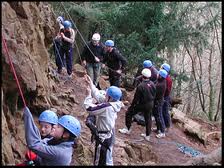
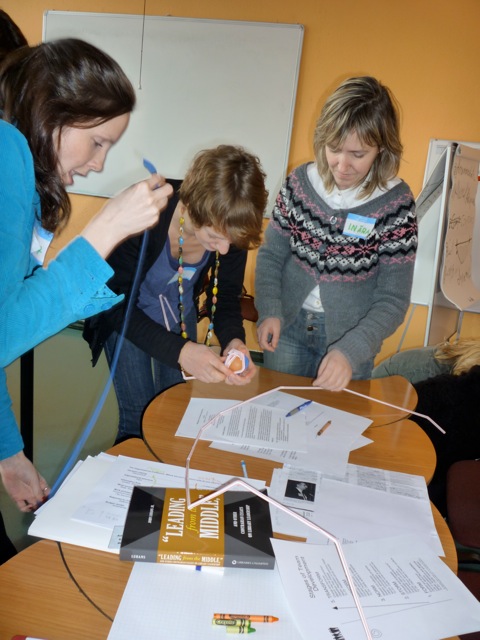
The translation includes some excellent photos of Orpheus and some photos from my Riga Fulbright class earlier this year.

Managing Self

Posted by jlubans on December 05, 2012  •  Leave comment (0)

While I was in NYC last week, a couple of friends talked to me about the Orpheus Chamber Orchestra and its organizational model. One asked, “Surely, the model cannot be applied anywhere else, can it?” Another friend, as we talked about this conductor-less group, queried “Isn’t Orpheus self-selected?” In other words, was not Orpheus born that way, a natural grouping of like-minded people?
So, can the model replace hierarchical groups?
A good question and I am going to try to come up with a more rounded explanation than my usual response of fitting the Orphean model to professional groups, like a legal, media, or medical practice or, in my realm, a medium to large-size academic library.

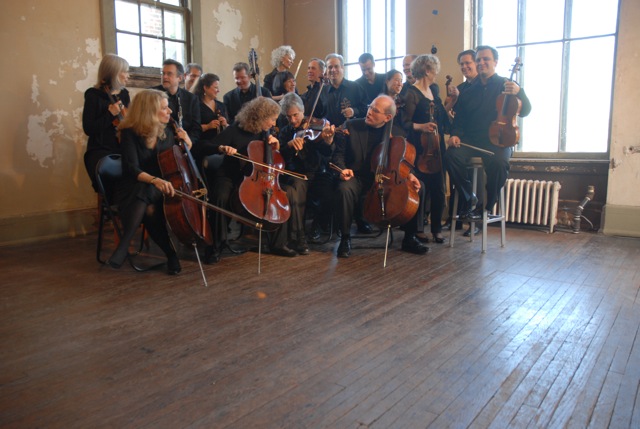
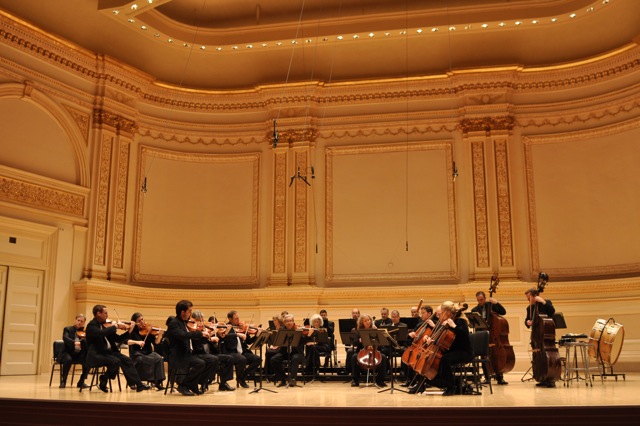
20121205-Opheus Chamber Orchestra-2481.jpeg
Caption: Orpheus in performance at Carnegie Hall; Like Kilroy, I was there in the first Tier, Dec 1. (Used with permission.)
In fact, the question was on my mind while listening to that evening’s glorious music (Prokofiev, Barber, Mozart ).
As the reader knows, I often write and teach about Orpheus. Chapter 6 of the book is “The Invisible Leader: Lessons for Leaders from the Orpheus Chamber Orchestra.” That chapter describes in detail many of the attributes of the orchestra, including the claim that Orpheus demonstrates more leadership than do hierarchical organizations. Which of course it must since there is no conductor, no single leader – each musician takes responsibility for the whole piece, not just his or her part.
And, my most recent explanatory blog entry about Orpheus is here.
Well, what happens when a hierarchical organization adopts the Orpheus model? What changes?
Here are a few of the differences, some characteristics and features. This is a preliminary listing, derived from my years leading self-managing teams and from my decade of observing Orpheus. If you have some aspects to add or delete, let me know.
- A greatly scaled back administrative group. The former departments, now self-managing teams, take on many of the responsibilities of divisional vice-presidents. While reduced in numbers, the administrative office still provides organization-wide services, like professional development and learning. Also, accounting continues centralized. There is an external-facing Leader with an overview of the organization but this is a leader in the Taoist tradition: "The best leader leads least".
- No performance appraisal. Stop cheering, please! Simply, it is not needed in effective teams.
Discipline is needed less because there are few if any administrative rules and regulations that contribute to problems and get in the way of real work and productivity. Teams are self-managing and they counsel, coach and discipline as needed.
- Less closed-off office space. Instead, most people use open workstations and cubicles. Conferences are held in former corner offices (with views) out and in. The architectural idea is to make collaboration easy.
- A supportive support staff. Non-career staff are there to assist teams, offer input and ideas, and largely to implement the work of the organization. Support staff are responsive and responsible; they are a working extension of the organization’s mission, helpful to one and all, inside and outside the organization. Support staff facilitate information requests and connect outsiders with insiders.
- No standing meetings, apart from an annual “New England town-hall” event. The annual meeting sets the budget, chooses new initiatives, and re-asserts priorities, values and mission. All other meetings are impromptu, called as needed. Whoever calls a meeting takes responsibility for research and preparation of the topic prior to discussion and resolution.
- Collaborative decision-making. If a decision involves another team, it has to include the other group and anyone else touched by the decision. Occam's razor frames the decision-making process.
- Salary equity. While not totally flat, salaries are less stratified than in the hierarchy. Regardless, salaries are competitive with markets. Seniority does matter, but most people make about the same. The leader’s salary is more but moderately so.
- Hours worked are reasonable, 30-40 per week. People set their own schedules, recognizing there is life beyond work. Vacations and sabbaticals are generous. Productivity is high.
- The “org” chart is a circle.

There you have it! None of these features require a genetic pre-disposition. (Actually, humans are already pre-disposed toward this type of organization!) All that’s needed is willingness to simplify the workplace, take responsibility and do more real work than under the old ways. If a person is at odds with managing self, he or she has the option to leave. If a musician yearns for someone in charge - a conductor, that musician should be in a conductor-led orchestra! Most re-organizations attempt, but rarely succeed, at shrinking the hierarchy. The Orpheus model is different. It reduces non-essential staffing and results in a more empowered and productive staff.


Failing to fail

Posted by jlubans on January 15, 2011  •  Leave comment (0)

This follows up my Committing to Magic post from October 24, 2010.

As unpleasant as failing may be, we learn from it. In my admittedly contrarian point of view, if we want to hasten learning, we should fail more often. Of course, losing or failing runs counter to our desire to do it right, to win, to reach the mountain top, not falter half way up.

There is a type of failure that we do not learn from – when we fail because we do not try or care enough to do our very best. There’s no learning from a mediocre effort.

The best coaches use a hard fought loss to make a team better. Just recently a highly ranked basketball team lost a game, I was impressed with what one player had to say after the loss: “This tape's (the game video) gonna be out there now. Teams are going to watch this tape to see 'This is how X got them. This is how we can get them.' Now we can just learn from this game, get better and look forward to (the next game).” There’s a player who does not fear failure!

My October 24 post was about how Orpheus Chamber Orhchestra musicians coached a student orchestra to play without a conductor. As readers of Leading from the Middle know, Orpheus plays without a conductor and still produces a world-class sound. If anyone can, Orpheus should be able to demonstrate to students how they go about making great music without a boss telling them what to do. Over the years, I’ve been impressed with some of the Orpheus’ coaches. Their coaching calls on the students to take ownership, to collaborate with each other in the playing, and to make decisions usually reserved for a conductor. On a rare occasion, I have seen Orpheus musicians who, interestingly enough, coach more like conductors and leave little room for a student orchestra to make its own mistakes. This avoidance of failure popped up in a follow up survey report on the most recent student orchestra learning how to play without a conductor: a few students recommended that Orpheus coaches act more like conductors!

I responded to the report's author with a question:
"Are these students allowed to 'fail'? I use the word advisedly. In other words, will a coach let the players go with a 'bad' decision if that is what the musicians want to do? Or, are these students looking for the 'right answer' from the Orpheus coach? It comes through in the report that the Orpheus musician/coaches had a pretty good idea of what the music should sound like and were not reluctant to direct the students toward that interpretation. Certainly, Mr. X did. The different coaching approaches left me wondering how clearly Orpheans understand their coaching role. I would say that the coaching at times is more what I see among sports coaches, who impose their will on a team to win vs. a coach who wants the team to develop and become highly effective.

When I think of applying the Orpheus model to a management class - with teams having to choose, develop and present a project - I can see where after training the teams in group dynamics and interpersonal skills, I would leave the groups alone - to let them figure it out, learning from their mistakes, their trials and tribulations. I'd look in from time to time over a semester and I'd be available if a rescue were needed but otherwise, it would be up to them. Up to them."


I’ve seen this rigged avoidance of failure before: in outdoor adventure events there is strong motivation to have all participants succeed. Whether I am teaching the event or participating in the event I am tempted to make success happen.
20110115-fear fail.jpg In belayed rock climbs, I’ve seen instructors literally haul up someone who has made a good effort but simply does not have the strength to make it the rest of the way. Most participants know the person did not make the full climb, yet we celebrate like he did. Maybe we are celebrating his good effort?
20110115-wall.jpgWhat happens when all members of a group cannot get over a 14-foot tall wooden wall? There’s a deep value, like for the losing basketball player, in appreciating good effort, in talking with "bruised and battered" participants about what went well and what could have gone better.
While teaching in Latvia I am going to experiment with self-managing teams with the “Self-managing team Project: Leading from the Center”. There’s a risk these teams will not do as well as I might want them to. After all, like the student orchestra, if left alone, a team might make poor choices, it might knot up with failed communication, drift along with no one leading, and it might settle for adequate rather than best. We will see. Here is the gist of the assignment:

Each team will organize itself, choose a topic (about a real problem or question for Latvian libraries), plan and prepare a study plan with defined roles for each member. On June 3rd each team will make a fifteen-minute presentation to the class about the study’s outcomes. The presentation of outcomes and recommendations will be in Latvian with a written English summary for the instructor.

Prior to team formation we will spend several classes on teamwork, self- directed work groups, conflict resolution, communication and peer coaching. Also, once the teams are formed, the instructor will attend two meetings of each team and will be available for consultation and coaching throughout the semester.
….
Following the presentations we will assess what each team learned about self-management and what went well and what could have gone better.

No doubt, I will be tempted, just like the Orpheus coaches, to intervene when the music is not as good as I think it should be; tempted to tell the team how to solve the problem instead of empowering the team to do it or fail trying. I will try to bear in mind that if I too assiduously protect them from failing, I am doing them a disservice.

If you have thoughts on how to improve this assignment, let me know.

A “Noisy Orchestra”

Posted by jlubans on January 16, 2013  •  Leave comment (0)

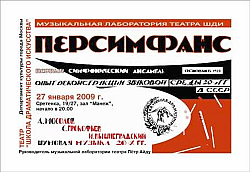
20130116-persifamspic.jpg
Caption: Advert for Persimfans , January 2009 in Moscow.
Speaking of democratic workplaces, there once was a conductor-less orchestra in the Soviet Union: “Persimfans”, short for Perviy Simfonichesky Ansambl, or First Symphony Ensemble (1922 – 1932).
The group interests me since I often blog about the conductor-less Orpheus Chamber Orchestra (now in its 40th year!). There are no less than a dozen Orphic mentions, for example, “
Committing to Magic”. And, Chapter 6 in the book, “Leading from the Middle”, “The Invisible Leader: Lessons for Leaders from the Orpheus Chamber Orchestra” is among the book’s most frequently cited.
I dwell on Orpheus because they are a living, breathing example of a democratic organization, one that is self-managing and - while there are many leaders - “leader-less.”
Since I am eager to learn of other musicians running their own show, I was drawn to a brief article,* written in 1928, during Persimfans heyday. As you might expect, Moscow’s “Noisy Orchestra” was founded in 1922 with revolutionary fervor. That year’s prevailing sentiment was echoed in Persimfans’ one-day revival in 2009: "Just as the government didn't need a tsar, so the orchestra didn't need a director!"
While celebrating Persimfans’ considerable accomplishments (200 concerts) – all without a boss in sight – the authors offer up some insights and reservations about the inner workings prior to its demise in 1932 “as infighting among the musicians, pressure from the Bolshoi and Stalin's purges tore the group apart.”

From the beginning Persimfans was a revolt against the conductor. The main leader, Lev Moiseevich Tseitlin, saw conductors as superfluous entities claiming credit for work they did not do. Mr. Tseitlin (aka Zeitlin) was a first class violinist and the concertmaster of S. A. Koussevitzky’s symphony orchestra in Moscow.
As a result of the revolution, the stellar conductors had flown from Moscow and Tseitlin had at his disposal a world-class orchestra, one that had been led by the world’s best. These musicians already had an accomplished repertoire and some notions about musical interpretation.
Most Persimfans performances required 20 rehearsals – a huge investment of time and energy for reportedly very little money. In concert, the Persimfansians played in a circle, the better for the 100 players to see each other.
The orchestra was an immediate favorite with the Russian public, their comrades, but it had a few detractors. Among the latter, one termed the quality of the music “a mean arithmetical affair,” probably alluding to the now-missing inspiration of a truly great conductor.
Another critic, said that any good conductor could have led – without any rehearsal - this already expert orchestra. After all the musicians had played the repertoire countless times.
This last criticism echoes the effort and time it takes for self-managing teams to become effective. Yes, at the beginning of a team’s formation, a single leader can accomplish an assigend task more quickly than a team. However, a really good team keeps getting better over time, and eventually outperforms the solo leader.

Persimfans was not exactly self-managed: Tseitlin conducted all the rehearsals! And, in performance, all kept an eye on Tseitlin’s bow just like musicians do with a first violin or concertmaster. Perhaps that is why, for some critics, the orchestra’s quality never reached the highest level. While some will argue that Orpheus would be better if conducted, there is little dispute that Orpheus has its own soaring voice and achieves levels of beauty usually attributed only to the very best conductors.
In 1932 the music died for Persimfans. But conductors were soon back on Moscow podia for other orchestras. While Persimfans might have flown apart on its own, there was some recognition among the comradeship that while all are equal, some are more equal than others. If Mr. Stalin was “Father” to Russia, then a leader-less orchestra might be perceived – with dire consequences - as undermining the concept of a great leader for the masses. Mr. Tseitlin did survive the purges, dying a year before Stalin, in 1952.
Obviously, as demonstrated by Orpheus’ success, the “shtick” of being conductor-less is not enough to carry a musical group to greatness. Orpheus doesn’t hate conductors. They love music, are accomplished musicians, and want to have a say on what to play and in how to perform the selection. That is enough for inspired and talented musicians to make something beautiful happen. Or, put another way, you won’t go far if your motivation is to define what you are not. Instead you need to define who you are, what you want to achieve and how to you will get there. When that happens, a team or an orchestra, is well on its way to greatness.

*Sabaneev, Leonid and Pring, S. W., "A Conductorless Orchestra", The Musical Times 69, No. 1022 (1928): 307–309.

“The Maestro Complex” Part 1.

Posted by jlubans on May 10, 2012  •  Leave comment (0)

20120510-hagner.jpeg
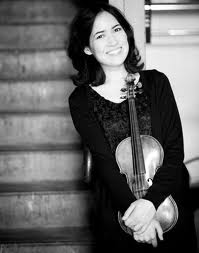
Caption: Vivian Hagner
While in New York city in April I had the pleasure of observing the violinist Viviane Hagner rehearse with the Orpheus Chamber Orchestra. She was their guest soloist for a performance at Carnnegie Hall. If you follow this blog, you know that the Orpheus Chamber Orchestra (composed of between 25 -40 musicians depending on the piece of music) plays without a conductor. There is no boss. The players make all musical decisions (tone, mood, interpretation, tempo, etc.) Each musician is free to offer well-considered and well-informed commentary within the rehearsal time frame. The collective goal is an outstanding performance. While I have written extensively about their democratic process, I always find fresh insights at each rehearsal about their unique way of making decisions.
One of my on-the-road reads was “What Do Conductors Do?” by Justin Davidson, New York magazine’s music critic. He tells - a la George Plimpton or maybe, Walter Mitty – of his adventures in conducting the Juilliard School of Music student orchestra. Not a rank amateur, Mr. Davidson is a student of music and once conducted a few of his own compositions in college. And, he spent two months diligently preparing, with two Juilliard conducting coaches, before taking wand in hand for the 6-minute overture to Mozart’s Don Giovanni. Still, Mr. Davidson is to be admired for his adventurous spirit and frame-by-frame analysis of how he did it. You can see a brief video of what happened at this .
My interest in his story was more about how he led the orchestra than his musical interpretation of Mozart. The anxiety, the “Maestro Complex,” he feels about his leadership - that “the person responsible for the totality of sound produces none” - probably is similar to that of a work group meeting for the first time with a new manager or leader. The workers, just like the musicians, are thinking: “Does this person know what he is doing? Can we have confidence, trust in his leadership? And, the leader shares in the uncertainty: “How am I coming across? Am I being clear about my expectations? Are these people on board with my leadership? Will we excel or muddle along?”
There are multiple theories about how much we should involve workers in decisions about getting the job done. Some managers prefer to direct the worker – the expert manager knows more (he or she certainly believes that) than anyone else therefore it is for him or her to make all the decisions. Others, less certain about knowing it all, take a more democratic approach and expect the worker to have ideas on how to do a better job. While this manager “lets go”, he or she is no different from the micromanager in wanting results. In my experience, a manger’s genuinely “letting go” results in more innovation and higher productivity than does the omniscient micromanager.
The conductor, as a highly visible leader, gives us insights into the process of leadership and followership. Conducting is not karaoke – a version of singing along. In a live musical performance the conductor is literally a beat ahead of the orchestra. The orchestra follows. Like what a dancing instructor told me: “On the dance floor, good leaders initiate the movement they want from their partner and then follow the movement they've created.” That’s sort of like it is between the conductor and the musician. What’s unknown is how much input the musicians have had in the decision making prior to the performance; how much collaboration has gone on among the musicians and between them and the conductor in developing the interpretation and delivery of the music. Lots, some or none?
20120516-Orpheus USEIT.jpeg
Caption: Orpheus at ease.
Today’s rehearsal, at the Kraft Center on W. 115th Street, was Ms. Hagner’s first time playing with Orpheus
Ms. Hagner rehearsed two pieces: Henry Vieuxtemps’ Violin Concerto No. 5 in A minor and Beethoven’s Romance No. 2 in F Major.
I got there late, but soon after I sat down and listened, I was captivated by the bel canto quality of Ms. Hagner’s playing. I use the operatic term "beautiful singing" deliberately because it has multiple meanings about musical depth, breadth and range. The term fits what I heard: a lightness and richness, transcending and soaring alongside that of the orchestra.
Ms. Hagner, in jeans, sweater and flat shoes, plays with energy, rising up on her toes, moving about, playing toward the orchestra. (Good naturadly, a violinist reminds her that she should face front, not toward the orchestra. I think she was enjoying the collaboration so much that it was natural to turn to the orchestra.) I picked up on what must have been an immediate camaraderie – a liking and trusting of each other. (That said, I discovered during the 2.5 hour rehearsal Ms. Hagner's unstated charm that draws people to her.)
Today’s concert master (and first violin – for both pieces was
Martha Caplin.
As the concertmaster, she is in charge of the “core”, the group of 4 or 5 musicians who make pre-rehearsal musical decisions. And, as concertmaster, she led and facilitated today's rehearsal. She is not, however, the only voice offering guidance and direction. At Orpheus ideas can come from any section of the orchestra.
Along with their patented forms of giving and sharing of information with each other – “say it, play it, sing it” -I have often seen Orpheus musicians stop playing and go out into the rehearsal hall to listen to the music. Today at least a half dozen players took turns to stand, a few steps behind me, and listen intently – score in hand. Then the musician describes what he or she heard and makes suggestions on what needs to be improved in the overall sound, pace and balance. Or, it can be a request to develop a less quantifiable quality, more nuanced, such as making the music “more sensitive” or “less mushy.” During the Beethoven piece an observer offered: “(The sound is) not as convincing; it should be darker, richer.”
Nor was Viviane reluctant to offer her ideas: At one point: (That was) “a little thick, get more air in the sound.” At another, she tells them, “That was good, that was great – we got it. One more time.” Shortly after, there is a mess up, but it results in good humor, not any blaming or finger pointing. Everyone wants the piece to work. That is what drives the discussion and decision-making; it is not one interpretation competing for first place. Rather the discussion, the back and forth, is about making the most of this musical piece. The process is collaborative; no one player has the answer. Instead the answer evolves, builds as the group rehearses and talks about it, tweaking, improving, and clarifying.
The group is having so much fun that Ronnie Bausch, a veteran member of Orpheus, admonishes: “Let’s do it for real; too many jokes, asides; now, all together.” The result gets applause.
Making decisions like this – typically the realm of the musical director - means knowing the ins and outs of the music, literally “knowing the score”. Each musical selection has at least a dozen or more Orpheans who hear the entire work, not just the sound his or her section makes. It is this shared overview (the big picture) that leads to the performance the orchestra wants. It is Orpheus’ unique sound.
At rehearsal’s end, I asked Ms. Hagner, “Did you miss having a conductor make decisions?” She smiled, “I did not miss one today.”
(Part 2 of "Maestro Complex" is here.)

Training the 21st Century Information Professional

Posted by jlubans on May 12, 2010  •  Leave comment (0)

“Leading from the Center: Training the 21st Century Information Professional”


Pilot proposal. Comments welcome.

Background: My proposal is based on the Orpheus Chamber Orchestra’s model of conductor-less music making. (The book includes a chapter on Orpheus). I have worked with Orpheus for over a decade in studying their group decision making and each musician’s taking full responsibility for a performance. Doing so, Orpheus produces some of the finest music, often, if not always, exceeding in their own way, conductor-led performances.

When Orpheus began in the mid-90s to coach student orchestras at the Juilliard and the Manhattan schools of music in the Orpheus way of music making, I asked myself: Why not offer library school students self managing experiences, ones rigorous and challenging enough to transform and inculcate students in how to get the best from professional groups? And, if we are indeed becoming more collaborative in how our libraries are run, then gaining experience in self management, leading and following seems a sensible thing to do . Library schools ought to offer an opportunity for those who are interested in the challenge of working without executive oversight.

A student’s getting a job, after graduation, on a self managing team, while nice, is less important than the student’s self growth and, through the experience, gaining skills and awareness on how to bring about positive work place change in any setting.

The pilot class idea was first discussed at an August 2009 conference in Bologna, Italy*. And, I brought the notion up again at a November 2009 conference in Zagreb, Croatia. Also relevant to this discussion is my Chapter 17 in the Leading from the Middle book: “Peer Coaching for the New Library.”

20100512-po colegio espana.jpg

Photo: The street sign for the Via Urbana set high into the ancient wall of the Collegio di Spagna in Bologna, Italy suggests an enduring past(since 1488) and an accommodation of the modern. The battered inaccessible door, set high above the street, might symbolize the entry through which we leave the hierarchy and settle into more democratic organizations. (Taken by John Lubans, Jr., August 22, 2009)

Each time I mention the idea at conferences and to colleagues, I come away with a better sense of how to introduce the concept of leading from the middle and how to allow new librarians to actually give it a try. That is why I am putting the idea up on the blog. Please give me your ideas.

Originally, I termed the pilot class the “peer coaching institute”; My colleague Kate Wittenberg suggested the new title, one that speaks directly to what we are trying to do – to create a new model for working in libraries, a model that is less reliant on hierarchy and more dependent on self management to inspire new programs and to improve existing services. The new title recognizes it is not just about coaching each other – not a bad idea in itself - it is also about group work and taking turns at leading and following.

What then does this have to do with leadership in the library? For one thing, the pilot class likely could provide a response to the question: What does a leader do in an organization of self-managing teams? Students who participate in this pilot should be able to speak about what they learned and what it means for them in the new library organization, the post departmental library. (BTW, the post departmental term was given me by another colleague, Ilene Nelson.) I would expect these students to help clarify the role of the leader. I see the pilot class as a circle within a circle. The inner circle is the experiment – the laboratory - the external circle is the observatory, in which we learn about what a successful self managing team needs from managers and leaders.

In order to make the best collaborative decisions, we have to have groups of people who work well together, who disagree at times and yet move forward, who communicate clearly, who take turns leading, who produce under stress and engage conflict in productive ways.

The Leading from the Center Self Managing Team Project

Who? A dozen or so library science students work independently for credit with a sponsoring faculty member (possibly the one who normally teaches the required library management course) and a practitioner librarian coach. The students select a semester long research project topic for study and presentation of outcomes. The practitioner coach oversees and facilitates the project, including its evaluation.

What? A semester long self-directed team project – about a real problem or question - conducted by a self managing team of students with an end of semester deadline. The design of this project is based on the immersion model of team development practiced by the Orpheus Chamber Orchestra in how they work with the student orchestras. The student orchestra, working without a conductor, selects, rehearses, interprets and presents a musical performance.
The library group’s independent study project will need to be as meaningful for library science students as an end-of-semester live and conductor-less musical performance is to the student musicians.

The research outcome will be presented to peers, faculty, and others at a public forum. While the topic is chosen by the team, here are some to illustrate potential scope and content:
A new way of doing something.
Leading the new library.
Developing a way to channel information seekers to the library web page when starting research.
A library web page that draws users to use library resources.
A marketing plan for a library to become the go-to for information needs, engaging stumped Googlers.
Etc.

Where? Based at one or more participating library schools, the pilot uses existing space and resources: class rooms, meeting rooms, media equipment, library staff and resources.

When?
The project is semester long, for academic credit, starting with an organizational meeting of interested students, a faculty sponsor and the practitioner coach. The latter will work with the team of students regularly throughout the semester to the public presentation.

How? With guidance from the sponsoring faculty member and the practitioner coach, the student team will first go through a several day workshop with training on group dynamics, communication, team building, leadership/followership and conflict management. An experiential component might include outdoor team building activities. Following this introduction the students will choose their research topic and prepare an action plan from start to finish.

Budget considerations:

Travel and accommodation for the practitioner coach.
Team budget, including facilitator costs for introductory workshops, meals and lodging.
Allocation for inviting Orpheus musician coaches from NYC to talk about non-musical applications or for library students to attend rehearsals in NYC to observe how Orpheus coaches and trains the student orchestras.
A travel and food allocation for use by the team, as necessary, throughout the semester.

NOTE:

*Lubans, John. “Peer Coaching for the New Library” in Strategies for Regenerating the Library and Information Profession ed. Jana Varlejs and Graham Walton (Munich: K.G. Saur, 2009): 126–36. The proceedings for the IFLA satellite conference “Moving In, Moving Up and Moving On: Strategies for Regenerating the LIS Profession” CPDWL/New Professionals Discussion Group, Aug. 19, 2009, the University of Bologna, ex-Convento di Santa Cristina.

Leadership from the Dead

Posted by jlubans on August 22, 2010  •  Leave comment (2)

August 23 update: I thought I'd share one of my definitions for what it means to be empowered, like the Dead Head staff is said to be:
Empowerment is an overall freedom for the individual to do good in and for the organization in pursuit of agreed upon organizational goals. It includes an awareness of others and their contribution, and a willing, active support for others.
Do we recruit people who can put that philosophy into action? What does this real empowerment look like? How is it made manifest?
<<<<<<<<< >

My book, Leading from the Middle, has two chapters (The Invisible Leader & Peer Coaching for the New Library) and several allusions about and to a musical organization (Orpheus Chamber Orchestra), along with a chapter (Orchestrating Success: A Profile of Simone Young, Conductor) about a musical leader.
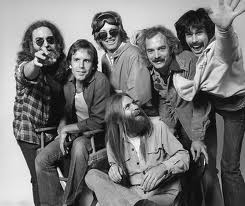
So, it is only natural that I was drawn to an organizational theory discussion of the musical group, The Grateful Dead, written by management professor, Barry Barnes: “Strategic Improvisation: Management Lessons from the Dead.”*
20100822-images.jpg

When I first saw the title, I was reminded of a bit of office humor posted in a cubicle: If you doubt there’s life after death, come around here at quittin’ time!

Professor Barnes applies and explains Frank Barrett’s strategic improvisation technique to the long run and huge success of the Grateful Dead. He quotes Barrett from 1998: “…when improvising musicians get together they ‘do what managers find themselves doing: fabricating and inventing novel responses without a pre-scripted plan and without certainty of outcomes; discovering the future that their action creates as it unfolds.’” (p.269). Of course, Mr. Barrett is referring to managers who proactively seek a solution to an anticipated challenge. Passive managers often avoid or delay taking action by following management formulas, like strategic planning.)
Strategic improvisation has seven requirements that transcend beyond music to other types of organizations.
1. Interrupting habits
2. Embracing errors as a source of learning
3. Allowing maximum flexibility through minimal structures
4. Continually negotiating toward dynamic synchronicity
5. Relying on retrospective sense making
6. Learning informally and developing group norms
7. Alternating between soloing and supporting

When I applied these requirements to my observed “Take-Aways for the Non-Musical Boss” from the Orpheus Chamber Orchestra, I found several similarities:
Take turns leading, take turns following (Barrett’s #3 & 7).
Encourage independent and articulate critical thinking (1, 2 & 4).
Manage self, disagree agreeably (4 & 6).
Listen with all your heart (4).
Be responsible toward the organization (2 & 6).
Demonstrate a philosophy of work that values followers and leaders (1, 2, 4, & 7).

Employee empowerment is a much misunderstood, misapplied, and, subsequently, maligned term, yet genuine empowerment is highly desirable according to Prof. Barnes: “Alternating between soloing and supporting is a critical ingredient for organizations where employees must not only follow but also lead from time to time … as they deal with the novel and unexpected situation.”
For the Grateful Dead, “Even with the greater degree of formality and structure of a corporation, they (the band) continued to alternate between soloing and supporting with the role of president rotated among willing band/board members.” (p.276). In other words, genuine empowerment.
I whole heartedly second Professor Barnes that strategic improvisation can produce a healthier and more responsive organization, one that is more able to anticipate and respond. The question that needs answering for an older non-improvisational culture is how does one become a Dead Head?; how does one implement this new way of working? What has to change in your workplace for it to align more with the way of the Grateful Dead or the Orpheus Chamber Orchestra or Southwest Airlines? Starting with yourself, what would you change? Play on!
* The Grateful Dead in Concert : Essays on Live Improvisation edited by James Alan Tuedio and Stan Spector. Jefferson, NC : McFarland, 2010 (pp.267-278)

Committing to Magic

Posted by jlubans on October 24, 2010  •  Leave comment (0)

20101024-Orpheus.jpg
It was fortuitous that only a week after leading a workshop in Atlanta on work place coaching – in which I mentioned the peer coaching of the conductor-less Orpheus Chamber Orchestra*, (pictured above) - I was able to attend a rehearsal by a student orchestra (minus a conductor) coached by a musician from Orpheus!

Martha Caplin, Orpheus violinist, would coach an evening rehearsal of Bach’s Orchestral Suite No. 3 in D Major and Mendelssohn’s Symphony No. 3, "Scottish," by the Manhattan School of Music student orchestra.

While still early, I was one of the last to get to the John C. Borden Auditorium, the School’s main performance space with its over 800 seats. The 25-30 musicians for the Bach piece were already there, either in the seats just below the elevated stage or up on the stage, tuning their instruments. All the energetic droning and sawing suggested to me that the group was wound up and ready to go.

Liz Mahler, the Orpheus coordinator (and a Juilliard graduate violinist), introduced me to Martha. Martha was in a pink bolero jacket – a half smock style and emanated an immediate friendliness, a kindliness approaching what I would call at evening’s end a motherly-ness or the loving ambiance of a favorite aunt.

Liz let me know the orchestra is zeroing in on its Friday performance, three days away! Instead of working a full semester at learning how to select the music, take responsibility for rehearsal and for performance, this student orchestra started at full speed, two weeks ago!

With only two more rehearsals after tonight for their three-piece performance, Liz cautioned me that Martha would intervene more than might be expected in a self managed rehearsal. I wondered how much she would revert to the conductor/leader model.

Unusually, as they began the Bach piece, all the violins were standing, 6 or 8 players in all. When I asked Liz why, she said the standing was unique to this piece, kind of like having multiple soloists.

(As the first bars of Bach’s music filled the hall, I made a note in my journal: “How nice to be here!” My relief probably was in large part due to the bother of getting to NYC; the first few notes of the music were indeed exhilarating and made it all worthwhile.)

To my untrained ear, the students seem to hurry their way through the Bach piece. And, there was no eye contact, each player focused on his or her paper score.

As promised, Martha steps in – in a gentle way. “OK”, says Martha, her violin in hand. “Your tempo is OK; remember this is an overture; you want to let the audience hear what is coming, but your playing should not have a feeling of anxiety." Use “bigger beats”. “Big, big beats”, she demonstrates with her arms, gesturing from her toes up. “(It’s) different from rushing through, rushing ahead. You are right about the enthusiasm (in the music) Yes! BUT, Ahh. Wait for it, the ahhhh for the audience.”

She demonstrates with her violin, light, advises, “listen to the brass”, be in touch all the time." “Already better.”

Martha uses both “adjusting" and "reinforcing" statements” – the ones I talked about in my workshop – to good effect. Her criticism is well balanced, with more pats on the back than asking the players to modify a sound or tempo. Students respond to her, engage with her. There’s a growing comfort, an easy willingness to try stuff, to adjust toward what Martha is telling them she is hearing.

Martha’s now up on stage, alongside the second violin in the middle, playing. Then, back in the center aisle out front of the stage, keeping time, swaying with hands and arms.

She cautions a second time about the anxiety. Then, “Way better”. I can see a concurrent agreement among the players. Now the clarinetist's eyes are in contact with others.

Martha is back on stage, walking in their midst.

She further sets them at ease, describes that their rushing, even running, through the piece, may result in missing, forgetting a nuance, An, “Oh, shit”…moment (Much laughter) of what might have been had we taken it slower. She asks them for “more air, more delighted-ness” in the playing.
Martha moves with the music, displays her fondness for it. Now, a high thumbs up for the group.

A cellist player is out in auditorium, listening. He stops the group and gives feedback to the group.

Another student violinist goes into the auditorium to hear, encourages them to play “like with the knees” to simulate the movement in the playing, the feeling in the music.

“OK”, even I can pick up the added richness to the music by the students' slowing down. More violinist feedback from out front. Martha: “Really good, sounds great.”

There are now six 6 players out listening to the collective sound, “lovely.”
Lots of discussion now, peer coaching going on in every direction.

Martha talks a bit about different ways of playing this piece, two styles; she prefers them to make a “commitment to magic” Martha demonstrates on her violin what THAT sounds like.

I’m picking up layers of sound, as the students fine-tune their instrumental groups. A coming together.

A touch of anxiety reasserts. “Bach, trust him”, encourages Martha. “Listen to the trumpet”. It's silvery smooth sound, glides above the orchestra.

More discussion among the players, only a few do not say anything. In general, highly participatory. “Just try it a bit,” Martha promotes experimentation.
The timpanist speaks up. (A first in my observing rehearsals for several years!) Martha tells whom to listen to for the sound in a particular segment. “Listen to the cello.” “Getting better, just trust it.”
....

The extra players for the Mendelssohn piece are coming in now. Different students coming in – checking their cell phones instead of talking to each other.

This is a larger musical piece; the winds and brass will be on risers. Tuning up again. There’s a new concertmaster and the person who was the 1st violin in the Bach is now a second fiddle. Martha is side by side with them. Her mannerisms, her gestures, are always encouraging the students, welcoming them to try out something different, to push themselves, Martha’s coaching is more about showing, suggesting, than about telling, directing.

These students want to be coached by someone like Martha. By someone who knows what she is doing. And, they listen to each other!

The orchestra is now double. It starts to play, Martha is gesturing, more up, be involved. (Now it’s slow, draggy). A “dreamy” sequence someone calls it. Soporific, too, I note.

“More subtle” asks Martha. In her feedback, Martha alludes to the sensation of a “heart warming up”.

She asks for more listeners in audience, promoting and prompting their individual roles in giving feedback, being proactive – after all there is no musical director, no conductor to tell them. The winds speak up. There are as many as 4-6 listeners in audience.

The concertmaster acknowledges the 3rd violin, out on the wing of the orchestra. Martha plays alongside the concertmaster, walks over to the winds, side by side. and plays alongside the satellite player on the wing.
Martha models the tempo, tone, and gives them all a reminder about the time – they have until 9:30PM.

She asks, “What do you want to do?” They decide.

Martha tells the brass when to kick in. She stands next to them. “Let’s see what happens. Try it out.” She is a coach/leader, very much in the middle, alongside other leaders. She inspires conversations with her and among other musicians. She demonstrates - quickly always with minimum airtime – no speeches or historical lectures about the music. There’s time and space for peer coaching to take place.

*In chapter 17: “Peer Coaching for the New Library”
of LfM, I elaborate on my “take-aways” from observing several student orchestras learning to play without a conductor. In summary, I saw these as essential elements for the orchestra’s success, and by extension, for the success of any self-managing group:

Collective listening
Time management
Delegation of responsibility
Being prepared
Being proactive
Communication – talking - giving feedback

How’s your organization?

Posted by jlubans on June 28, 2011  •  Leave comment (0)

One of my most useful activities in class and in workshops is for participants to complete the Organizational Continuum, a one page chart. I got an early version of the chart from Jerry Campbell, my boss at Duke University, and I have adapted a few times since.
Here it is, in abbreviated form:

The Organizational Continuum: Where are you? On which side do you want to be?

Decision making:
Hierarchical …………………………………….....................Collaborative
Organizational structure:
Rigid ……………………………………............................Flexible
Information flow:
Limited (filtered)……………………………............Organization-wide
Work environment:
Boss: Worker ………………………………....................Team-based
Work process:
Procedure-based (“By-the-book”) ……..........Continuously improving
Response to change:
Defensive ……………………………………....................Open
Budget model:
Incremental ………………………………………....................Fluid

Most recently, I asked my Riga students to fill out this form. I explained to them that musically speaking, on the left is the conductor-led organization. We know who the boss is.
On the far right is the self-managing Orpheus Chamber Orchestra. They play without a conductor and they play very well. There is no obvious boss.
I asked my students to chart what their current organization is and then to chart the organization they want.
My 16 students – each of them – went from a line on the far left (where they are) to a line on the far right (where they want to be.)
What would your chart look like?
In my Klaipeda presentation about 90 or so librarians and university administrators took the exercise using a translated version of this chart. The end result was the same as for my students. The status quo is the command and control model on the left; and, seemingly everyone’s desired organization is on the right with more freedom and less direction.
Next time, I will stop talking and ask the audience to reflect about what they can do to move from the left to the right, clearly the direction they want to move toward.

Teaching Self-management.

Posted by jlubans on September 14, 2011  •  Leave comment (0)

Can the concept of self-management in the workplace be taught successfully?
That was my question, during my Fulbright semester, when building the class agenda for a graduate level introduction to management at the University of Latvia. My conceptual model was the Orpheus Chamber Orchestra’s musicians coaching a student orchestra to perform a musical concert without a conductor.
Another question, once underway, could I leave the teams alone or would I need to intervene in conductorly ways, like I saw some Orpheus musician/coaches doing?
Besides a strong curricular emphasis on teamwork, I designed three projects over the semester for three different student teams. In other words, each student was part of three different teams. The third project was to be these students’ concert performance in which they put together all they had learned about teamwork and collaboration.

1. “Books2Eat” team
2. “Women as leaders” interview team
&
3. “Self-managing team” working on a team-selected topic.

In team project number 3, the self-managing teams (5 or 6 students each) presented their findings and recommendations on the last day of class in Riga on June 3. 20110914-picpresent1.jpegHere are their topics:

Team A. ”One library – equal possibilities for everybody.” They developed a submission ready grant proposal to create a “socially accessible environment for every inhabitant of our city.”
Team A’s product was a “funding ready” proposal for improving access for disabled library users.

Team B. (The “Garden of Eden” team!) Women in the profession – A look at economic and prestige aspects of librarianship. The team hypothesized that the “field’s feminization (female predominance in the sector), the traditional treatment of librarian as a secondary profession” result in low salaries for librarians and inordinate salary reductions during economic downturns.

Team C developed ways to make the library more relevant to students and to draw them into the library building. Team C has these goals in mind:
- Draw more young people into public libraries
- Make students more excited about using the public library
- Become more appealing overall to the students and to get them to use the library as a resource more often
- Entertain students while familiarizing them with the library for their future use
20110914-PIclipdub.jpeg
20110914-picpresent2.jpeg
To return to my question about teaching self-management. Each team’s plus/delta (what went well, what could have gone better) gives us insights into the stresses each team endured and survived and the pluses show each team’s success.

As you can see in the attached plus/deltas, each team has many things they would change and shortcomings they would like to improve upon. Their candid listings suggest to me an elevated understanding by each team of what is desirable behavior and what is required for a successful group project, for a team to be highly effective. The deltas show an understanding of not only what to improve but how to improve - literally, what they would do differently if they were again in a team situation.

These students learned a great deal about teamwork dynamics and what it means to be self-managing. When I contrast my students’ work with the conductor-less student orchestras I find similarities. The student musicians, like the Riga students, delivered a high quality product and yet have a long list of what could have gone better!
Just like the student musicians, some would prefer a boss, a conductor to direct and to demand. Most, if I look at the pluses, see the value of working in teams and derive satisfaction from that process. No team asked me to intervene, either in the plus/deltas or during the semester. Perhaps I could have done more as a coach, but as a first effort, I am very pleased with and proud of the students

My own delta: give each team one hour to present and respond to comments and questions. Twenty minutes was sufficient for the report, but left little time for questions and discussion. There were numerous questions we could have discussed not the least of which would have been about the plus/deltas and their meaning.

Appendix: Team Plus/Deltas

Team A Plus/Delta
PLUS
• Good teamwork.
• New knowledge acquired.
• Clear distribution of assignments and roles.
• Equal contribution to the work.
• Possibility to cooperate and to get acquainted with new people.
• Topical theme (there are very few libraries, which disabled people can visit freely and get in easily).

DELTA:
Concern in the beginning, how successful will be our cooperation with the previously unknown people.
• Small lack of motivation to begin the work out of the project earlier.
• The lack of the leader who will motivate us to aim higher and to perform even better.
• Difficulties to get together.
• Need more teamwork.
• Need to change strategy to get better teamwork.

Team B Plus/Delta
PLUS
• Team is made of various profiles of people belonging to different levels of knowledge and experience;
• Everyone were informed about the progress of the task activity;
• Actively conducted questionnaire distribution;
• Since the project’s theme was made up, all team members were clear about what to do, about responsibilities;
• The team’s ability to agree on a goal, theme and actions to reach the goal;
• Good ideas;
• Team members’ responsibility taking;
• Responsive members of the team;
• Respondents were also very responsive. We received back a great quantity of questionnaires;
• Duty sharing (distributing among members of the team);
• Collaboration / also had Yes people on the team;
• Good organization using e-mail – communication;
• Constant progress discuss;
• Mistake correcting (each member had an opportunity to correct mistakes);
• Everyone had an opportunity to express ideas, participate in questionnaire analyzing;
• Taking the self-managing team project problem (assignment) very seriously;
• Great planning and time distribution;
• Two bright leaders on the team, who took initiative;
• Each member of the team chose a task (part of the project) for himself, without pressure, independently;
• Everyone has completed his task successfully (according to their capabilities);
• The team had an informal leader, who took initiative in bringing the team together, organization of work and activities;
• Presentation will be very good!

DELTA:
• Before starting working, precise and objective tasks and roles of each member of the team should have been determined;
• Endeavor to listen to each other;
• Limited opportunity to work as a team on a project for every member of the team. The communication was within the groups of two or three people. At the beginning of the project, there were only two or three people involved in a discussion by e-mail;
• A leader was needed for decision making;
• Bad circumstances;
• The form (questionnaire) could have been developed better;
• The team’s spirit appeared in the end of the project’s making;
• Communication could be better;
• Hard to work with people from different institutions;
• Hard to find time to meet;
• Could have met more often with the team;
• Too much focus on details sometimes;
• No clarity about the problem formulating at the beginning;
• Very limited direct-acting communication possibilities;
• Different teamwork building activities weren’t … used („intellectual parties”, collective discussions at the cafes or at someone’s home etc.);
• The more quiet, more restrained team members weren’t fully engaged in teamwork in the beginning (their potential wasn’t fully unlocked and used).

Team C Plus Delta
20110914-plusdelta.jpeg


Table of Contents

Posted by jlubans on July 20, 2010  •  Leave comment (0)

I thought having the book's T of C available might be a way to get more exposure in the search engines. We'll see.

Table of Contents


(Leading from the Middle & Other Contrarian Essays on Library Leadership by John Lubans Jr. Published by ABC-Clio, 2010 )

Part 1
Leadership, Leading from the Middle, Teamwork, Empowerment, Followership

1: Balaam’s Ass: Toward Proactive Leadership in Libraries
2: Leading from the Middle: I’m the Boss
3: Teamwork in Libraries
4: Letting Go: A Reflection on Teams That Were
5: Bridger and Me
6: The Invisible Leader: Lessons for Leaders from the Orpheus Chamber Orchestra
7: Southwest: The Unstodgy Airline
8: More Than a Game: A Season with a Women’s Basketball Team

Part 2
Leaders, Bosses, Challenges, Values

9: I Can’t Find You Anywhere But Gone” Revisited
10: It’s in the DNA: Infusing Organizational Values at Southwest
11: She Took Everything but the Blame: The Bad Boss is Back
12: I’ll Ask the Questions: The Insecure Boss
13: The Spark Plug: A Leader’s Catalyst for Change
14: A Zabarian Experience
15: Orchestrating Success: A Profile of Simone Young, Conductor

Part 3
Coaching, Self-Management, Collaboration, Communication

16: Coaching for Results
17: Peer Coaching for the Post-departmental Library
18: You Have the Resources
19: A Gift from the Woods
20: Leaving the Comfort Zone
21: On the Road Again: Lessons along the Way
22: Rock Castle Gorge
23: Sacred Teams
24: Seeking First to Understand…
25: The Stove Side Chat
26: You Can’t Build a Fire in the Rain: Sparking Change in Libraries
27: What? So What? Now What?


Part 4
Techniques and Tools, Productivity, Climate

28: Sherlock’s Dog, or Managers and Mess Finding
29: Deterministic, Highly Reductive and Transient
30: From the Gutter to You is Not Up: Worst and Best Practice
31: I’m So Low, I Can’t Get High: The Low Morale Syndrome and What to Do about It
32: Productivity in Libraries? Managers Step Aside!
33: She’s Just Too Good to be True, But She Is: Recognition Ceremonies and Other Motivational Rituals
34: I’ve Closed My Eyes to the Cold Hard Truth I’m Seeing: Making Performance Appraisal Work
35: To Save the Time of the User: Customer Service at the Millennium
36: Where Are the Snows of Yesteryear…? Reflections on a Suggestion “Box” That Worked

"I Borrowed the Shoes But the Holes Are Mine.”

Posted by jlubans on May 01, 2011  •  Leave comment (0)

20110501-sem.jpg
The Klaipeda conference, April 27, 2011, in Lithuania, attracted 90 participants. Del Williams (Fulbrighter at Klaipeda U), shared the morning session with me. The afternoon session feautured four Lithuanian librarians reporting on research topics. One of the speakers (Gražina Lamanauskienė, Director of Šiauliai University Library) had applied the concept of "distributed leadership" to her library; I hope to post her slides here.

My talk: "Leading from the Center: ‘I Borrowed the Shoes But the Holes Are Mine.’”

Here's the abstract:
"Leading from the Center: Meaning, Experience and Implications."

Since the mid-2010 publication of his book, Leading from the Middle the author has reflected on the book’s central argument: the more democratic a workplace, the higher its productivity and creativity. This talk shares those reflections and experiences.

While reviews have been overwhelmingly favorable (a starred review in Library Journal!) some readers have questions about the book’s central argument. Indeed, some doubt that followers can lead.

If the democratization argument is even partially true, what are the implications for the various styles of leadership, from the hierarchical (systematized) to the most “Theory Y” of leaders? What are the implications for entry-level librarians who seek responsibility and a share in decision-making? What skill sets does a middle or senior manager need to evoke the best performance from beginning librarians, those who yearn for innovative and supportive work cultures and who prefer action over sitzfleisch.

The author will touch upon gender differences in leading/following as revealed in his research on women leaders in Latvia, done in collaboration with his students.

And, Lubans will share his observations about the few libraries with genuine staff empowerment. Also, he will draw upon organizational models from musical realms – the Orpheus Chamber Orchestra and the Grateful Dead - along with his experiences in using a self managing teams model in his teaching a at the University of Latvia s part of his Fulbright scholarship.

Holding forth, making a point which now eludes me:
20110502-vforvictory.jpg

Del Williams and me listening to afternoon presentat20110502-Del&me.jpgions:


The not so effective coach

Posted by jlubans on November 11, 2010  •  Leave comment (0)

While my recent “Committing to Magic” story tells of coaching that results in a higher level of musicality among student musicians - along with personal and team development - the reader probably knows that not all coaching is alike or at the same level. Not everyone has Coach Martha Caplin’s gift for relationship building.

So, it might be helpful for me to define the other end of the coaching spectrum: the not-so-effective-coach.

I’ve observed a rehearsal of student musicians when the coaching did not help; it may even have hindered the performance.

In the coaching chapters in my book and in my workshops I mention five essential elements* that are shared between the coach and the person(s) coached, in this case, the student musicians. Each shared element has an average range and can vary from below average to high above average.

A below average score indicates that the coaching could be better. I admit my index is imperfect and it is open to (mis)interpretation. I could be wrong in my observation of this one rehearsal, but here is what I learned about HOW NOT to coach,

Since using negative examples is not my favorite way to explain something, I’ll keep it brief:

- Be directive. Minimize interaction. Let them know who’s in charge through posture and the use of interrogation instead of conversation. Do not promote, demonstrate or suggest ways for the students to hear the music – among themselves our out front in the auditorium, listening and observing.

- Use up airtime; hold tight the (invisible) mike. Give long explanations of the piece being rehearsed. Tell the group, but do not encourage a response. You are the expert, you are the conductor. (Ooops! That slipped out.)

- If at first your technique for some musical point does not get results, try, try again. The players’ reluctance and lack of engagement means they are slow learners and do not fully understand what you are doing for them. Tell them they are “blessed” to be performing this piece; imply they need to step up their efforts.

- Ignore the work done in previous rehearsals. Be oblivious to the work of the student core group, those instrumental heads who have thrashed out the tempo and interpretation and mood of the piece. After all, you have played this piece many times and know how it should go.

- Do not expect to learn from the student players. Instead provide expert direction for them to imitate. As you know, the outside expert brings considerable expertise to solving problems. If the players have anything to teach you, there’d be no reason for you to be there.

- Finally, if the group is not talking, don’t stop the rehearsal to find out what is going on even if you are coaching them the Orpheus skills on how to be self-managing, self-directing, and self-sufficient musicians!
_______________________________

*James Flaherty. Coaching – Evoking Excellence in Others. Boston: Butterworth/Heinemann, 1999.
Elements of coaching:
1. Relationship
2. Pragmatic
3. Two tracks.
4. Always/already.
5. Techniques don’t work.

The Un-democracy

Posted by jlubans on August 29, 2012  •  Leave comment (0)

20120829-undemocracy1.jpeg

Since I will be about the Democratic Workplace, I ought to have a definition for what that means. I live and vote in a democratic nation – there are some 120 democracies around the globe. As many, some vehemently, will tell you, democracy is imperfect. Of course, when the critics reveal, in moments of candor, what they have in mind for government, democracy is vastly preferable. It is the only model (apart from a Thoreauan anarchy) that promises all individuals freedom, choice and power.
So, democracy, in theory and in practice, appears to be a good model for nations. What about democracy for business?
Most bosses – for-profit and not-for-profit – make it well known to workers “We are not a democracy!” The boss may be of a participatory bent and good at listening and all that, but she is not about to surrender her legal authority and responsibility (and explicit expectation) to give a thumbs up or down on what happens in the business.
And, there’s many a boss – in both sectors – who believes that without his steady guiding hand, his unique vision, his je ne sais quoi as it were, the business would falter and fail. Perhaps.
If you’ve read this far, you may be itching to ask me, “What do you mean by the democratic workplace?” Fair enough.
Another question. “Is it even possible to have a democratic workplace?” We have democratic governments, but government offices (bureaucracies) are anything but democratic.
Maybe I should first list out some of the qualities that make for an un-democratic workplace. A negative approach is not my preferred way to consider a topic but when I (or you) “flip” the negatives, we’ll have a good start on what the democratic workplace looks like.
One dominant leader.
Centralized power.
Workers are “told”; little, if any, choice.
Closed “books” (finances and personnel).
Little worker participation, in any influential way, in planning.
Hierarchy rules, with layers of supervisors responsible for workers.
Communication follows the hierarchy.
Extensive “grape vine” communication among workers.
Many “pragmatist” – survivor – followers.
Managers supervise more than do “
real work” .
Administrators make decisions.
A pronounced fastidiousness about policies and procedures.
Formal (and elaborate) performance appraisal.
Individual perks, from parking to pay, align with the hierarchy.
A reactive, not proactive, organization.

SOON: The “flip” side.
Note: Of course, offers up numerous concepts about democratic principles. The chapters on Southwest Airlines and the conductor-less Orpheus Chamber Orchestra are especially relevant. My personal experience with the democratic workplace appears in Chapter 4: “Letting Go: A Reflection on Teams That Were”.


Jazz and teamwork

Posted by jlubans on February 07, 2011  •  Leave comment (0)

What does a jazz group have in common with a classical orchestra like the Orpheus Chamber Orchestra? Well, besides not having a conductor, a few other things come to mind, like the essential need for intense - in-the-moment - communication among the group. And from time to time, for soloists to take the lead and assume much of the responsibility for the music.

And, when done soloing, the player has to step back into his or her player role and support, intuitively it seems, the creative sound of the next soloist. While the players know there will be solos for each of them, the exact shape and sound, even duration, are not planned out. So, while support is essential to rounding out the sound of the soloist, it is not until the solo is underway, that the support players figure out how to offer their support. While our work world routines are planned out and predictable, the exciting and innovative pieces - the creative – are not. How do we support each other during those moments of uncertainty? Does the music stop?

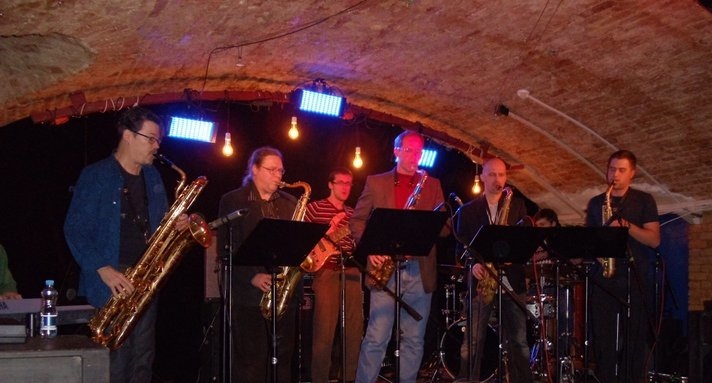
On one of my first nights in Riga, I observed a jam session in the student club at the Jazeps Vitols Latvian Academy of Music featuring my Fulbright colleague, Chris Beaty, pictured here taking the lead as the middle saxophone:
20110207-Chris Beaty.jpg

The combo, which sounded great, was composed of five saxophones, one drum set player, one electric bass guitar, and one keyboard player, a total of 8, a good size in my experience for any team. Four of the saxophonists were faculty members, the remainder were music students, including one high school musician.

Chris told me the group had practiced twice, but not as a complete group. True, each knew the agenda – Nic, the faculty member saxophonist on the left in the picture took on the role of organizer and the equivalent of first chair, or first violin. In keeping with the extemporaneous nature of certain kinds of jazz, he was a laid back leader even though at the start and end of each piece he was the lead communicator.

The drummer, Chris told me, has an equally important role because he controls the tempo, the beat. Obviously, Nic and the drummer would have to be in synch (sharing the leadership) for the music to be as good as it was. So, who was leading? With a conductor, there’s hardly any question – it’s the guy (more often than not) who does not play an instrument.

With a jazz group, the turn taking and distribution of musical roles that I observed, makes the leader’s role ambiguous and more challenging than being the up-front leader of an orchestra. It is less easy to lead when your leadership encourages others to take the lead. Perhaps that is what Max De Pree was referring to in this quote from his Jazz Leadership, published by Dell in 1992:

“A jazz band is an expression of servant leadership. The leader of a jazz band has the beautiful opportunity to draw the best out of the other musicians. We have much to learn from jazz-band leaders, for jazz, like leadership, combines the unpredictability of the future with the gifts of individuals.”

At that Riga jam session, I only got to see the peripheral aspects of the teamwork and shared leadership, but I came away with wanting to know more about jazz organizations and their kinship to work groups that produce their own versions of great music.


Labas rytas! "Wearing Holes in Borrowed Shoes!"

Posted by jlubans on December 05, 2011  •  Leave comment (0)

This is the text of my talk from my December 2, 2011 talk in Vilnius Lithuania*.

Labas rytas! (Good morning!)
20111205-vilniusJL.jpeg
My talk today is largely based on my new book, Leading from the Middle.
1. Meaning
2. Experience
3. Implications.

I have added a country western song as a sub-title: "I Borrowed the Shoes But the Holes Are Mine." The sub title recognizes what others have done in thinking about the democratic workplace and that I am building upon those ideas. Yet, I am putting my own holes in those borrowed shoes!
You get the idea?
1. What is the Meaning of Leading from the Middle?
My book promotes a democratic, empowered work place. I argue in the book that the best work places give staff the freedom to achieve their full potential. The less command and control, the better. The book also reveals how I lead, how I manage, so it is not all theory. Please do not think that I am advocating anarchy, however interesting it might be to find out how an anarchous library would function.

Frankly, there was some resistance to publishing the book, but what bothers me most is our superficial thinking about good leadership, about being productive, and about managing for best outcomes. It seems like none of this is especially important to us and that good leadership is something that happens somehow without our having to think too much about it. Leadership comes with the title on the door! Right? Where does bad leadership come from? How do bad followers come about? Good followers? Most of us know a few good and many bad leaders. What sets them apart? Is it really all happenstance?

I think the democratic work place – the one espoused in the book – appeals especially to the younger, newer professional. Our new librarians – the best ones in my classes in the US and in Riga - are demanding a say, they yearn for something more. Will we – today’s leaders – give them what they want?

I’d like to talk about my U of L class and how it learned to self-lead. My model for the class was that of a student orchestra learning how to play without a conductor modeled after the conductor-less Orpheus Chamber Orchestra. I have studied this self-managing group for over a decade and continue to marvel at their accomplished playing. Here is a picture. What or who is missing?
INSERT Carnegie Hall pics

My University of Latvia students responded very well. Not only did they excel at three team projects they also made connections between theory and practice, linking lessons and concepts learned in group activities to lectures and readings and to their own experience.
We know the hierarchy prevails in Latvian culture, as it does in the USA and I believe it does in Lithuania. I expect these students when given leadership opportunities will modify work place cultures toward the more democratic and less bureaucratic.
At the end of the class the students told me what worked and what did not: Self-management in a group is no easy task. While pleased with the results, many issues (storming) had to be resolved before the groups could produce an end product, one that met a minimum standard of acceptance.
More than once each group wished for the intervention of a strong leader – deus ex machina- like - to take over decision making, to tell them what to do. Informal leaders did appear and they made a difference.
I asked: Are effective teams more productive than the boss led variety? The answer: It depends.
A quintessential lesson from my students - I did not fully appreciate this until a recent panel presentation by three of my students ( from left, Edite Maliseva, Inara Kindzule, Aija Uzula)
(Insert picture from panel)
at my November 30 Riga workshop: Assign or have groups clearly spell out, early on, individual roles and expectations, including leadership, very much like the concert master that takes responsibility for each piece of music performed by Orpheus.
2. Now, I’d like to talk about the Experience
I have empirical evidence that empowerment, when done in a genuine and supportive way does result in a more creative and productive work place than does the hierarchy. I have seen it happen, I have been involved with it.
Still teamwork is not for everyone. Some of my library groups were unhappy with empowerment and were passive about sharing power.
Real empowerment works. Not just in libraries: in business and in music and there is much research to support the notion of freeing up people to do their best, to be all they can be.
Is Teamwork natural?
Well, apparently so: Harvard biologist Edward O. Wilson was quoted in the, April 17, 2011 issue of the Boston Globe:
“Under certain circumstances, groups of cooperators can out-compete groups of non-cooperators, thereby ensuring that their genes — including the ones that predispose them to cooperation — are handed down to future generations….
(This) is what forms the evolutionary basis for a variety of advanced social behaviors linked to altruism, teamwork, and tribalism.”
(Centuries before, Adam Smith wrote about man’s inherent altruism; now even some Darwinists appear to accept his idea that people like helping others simply for the pleasure derived from their kindness.)

And, the honeybee has much to teach us about collaboration in the workplace. Bees are leaderless – despite popular belief, the queen has no executive role. How then does a swarm of 10,000 bees survive?
How does the swarm select a new home from dozens of options?
How do the bees choose the one best site with an accuracy rate of 80%?
The recent book, Honeybee Democracy – Medus bite Demokratija - offers a fascinating look at democracy in the world of the honeybee.
Scout bees, when home hunting:
1. Identify a diverse set of options,
2. Freely share the information about these options,
3. Aggregate this information to choose the best option.
“Remarkably the scout bees do all these things without working under the guidance of a leader.”
3. So, what are the Implications of the concept of leading from the middle?
Leading from the middle creates new expectations among students and I was obliged to try different ways of teaching, e.g. I used children’s books and other activities
INSERT PIC
to make points about effective followers, about least likely followers, about resourcefulness, and about attitude.
Likewise, different power dynamics come into play for leaders and followers. Leaders in an empowered organization need people skills (and a strong sense of self value and confidence) to get the most from library staff, to enable staff to reach high levels of achievement.
It’s easy to talk about empowereing staff but much harder to carry out. It can be difficult to turn people loose for real. What happens? What does it mean for a manager, for a leader? When the group takes off – when the orchestra is “unleashed” what happens to the conductor? When I did it, my traditional supervisory leader role changed. It changes vastly for the better in my eyes, but it can be scary and can make a leader vulnerable, something I personally discovered. When followers become leaders, that raises questions about our leadership role and necessity as leaders and managers. Do we have a job? Of course we do. We learn to lead more and manage less.
I have a challenge for you. Be more bee-like!
Thank you!

*NOTE: "Leading from the Middle: ‘I Borrowed the Shoes But the Holes Are Mine’”
was Presented December 2, 2011 at Vilnius University, Vilnius, Lithuania at the conference, "Library science and practice: yesterday and tomorrow", the 80th anniversary of the Lithuanian Society of Librarians.

The “Maestro Complex” Part 2.

Posted by jlubans on May 15, 2012  •  Leave comment (0)

Viviane Hagner (see Part 1) elaborated on her response: “Even in symphonies (with conductors, the players) need to talk with each other.” Her words are a good lead-in to Part 2 of the "Maestro Complex."

Davidson, in his article “What Does a Conductor Do?” suggests that leadership styles among conductors are changing. As implied in Ms. Hagner’s quote, he claims that there is a perceptible shift for more freedom (and power) for players.
This change is due more to unionization of musicians than to conductors “letting go” of their usual tight grip on the reins. A tyrannical conductor can still publicly humiliate a musician, but he’ll pay a price. The modern orchestra (a few are self-managed) has some say over which conductors get asked back.
Still, Davidson’s preferred way of leading leans to the traditional conductor, the self-sufficient and all-knowing maestro. I am not suggesting Davidson turns into an intolerant leader. Rather, he acts on the received tradition that the conductor’s job is to figure out the music and to lead it. Input from the musicians is incidental; it is not pursued. After all, as Davidson says, “(a) good conductor is a parent who’s always ready and always right.” In other words, musicians are children in need of guidance/direction.
While most of us think it is desirable to share decision-making, when we become THE boss, our go-to way of leading, our intuitive impulse is to centralize decisions, to go it alone - just like Davidson did - regardless of evidence that collaborating with others usually results in better decisions. (No, seeking advice from an inner circle of like-minded managers is not the same as talking to the people doing the work.) It takes a deliberate effort to ask for the workers’ advice and opinion. Doing so (letting others participate) can be seen by some as weakness. I am reminded of a study in a recent book, Sway. The authors maintain that dissent – a normal part of democracy - is essential to limiting our wrong-headedness. To get honest dissent, the boss has to establish a climate that permits, even empowers, dissent. Airlines now train cockpit crews in how to “block” – the term for getting in the way of irrational behavior - when a safety rule may be violated. Not only does dissent improve decision-making it can also save lives.
Corporate leaders, because they rarely allow others to see how they lead, are under far less scrutiny than are conductors (or surgeons or airline pilots). Inferior performance in an organization can be hidden for years or, if business is good, an inferior leader can take credit for the work of effective followers. Some corporate leaders may fantasize that they, alone, make the difference. I recall a friend’s boss who often spoke at professional meetings and encouraged collaboration and risk taking, innovation and experimentation. Back home, my friend learned to her dismay, that her boss talked the game but then punished anyone who took him up on it. If you experimented, innovated, collaborated with others then the boss would undercut your efforts, maybe even encourage you to leave. This boss was not about to relinquish control, and the organization suffered. Of course the damage (unlike a failed public musical performance) caused by this boss is not easily perceived by higher ups.

Early on in my career, I certainly thought it was up to me to make decisions and to do so with minimal input from staff. As I matured, I suffered less from Davidson's Maestro Complex (the need to justify my higher salary and to exhibit my “superior” knowledge). When I turned to the staff for help, we achieved our goals and higher productivity. It was really very simple, I had no illusions about my expertise, so I had to let go and allow staff to collaborate. Not that I was detached; I was an active participant in work meetings and I did ask good questions that complemented my ability to spot redundancies at 50 paces. I knew the type of followers I wanted and was active in recruiting them. And, I was very good at finding the best people (both staff and managers) and allowing them freedom to get the job done. My “hands off” approach worked well for about five years. Then, because of organizational shifts, we started to bog down once again, returning to the hierarchy in structure and behavior. My way of leading now ran counter to what the organization wanted and, as I have already said, inefficiencies can be easily rationalized and covered up. Finally, when my boss departed, I lost the necessary support and my days were numbered.

For those five golden years I did not have to justify my presence – staff relished their freedom (and saw me as the source of that freedom) and my boss supported me. Insecure conductors (and managers) "gesticulate, point, urge, and cajole" – they micromanage. For example, one of the conductors coaching Davidson in one session “demonstrated for a percussionist how to get the right sound on the triangle, corrected a bowing in the violin part, sang the bassoon line, and pointed out a subtle harmonic shift—all without glancing at the score.” For Davidson the key point here is the conductor’s phenomenal memory. Well, a good memory is important, but this is micromanaging. Why not let the musician make the mistake and figure it out; why not let them “lead” themselves and make decisions relevant to the work they do.

Conductors are essential for facilitating communication in large orchestras.
20120515-Chichon1.jpeg
Caption: Karel Mark Chichon
Some conductors, like Karel Mark Chichon, whom I have seen perform a half dozen times with the Latvian National Symphony, have great gifts. Maestros, like Chichon, can take a very good orchestra and make it great. They understand the composer’s meaning, articulate it, and somehow inspire musicians to reach high levels of performance. I doubt there is much micromanaging (or ass-kicking, to put it crudely) by this superb leader; the true maestro works at the conceptual level, eliciting a particular sound from the musicians, the workers. It is up to the players to rise to the occasion, to meet the conductor at the mountain top and share in the joy of the music! The conductor trusts the musicians and the musicians trust the conductor. This shared trust spurs everyone to higher and higher levels of performance. That’s the best kind of leadership: followers and leader interacting and producing something very good.
Interestingly, Davidson does note, among other clues, his mentor’s advice (very much like a manager’s “letting go”) for getting through a dicey part in the score:
“Just beat clearly and they’ll take care of it.”
However, Davidson qualifies this counsel: “That’s a useful though not universal commandment: Do Less.”
Davidson’s coaches give him additional insights about leading: One tells a conducting student not to lean toward the players, (hectoring them) instead “to set aside the baton, close his eyes, and turn his back to the orchestra so that he’ll listen more and insist less.” No micromanaging there.
Then, Davidson heard some great advice from Bernard Haitink, the Dutch maestro during his visit to Juilliard. Observing a student rehearsal, Haitnik cautions: “The musicians are very busy with playing.... “You (the conductor) should not distract them!” Definitely no micromanaging there!
Davidson further reinforces the notion of letting the musicians lead with this quote from a principal cellist: “It’s amazing how beautifully we play when we don’t know what the hell the guy on the podium is doing.”
In spite of these several bits of leadership wisdom, Davidson is anxious about how he will lead the student orchestra through a difficult part of the overture. He calls it the No, really passage. Worried for several days, he hopes for the best that somehow something will come to him.
Here he describes how he did in his conducting debut:
“I make plenty of flubs: I scramble the beat, forget a cue, confuse the players once or twice. The Juilliard students respond with sensitivity and respect, and a desire to play as beautifully as I will let them.” And, his mentor offers him high praise for how he conducted the No, really.
Why did Davidson not ask the student musicians for help or simply let them play through the No, really? To collaborate with them and figure it out. Davidson did well, but I am left with a What if? What if he and the students had talked about the No, really?
------------
“I learned more about conducting by watching (Orpheus) rehearse, than I have in all my conducting classes.”
This quote in my book comes from a conducting student who, like me, sat in on an Orpheus rehearsal. He had learned something remarkable: there is a process for and value in soliciting ideas from the players – the people doing the work. And while that may sound obvious to most managers, it is a lesson worth re-stating and practicing.

Brainstorming and Arm-wrestling

Posted by jlubans on May 30, 2012  •  Leave comment (0)

20120530-alone.jpeg
Jonah Lehrer’s provocative article, “The brainstorming myth” in the New Yorker got me thinking about how some groups are bursting with innovation energy and others are entrenched like stumps.
Lehrer backs up his hypothesis with research studies that conclude that brainstorming – with its “no criticism” rule – does not work. He cites Keith Sawyer, a psychologist at Washington University: “Decades of research have consistently shown that brainstorming groups think of far fewer ideas than the same number of people who work alone and later pool their ideas.”
Certainly I have seen brainstorming fail, but that failure rarely had anything to do with Lehrer’s central point: “Brainstorming enshrined a no-judgments approach to holding a meeting.” What gets in the way is less the suspension of criticism and more a lack of good ideas or a pathological reluctance to share those ideas.
In one instance I challenged, in a public forum, a group of 20 peers – the year I chaired this group of directors of large higher education bureaucracies - to come up with a quick list of ideas on what we could do to increase the productivity of our 2500 staff members. To me it would be a fun and creative exercise and we just might come up with some promising stuff. That’s not how it worked out. The group, recruited from the best and the brightest of our profession, had few ideas – I do not recall our pursuing a single one. Perhaps they were not willing to take part because of me – a maverick with democratic notions – or they feared looking foolish to the audience in the meeting room. Regardless, the slim pickings made me wonder at the time how these directors developed new procedures and processes in their bailiwicks. I suspected most leaned toward top-down directives with minimal staff discussion.
So, while Lehrer triggered this memory of a brainstorming failure, I also recall brainstorming that got good results. Success probably happened because of other factors. For one thing, there was good camaraderie and people were invested. Participants felt connected to each other – trust was high – and each participant knew the topic. Like the self-managing Orpheus musicians in rehearsal, each well-informed participant could see the big picture and did not limit his or her thinking to the immediate horizon.
Personally, brainstorming, or something like it, works for me. Give me a problem and I can list out two or three dozen ways to fix it. While jotting down ideas, I am aware some are foolish. I don’t stop to debate with myself, I build on those ideas – they become useful to me as I look for a solution. I hurry on until I feel myself circling back to earlier ideas – a natural stopping point. Then, and this is a key point, I quickly separate the wheat from the chaff - out of a list of 30 I will probably keep five or six, something in the 20% range, for further exploration.
And, I have seen brainstorming result in excellent ideas in the Future Search process of exploring where an organization wants to be. Absent a corporate will, the process breaks down – in my experience – at the crunch question: what will we stop doing to gain resources for the new?
Still, Lehrer’s explorations give us much to consider. He heralds that the best group work results when we are “hurled together” (architecturally). “Human friction creates sparks.” The best office space is open with an environment that forces us to interact with each other serendipitously and frequently rather than doodling behind closed doors. Executive suites, non-profit and for-profit, are at the opposite of Lehrer’s optimum. If you want a collaborative team at the top, you need to facilitate frequent interaction. Apparently, Steve Jobs did so at Apple: “he had the building arranged around a central atrium, so that (the) diverse staff of artists, writers, and computer scientists would run into each other more often.” (I wish it were that simple!)
20120530-herb.jpeg
Caption: Herb Kelleher Arm Wrestles For Ad Slogan "Just Plane Smart". (He" lost" and won!)
When I interviewed Herb Kelleher (pictured), the iconoclastic leader of Southwest Airlines, I saw that there were no windows in corporate offices and that the Love Field headquarters building had hallways so wide you could drive a herd of cattle down them. The walls were decorated with hundreds of examples of corporate lore and here and there were stations for people to sit and interact in chance meetings.
The quintessentials for successful group work are an organizational culture that supports (celebrates) group work and that people trust each other. For more ideas, see my Chapter 10: It’s in the DNA: Infusing Organizational Values at Southwest in Leading from the Middle.
Our greatest friend among the insects, the honeybee, has something to say to us in this regard. On page 43 of the Smart Swarm book, the author paraphrases Seeley’s “must haves” for bees to choose the best location for a future home: “Seek a diversity of knowledge. Encourage a friendly competition of ideas. Use an effective mechanism to narrow your choices.”

Sleepless Nights and Prozac Prescriptions

Posted by jlubans on March 20, 2013  •  Leave comment (0)

A frequent request I get, like I did after my talk at the Estonian National Library, is to provide library examples of democratic workplaces*. That’s an interesting question to answer since there are no all-out democratic libraries, quite to the contrary. Other realms** offer up examples, like New York’s highly successful Orpheus Chamber Orchestra or, in Brazil, the highly successful and productive Semco Group as described in one of my class readings: “Thought Leaders: Ricardo Semler Won’t Take Control.”
There have been some democratic efforts in academic libraries – I had a leadership role in one – but these are parochial and circumscribed. One research library claims to be team-based and that does appear to be true, but when I inquired about their rationale the official response was similar to other tentative efforts: to make staff feel more involved in the organization, and, from that engagement, to derive greater job satisfaction. That’s commendable but I would have preferred a public statement that the teams will improve on what the library does, will develop new services and will, quantifiably, increase productivity.
I have always held that a re-organization needs a substantial rationale. Shifting people around into a new, feel-good assemblage is not enough. Some good may come from re-organization, but the dozens I have witnessed - including a huge one underway right now - show more imbroglio than improvement.
I have not much history with the Semco Group but from what I read and observe, many executives the world over admire Ricardo Semler, the owner-founder. Few, if any, want to duplicate his democratic workplace. Semler says - facetiously, I think - that there are two reasons for this: That 80% of business people will not give up control. And that the other 20% do not trust mankind, on its own, to do good. Does this absolute ratio, however tongue-in-cheek, apply to libraries? Probably.
I certainly recall a multitude of queasy feelings when I surrendered control over a bevy of departments. Because compensation and status is based on one’s place on the hierarchical ladder, a flat and ladder-less terrain may induce sleepless nights and Prozac prescriptions. Worse, some leaders egotistically do not believe staff capable of self-management (people need supervision!) and/or that none can replace their most excellent leadership. They are certain that the democratic way of work is utopian and naive in the real world of the hierarchy!
Yes, I did find - at some personal cost - that democracy in the library workplace is not for everyone. Indeed some of the library work groups I supervised were unhappy with empowerment and were very passive about sharing power. They abhorred the notion of limiting a boss’ power and freeing up people to do their best, to be all they could be.
Because of this intransigence (plus libraries are almost never stand-alone institutions which further restricts their autonomy) my book
and blog are meant to stimulate and challenge individuals, not to vex hierarchical dinosaurs. So, I encourage the individual - leader and follower - to think about democratic concepts and to apply democratic ways of working to his or her local situation. If you are a department head that believes people work best when trusted, respected and free to make decisions about how to do a job, then be democratic in leading. Or, if you are a hard working follower, then support and practice democratic concepts in working with others.
Even if your workplace is the most constipated and untrusting hierarchy, you can be democratic in what you do and think. If you are required to take part in the ritual of formal performance evaluation, you can coach and advise people separately from the paperwork.
I think the democratic work place appeals especially to the younger, newer professional. Our new librarians – the best ones in my classes in the US and in Riga - are demanding a say, they want something more. We should be paying attention.
There is a glimmer of hope on the library horizon.
A colleague at a conservative research library tells me administrative attitudes about command and control are shifting. Her term for what she is seeing is the “post-departmental” library. Her meaning: the hierarchy is frequently by-passed and that a more matrix-like organization is emerging. While departments remain, library-wide task forces - composed of staff and supervisors - are used to set policies and to avoid departmental turf battles. While this library has a long way to go on the democratic continuum, it may well exemplify what is occurring in other large libraries.
From what I know of my friend’s library, I can well imagine that the executives pine for the good old days of command and control, but they have had to make concessions. If they resist during these difficult economic times, they might discover that their power only exists as long as those whom they supervise want them to have it. I am optimistic that many reluctant administrators, like the room full of managers I spoke to in Estonia, actually may come to like a democratic organization.

*As defined here:
Many leaders.
De-centralized power.
Open “books” (finances and personnel).
Planning involves everyone.
Team-based, flat organization.
Many effective (independent and critical thinking and action-taking) followers.
Managers do “real work”.
No formal performance appraisal.
Workers help define individual perks, from parking to pay.
A proactive organization.

**For more examples of democratic organizations, there is the WorldBlu (Freedom at Work) web site for its list of “Most Democratic Workplaces.” There are no libraries or academic institutions on that list, but it is well worth looking at since those on the list are carrying out and helping define what it means to be democratic.
 
site stats