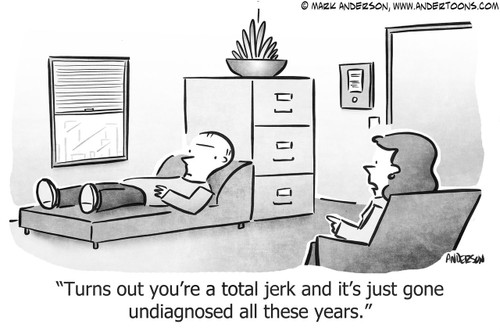
Jerk Introspection

Posted by jlubans on July 25, 2023  •  Leave comment (0)

null
Over the years, I’ve devoted several blogs to Jerkiness; here are several:
“Fifty Shades of Jerkiness” (2016)
“Of Jerks, Bozos, Dorks, Fatheads, Nincompoops, Dunderheads, Twerps, Bamboozlers, Fakers, Hornswogglers, et al.”( 2015)
“’Boss-holes’ and Other Dour Denizens” 2017.
“Telling-off the Jerk Boss: Bad Idea?” (2015)
“How Jerks Happen” (2019)
and from the sports world an exploration of New Zealand’s “No Dickheads” rule in “Rugby in the Workplace” (2015).
Finally, perhaps an overly-optimistic take from 2022, “Jerks No More”.
These brief essays offer clues to how jerks come to be, their variety, and how to deal with them. Is there more to be said?
Enter introspection, as revealed in a WSJ article from June, How to Tell if You’re the Office Jerk.
The authors reveal a couple strategies for looking in the mirror and checking for telltale signs of jerkiness.
One approach is to ask others around you. They do know if you’re a jerk or not. The problem is getting them to tell you without high anxiety and potential rancour for both the teller and the listener.
In today’s avoidance society we need to take a different approach; perhaps a less direct and more oblique manner to permit the critic a way to offer constructive criticism instead of an uncomfortable silence or the appeasing, “No worries, you’re doing great!
Instead of bluntly asking, “Am I a jerk?”, put the question in a different and specific way.
For example, when dealing with a subordinate, “When I proposed that we should do X, I thought you were a bit hesitant. If that is right, can you suggest something different? I do want to hear your perspective.”
Then listen. And, then act on the suggestion if it really boosts your idea.
You will know.
Had I done that early on in multiple situations, there would be no suggestion of undiagnosed jerkiness on my part and I would have gotten to build on improved ideas.
In another case, if you as a leader are pretty sure about an idea, do not hesitate to get another perspective on your seemingly super idea.
Your asking for other views will result in two outcomes: your Jerk-o-meter reading will drop and your super idea will get better.
I recall developing a case study for a leadership workshop along the lines of something called “scenario writing”. I based my scenario on a recent experience. I’d finally unloaded some long delayed negative feedback on a subordinate for her numerous negative attitudes and actions.
My criticism was legitimate but, my subordinate was mortified and shocked.
In the case study I masked my identity as Jack and the subordinate as Jill and asked the workshop participants what advice they might have for Jack or Jill.
Who’s the jerk, Jack or Jill?
Was I surprised at the consensus response? Was I ever!
The workshop participants were strongly critical of Jack (me) and they prescribed much better ways to have had that uncomfortable conversation with Jill.
If you believe the workshop participants got it wrong and that Jill was only to blame, well, consider yourself a jerk.
Very likely you already know where you went wrong. Refusing to learn from that experience is being a jerk.
It does not have to be a case study. You can share with a few colleagues a real situation – without names. Just like in my workshop, those colleagues, not necessarily friends, will give you significant insights on what you should have done if you indeed messed up.
There’s value in the process of developing a quasi “case study”. Your shortcomings likely will become self-evident as you write it!.
Indeed, if you can be honest with yourself, you will see, as you write, what you might have done differently.
Not that you can repair the damage, although you should try.
Your efforts to repair, if sincere, may help assuage the bad feelings.
Interestingly, another tack for assessing one’s jerkitude: the lack of positive feedback even without explicit negative feedback may suggest there’s something wrong.
More than likely something is in the works.
Fairly or unfairly you may be seen as a jerk, when people only offer lukewarm support.
But by then, it may be too late to make changes. However, a comeuppance early in one’s career may point to what you could do differently to gain the level of support you desire in your next job.

__________
ONLY a click away, classic and modern fables suggest many ways of jerk avoidance, personal and profitable:

And, my book on democratic workplaces presents the anti-jerk way of leading and following Leading from the Middle, is available at Amazon.

© Copyright all text by John Lubans 2023

"Fireflies in the Dark*

Posted by jlubans on July 19, 2023  •  Leave comment (1)

Out and about, as is my wont, (see the blog Urban Wanderer) I happened across a new Riga monument, one installed in 2021.
null
Caption: Gunārs Astra in prison stripes.
According to its sculptor Gleb Panteleev, it’s an “awkward” tribute to the Latvian dissident Gunārs Astra (1931-1988) because Mr. Astra was himself an awkward, difficult, stubborn, and implacable human unwilling to accommodate the Soviet's Orwellian imposition on personal freedom such as the daily indignity of prohibiting the use of his native language, Latvian.
Opposed to communism and Russia’s occupation of Latvia, he was under constant surveillance by the secret police and twice sent to Siberia’s labor camps.
At his second sentencing (seven years of hard labor) in 1983 for anti-Soviet behavior, he risibly confessed that he had indeed photographed some pornographic images and shared them with friends.
But, he denied the trumped up charges of anti-Soviet agitation and propaganda.
His words to the Supreme (kangaroo) Soviet court live on:
"I believe that this time will fade away like an evil nightmare. It gives me the strength to stand here and breathe."
Given amnesty in 1988 as the USSR was falling apart, he died under mysterious circumstances soon after his release – likely, Putinesque poisoning.
Mr. Astra’s unshakeable resolve for freedom, reminds me of the fictional character from the 1967 TV show, The Prisoner. Imprisoned, he has no name, just a number, 6.
Like Mr. Astra he resolutely asserts, “I will not be pushed, filed, stamped, indexed, briefed, debriefed or numbered. My life is my own.
No doubt Riga’s new monument was not appreciated by the Kremlin who for decades was avoided by its neighbors as a bear not to be poked, even after its illegal annexation of Crimea in 2014.
Then came Russia’s full out war on Ukraine on 24 February 2022
Astra’s prophesy of the "evil nightmare" fading away is slowly happening. But, it is now 40 years later and Latvia and other former Soviet captives are finally and decisively ridding themselves of the many lingering physical and psychological reminders of Soviet times.
The so-called Victory (more aptly, Occupation) tower crashed down in a cloud of dust and much chagrin amidst Latvia’s post-1944 Russian population some of whom stubbornly, to this day, resist speaking Latvian and a few (one only hopes!) still yearn for “the invasion”.
Well, the invasion has come but it’s 600 miles away in Ukraine.
null
Caption: Only the dirt base remains.
More pointed and apolitical is the removal of the Pushkin statue in Kronvalda Park this summer.
Placed there in 2009 by an administrative fiat by Riga’s pro-Russian mayor, Nils Ušakovs, it took the war on Ukraine for Latvia to reach its limits for humoring Russia's explicit smuggery and thuggery.
Obviously, Pushkin, the famed Russian writer, was put there to insinuate to Latvians the superiority of Russian literature.
Instead it was just another Russification attempt, even 18 years after Latvia became a free republic again in 1991!

*Fireflies hint that there is light in the dark. If there is darkness and there is no light, then there is no idea about it." Gunārs Astra.

__________
ONLY a click away:

And, my book on democratic workplaces, which incorporates much of what Emery and Herzberg professLeading from the Middle, is available at Amazon.

© Copyright all text and photographs by John Lubans 2023

The Big Stay

Posted by jlubans on July 13, 2023  •  Leave comment (0)

null

There’s the Big Easy (NOLA), there’s the Big Sleep (Raymond Chandler), and there’s the “Big Guy”.
Now, after all these Bigs, there’s the Big Stay.
What’s the Big Stay(BS)? The Long Linger?
No, it’s the contention that “More Workers Are Hunkering Down And Staying In Their Current Jobs” instead of quietly quitting or resigning, as in the “Great Resignation” or the “Big Quit”, for greener pastures (better pay and benefits, work flexibility, an enhanced work-life balance and career advancement).
In 2021 we were told as many as 4 million workers quit each month.
Well, good enough; today’s labor force numbers suggest that there’s less employee turnover caused by a variety of economic and social factors including the astonishing - for some - personal epiphany that most of us have to work in order to live.
We may not live to work, but we work to live, to coin a phrase.
The Big Stay will no doubt assuage one of a manager’s numerous bugbears: retention.
But, motivating those staying will be an ongoing challenge because those staying in place include your star workers (engaged), as well as the deadwood and superfluous (not engaged) workers.
The latter, in a permanent state of disengagement, may be doing only enough to get by.
How do we keep the effective, engaged worker who likes his job? At the same time, the manager needs to keep in mind their engaged stars may only be staying until job openings pick up. And, what about the deadwood, the disengaged? Isn’t it time to address what’s not driving them?
So, HR types will be reminding you with their HR panacea that you need to continuously work on improving the employee experience; better “delivering great employee experiences”
so that your stars don’t wander off.
HRs underlying assumption is that an employee’s motivation is largely due to external factors. It harks back to the notion of KITA (Kick In The Ass) as a motivation strategy. There’s little evidence that KITA type encouragement has any sort of long-term effect. Likely, in some cases, your engaged employee (self-directed) may decide to leave because of your efforts to provide that great employee experience!
HR says that managers should pursue initiatives that foster engagement, belonging, and loyalty.
Like what?
Well, besides pay/bonus, benefits, flexible work there’s the employee/manager relationship, there’s the workplace culture, and finally the employee’s sense of belonging.
Decades ago, Fred Emery found six positive factors for employee engagement:
Adequate elbowroom for decision-making
Opportunity to learn at work
Variety in work
Mutual support and respect
Meaningfulness
Desirable future
Like Emery, Herzberg conclusively showed what it takes for people to thrive in the workplace
and what triggers internal motivators, that inner pride and satisfaction in a job well done. There’s:
achievement,
recognition for achievement,
the work itself,
responsibility, and
growth or advancement.
All too often HR and management consultants make a major mistake by ignoring that some workers arrive fully motivated – instead HR focuses on external factors, KITAs, to retain employees. Ignoring the motivation the employee brings to the job, can result in employee dissatisfaction.
There’s a better way. Consider, as a leader, how to apply Emery and Hertzberg’s thinking to enable your stars and to attempt to lift up the disengaged.
That’s, per Herzberg - the “unique human characteristic, the ability to achieve and, through achievement, to experience psychological growth”- what will lead to employee retention and each worker’s doing a better job each day.

__________
ONLY a click away:

And, my book on democratic workplaces, which incorporates much of what Emery and Herzberg professLeading from the Middle, is available at Amazon.

© Copyright all text John Lubans 2023

America’s July 4, 2023

Posted by jlubans on July 03, 2023  •  Leave comment (0)

Speaking of Independence Day, it’s a good day to repost something from April of 2020, smack-dab in the middle of the reaction to the viral plague.
The 4th is a unique holiday, celebrating every human’s aspiration for freedom.
Some of us get derailed – is it in the DNA? - and think they get to control my freedom, but most of us, cherish our freedom and know it to be in scarce supply and all too easily abrogated.
I am writing this from Latvia which borders on the East, Russia and Belarus, hardly paragons of individual freedom, ever!
Here’s that post from three years back, pretty much unchanged:

Of Hand washing, Cleaning up after Fido, Distancing and Organizational Change
null

What do these tiny tasks have to do with large or small organizational change?
As we know, new behavior can be coerced externally through the threat of punishment, in other words, a kick in the ass (KITA).
That kind of change is rarely permanent unless you live in a police state with an ever-vigilant police and compliant population.
The best change is internalized as a regular habit, one that we no longer rail or bristle at. We willingly wash our hands and we willingly pick up after our dogs. We willingly, if dolefully, shelter in place. We understand why we are
doing so, not just because we are told to do so.
But how do we get to that happier state?
Two recent articles suggest the challenges inherent in any behavioral change.
One of the two is about hand washing:
The reason why some people don't wash their hands: There are millions of non-hand-washers hiding among us. Why won’t they adopt this simple hygiene habit – and how can we change their minds?
The article suggests a multitude of reasons as to why people do not practice good hygiene. And, it suggests a variety of approaches that might encourage hand washing. The most favored are posters in toilets featuring feces on a bread roll!
In other words, using disgust to encourage hygiene. Is this not ye olde, ineffective external KITA wrapped up in a glossy ad?
Much like autopsy photos on European cigarette packs, the intent is to induce revulsion and to make us refrain from a particularly nasty habit.
But, do these methods work?
The proponents aver so, but there’s little evidence beyond wishful thinking.
The other article suggests a formula for successful change, large and small:
How to Change Anyone’s Mind: People instinctively resist being forced to do things differently. Instead of pushing, try removing the barriers that stand in their way.”
A change expert, Jonah Berger, offers five strategies:
Reduce Reactance
Ease Endowment
Shrink Distance
Alleviate uncertainty
Find Corroborating evidence.
I have written about one change effort here in Oregon – “Dog Poop and Problem Solving” - to influence dog owners to pick up after their dogs while out on walks in Oregon forests.
The foresters probably used every one of Berger’s five strategies and achieved improved trail conditions.
How lasting this improvement was I do not know, but I was taken with how well thought out the effort was and how it likely made a lasting difference for many regular users (human and canine) of the forest trails.
What is reactance and how it may result in our refusing to change a behavior?
Reactance theory has it that when people are restricted in some way – with few options - they feel a strong need to resist and fight back to gain their fundamental freedom.
In short, people who are told not to do something often feel an urge to do the very thing they're denied.
I posted a humorous item on this, “Getting Someone To Do What He Should Not Do
I see reactance playing out currently with the protests against state mandated shelter-in-place policies. While some see these protests as selfish and harmful to public health, those protesting are angry about what they believe is governmental overreach.
Most of them get the distancing notion but they are maddened by incongruity: if I can buy a can of paint in my city in Oregon why should not a citizen of a small town in Michigan be allowed to do so?
These are less protests about being cooped up forever; but more about irrational and inexplicable policies from leaders who do not listen.
In any case, there is a gap of understanding – all the noise aside – between what the protesters want and what the government wants. Berger’s steps “Ease Endowment”, “Shrink Distance”, and “Alleviate uncertainty” all could fill in that gap.
If the government were to offer corroborating evidence then some of the protesters would cease and desist. Without that evidence the gap remains.
It reminds me of a long ago time when food and drink were prohibited in academic libraries. Most students from past generations would never – out of learned respect - eat or drink in the library. That changed with the onset of the coffee culture and other evolving social norms.
Students now wanted to eat and drink while studying. Some bookstores were already featuring full size cafes with lattes to sip and sweets and savories to munch.
Offended librarians said “No way!” And offered highly unconvincing reasons why not, e. g. insects and other vermin were literally eating the books! Annually they’d mount an exhibit of the one library book half eaten by silver fish, (but maybe it was helped along by a borrower’s dog, we’re not sure).
Bizarrely, of course, when a student borrowed a book from the library for dorm use they could read it while munching a meatball sandwich, smoking a joint, or playing beer pong.
The librarians were wrong and wasted thousands of hours in enforcing unpopular rules, not to mention – but I will – gaining much ill will and reinforcing the fuddy-duddy stereotype of the librarian.
Years later, libraries surrendered to what people wanted and began to introduce coffee shops – very successfully - and stopped trying to control people’s study habits. There are far more books eaten by man’s best friend at home, than by cockroaches in the rare book room.
Still, we are left with the age-old question of how best to get people to do what is good for them?
In my career, a frequent blunder was failing to include the client in confirming a change was desired, a change that the client would regard as positive. Instead we knew best – like some in government – and proceeded with the change only to have it fail.
Had we consulted our constituents we’d have found whether the change was even necessary or if another idea would work better. Another plus, the client’s involvement would help the clients and their peers internalize the positive behavior.
__________
ONLY a click away:

And, my book on democratic workplaces, which takes into deliberate account America’s great experiment in self governance Leading from the Middle, is available at Amazon.

© Copyright all text John Lubans 2020 & 2023