“WE DID IT OURSELVES!”
Is my preferred lead-in to this reposting from a decade ago. In 2013 I termed it "”Atkārtot!"
That’s Latvian for “Repeat.”
The original blog appears below with some tinkering and edits.
And, no coincidence, I am now in Riga, Latvia for the Song and Dance Festival just around the corner* from June 30-July 8 2023.
Here’s the venue, the newly renovated and re-designed the MEŽAPARKS GREAT STAGE:
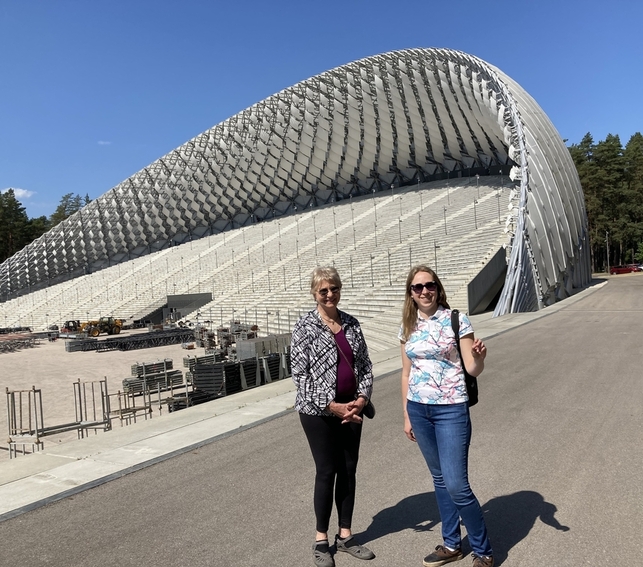
Caption: Two early ticket holders scoping out the venue. Behind them is the new staging for the thousands of choristers.
Why the change of title? Well, because I’ve come to realize that the choristers, when they chant “Repeat, Repeat”, are signaling their pride and accomplishment.
While requesting to be led, they are in no way subordinate to the conductor. The conductor is no more important than they, the singers.
That realization takes me back to the “Tao–the Book of the Way”a poetical, pithy and paradoxical volume: “If you want to lead people, You must learn how to follow them.”
And, most relevantly, there’s the Taoist’s enigmatic claim that the best leader, at the end of a job, is one about whom the workers say, WE DID IT OURSELVES!
That pride, that joy in wanting to repeat is what I’ve long tried (with some success) to install in the workplace.
No, not by imposing my directorial view on workers, but by “letting go”, that vastly misunderstood notion of trusting and giving freedom to workers, of releasing them to do the job they want to do. Of course this cannot apply to every workforce, only to those capable of being let go, of being unleashed.
How is this national cultural event different from traditional organizations?
Not very much.
The S&D is a top down hierarchical pyramid with boards, conductors, judges, thousands of unpaid performers in hundreds of groups, with much central planning and decision making.
The “anarchy” occurs during the performance, when the songs are sung and the dances danced. That towering structure fades into the background as the swelling music and applause resound in the forest and stadium.
It's when "work (is) transformed into spontaneous and meaningful play…”
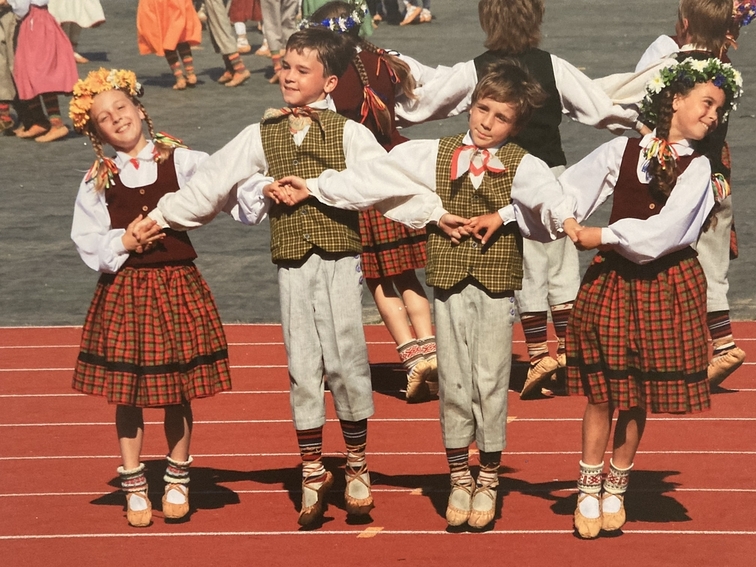
Caption: Photo of photo in the new Song and Dance museum in Mežaparks.
Finally, to quote from one of my former Latvian students who wrote an assigned essay about leadership in choir groups:
“There is no boss, because there is no need for that, motivation is enough high what means that the people do not need to push all the time, of course they need some support, but they know the purpose…”
So, there you have it. And here is that essay from 2013:
"Atkārtot!": Speaking up at Work.
I’ve been immersed in Latvia’s quinquennial Song and Dance Festival.
This weeklong celebration – nationally televised from start to finish - of Latvian song, dance, music, theater, art and crafts involves approximately 40,000 performers. Every community in Latvia sends its best to take part in DZIESMU SVĒTKI in the capital city, Riga. And, Latvians from all over the world converge on the city and fill its streets, literally, with dance and song. The grand finale features a community-sing with audience and choirs holding forth until 6.30AM the next day.
At the final song concert, held outdoors with 14,000 singers, led by ten or more male and female conductors, I observed an unusual practice.
After a particular song, one that went especially well, the choir would chant "Atkārtot!" to the conductor. You can hear it here, and, even better, here, asking to repeat the highly patriotic song “Saule, Pērkons, Daugava” (Sun, Thunder, and the mighty river Daugava.) Sadly, the song's composer and keyboardist passed away in 2021.
My cousin Ivars tells me that this chant is more about self-expression, “We want to repeat” than it is a command to the conductor. In my experience in the classical music world, I have never seen an orchestra say much of anything (with the notable exception of the Orpheus Chamber Orchestra, of course).
If there are to be encores, the conductor decides. If a particular aria goes well, the audience – in Italy, for example – may ask for it to be sung again. So, to have the performers feel this strongly and then express their desire is something I, frankly, like very much.
Why do I like it? Because of what "Atkārtot!" says about the relationship between the nominal leader – the conductor – and those being led – the followers.
Getting people to speak up is one of management’s biggest challenges; not speaking up in the workplace is more the norm. Here’s an insightful note from Ivars: “As this fest's grand finale is like a party after the 5-year work for the choirs, I guess they are feeling not that much as the performers but more like a part of the audience.” (Emphasis added.)
And I like what "Atkārtot!" says about the followers. This kind of follower has her own mind – she knows a good thing when she hears it. These followers have internal standards to which they aspire. Internal is the key word here.
Knowing you’ve done a good job is as much a personal realization as it is something for which you receive external recognition. These followers are analytic and they love – as does the conductor – what they are doing.
When something goes really well, they want more of it.
"Atkārtot!" is remarkable because it confirms the trust between leader and follower. The conductors (half were women – this is Latvia, remember!) are publicly honored by the choirs.
After the conductor leads the singing of a song, several of the choir members run up to the conductor’s platform and present him or her with flowers, smiles and hugs. You can see that at the end of the clip.
What does this have to with work?
Everything.
If we enjoy what we do and we do something really well, would it not be nice to do it again, that the accomplishment be recognized by one and all? If we have been well led, then let the boss know.
Maybe we do not do the flowers and the hugs but we surely can smile and offer thanks. This is part of a realization that all – each and every one of us - have done a good job and that it is worth taking the time to celebrate the achievement.
*The XXVII Nationwide Latvian Song and XVII Dance Festival, which marks the 150th year of the Song Festival tradition, will take place in Riga from the 30th June to the 9th July, 2023. https://www.dziesmusvetki.lv/en/about-the-celebration/the-song-and-dance-celebration/
And if you are interested in numbers here they are as June 30 2023:
According to official figures, a total of 40,560 participants will participate in the 2023 XXVII General Latvian Song and XVII Dance Festival. Please note that is the number of participants, not the number of attendees or spectators.
Among that number are 454 choirs (15,870 members) and 695 dance groups (16,879 members).
66 wind/brass bands (2,097 members) will participate in the song festival, while another 508 collectives from other cultural areas add another 5,714 members.
Latvia's overseas diaspora is represented by 88 collectives (2,587 members) and represent 22 different countries: the USA, Australia, Austria, Belgium, Brazil, Denmark, France, Croatia, Estonia, Italy, Ireland, Japan, Canada, Great Britain, Luxembourg, the Netherlands, Norway, Finland, Switzerland, Ukraine, Germany and Sweden.
_______________
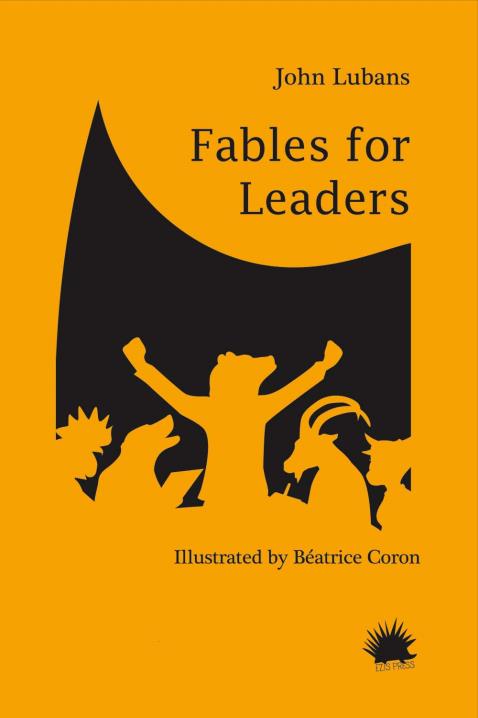
My book, Fables for Leaders, full of Aesopic wisdom for the workplace and song and dance festivals, is available. Click on the image and order up!
And, for the chorale seeking to better understand the notion of “letting go”, there’s
Buy here.

© John Lubans, all commentary and photos, 2013-2023
That’s Latvian for “Repeat.”
The original blog appears below with some tinkering and edits.
And, no coincidence, I am now in Riga, Latvia for the Song and Dance Festival just around the corner* from June 30-July 8 2023.
Here’s the venue, the newly renovated and re-designed the MEŽAPARKS GREAT STAGE:
Caption: Two early ticket holders scoping out the venue. Behind them is the new staging for the thousands of choristers.
Why the change of title? Well, because I’ve come to realize that the choristers, when they chant “Repeat, Repeat”, are signaling their pride and accomplishment.
While requesting to be led, they are in no way subordinate to the conductor. The conductor is no more important than they, the singers.
That realization takes me back to the “Tao–the Book of the Way”a poetical, pithy and paradoxical volume: “If you want to lead people, You must learn how to follow them.”
And, most relevantly, there’s the Taoist’s enigmatic claim that the best leader, at the end of a job, is one about whom the workers say, WE DID IT OURSELVES!
That pride, that joy in wanting to repeat is what I’ve long tried (with some success) to install in the workplace.
No, not by imposing my directorial view on workers, but by “letting go”, that vastly misunderstood notion of trusting and giving freedom to workers, of releasing them to do the job they want to do. Of course this cannot apply to every workforce, only to those capable of being let go, of being unleashed.
How is this national cultural event different from traditional organizations?
Not very much.
The S&D is a top down hierarchical pyramid with boards, conductors, judges, thousands of unpaid performers in hundreds of groups, with much central planning and decision making.
The “anarchy” occurs during the performance, when the songs are sung and the dances danced. That towering structure fades into the background as the swelling music and applause resound in the forest and stadium.
It's when "work (is) transformed into spontaneous and meaningful play…”
Caption: Photo of photo in the new Song and Dance museum in Mežaparks.
Finally, to quote from one of my former Latvian students who wrote an assigned essay about leadership in choir groups:
“There is no boss, because there is no need for that, motivation is enough high what means that the people do not need to push all the time, of course they need some support, but they know the purpose…”
So, there you have it. And here is that essay from 2013:
"Atkārtot!": Speaking up at Work.
I’ve been immersed in Latvia’s quinquennial Song and Dance Festival.
This weeklong celebration – nationally televised from start to finish - of Latvian song, dance, music, theater, art and crafts involves approximately 40,000 performers. Every community in Latvia sends its best to take part in DZIESMU SVĒTKI in the capital city, Riga. And, Latvians from all over the world converge on the city and fill its streets, literally, with dance and song. The grand finale features a community-sing with audience and choirs holding forth until 6.30AM the next day.
At the final song concert, held outdoors with 14,000 singers, led by ten or more male and female conductors, I observed an unusual practice.
After a particular song, one that went especially well, the choir would chant "Atkārtot!" to the conductor. You can hear it here, and, even better, here, asking to repeat the highly patriotic song “Saule, Pērkons, Daugava” (Sun, Thunder, and the mighty river Daugava.) Sadly, the song's composer and keyboardist passed away in 2021.
My cousin Ivars tells me that this chant is more about self-expression, “We want to repeat” than it is a command to the conductor. In my experience in the classical music world, I have never seen an orchestra say much of anything (with the notable exception of the Orpheus Chamber Orchestra, of course).
If there are to be encores, the conductor decides. If a particular aria goes well, the audience – in Italy, for example – may ask for it to be sung again. So, to have the performers feel this strongly and then express their desire is something I, frankly, like very much.
Why do I like it? Because of what "Atkārtot!" says about the relationship between the nominal leader – the conductor – and those being led – the followers.
Getting people to speak up is one of management’s biggest challenges; not speaking up in the workplace is more the norm. Here’s an insightful note from Ivars: “As this fest's grand finale is like a party after the 5-year work for the choirs, I guess they are feeling not that much as the performers but more like a part of the audience.” (Emphasis added.)
And I like what "Atkārtot!" says about the followers. This kind of follower has her own mind – she knows a good thing when she hears it. These followers have internal standards to which they aspire. Internal is the key word here.
Knowing you’ve done a good job is as much a personal realization as it is something for which you receive external recognition. These followers are analytic and they love – as does the conductor – what they are doing.
When something goes really well, they want more of it.
"Atkārtot!" is remarkable because it confirms the trust between leader and follower. The conductors (half were women – this is Latvia, remember!) are publicly honored by the choirs.
After the conductor leads the singing of a song, several of the choir members run up to the conductor’s platform and present him or her with flowers, smiles and hugs. You can see that at the end of the clip.
What does this have to with work?
Everything.
If we enjoy what we do and we do something really well, would it not be nice to do it again, that the accomplishment be recognized by one and all? If we have been well led, then let the boss know.
Maybe we do not do the flowers and the hugs but we surely can smile and offer thanks. This is part of a realization that all – each and every one of us - have done a good job and that it is worth taking the time to celebrate the achievement.
*The XXVII Nationwide Latvian Song and XVII Dance Festival, which marks the 150th year of the Song Festival tradition, will take place in Riga from the 30th June to the 9th July, 2023. https://www.dziesmusvetki.lv/en/about-the-celebration/the-song-and-dance-celebration/
And if you are interested in numbers here they are as June 30 2023:
According to official figures, a total of 40,560 participants will participate in the 2023 XXVII General Latvian Song and XVII Dance Festival. Please note that is the number of participants, not the number of attendees or spectators.
Among that number are 454 choirs (15,870 members) and 695 dance groups (16,879 members).
66 wind/brass bands (2,097 members) will participate in the song festival, while another 508 collectives from other cultural areas add another 5,714 members.
Latvia's overseas diaspora is represented by 88 collectives (2,587 members) and represent 22 different countries: the USA, Australia, Austria, Belgium, Brazil, Denmark, France, Croatia, Estonia, Italy, Ireland, Japan, Canada, Great Britain, Luxembourg, the Netherlands, Norway, Finland, Switzerland, Ukraine, Germany and Sweden.
_______________
My book, Fables for Leaders, full of Aesopic wisdom for the workplace and song and dance festivals, is available. Click on the image and order up!
And, for the chorale seeking to better understand the notion of “letting go”, there’s
Buy here.
© John Lubans, all commentary and photos, 2013-2023

 John Lubans - portrait by WSJ