King Bidgood's in the Bath Tub (AGAIN) and Won't Get Out

Posted by jlubans on August 02, 2011  •  Leave comment (0)

20110803-king-bidgoods.jpgA New York friend and I were having lunch in late July somewhere on the East Side. The debt crisis came up – it was still unresolved at the time. She thought my book on Leading from the Middle was highly relevant to what was happening, even encouraging me to write an op-ed for a newspaper.
We both agreed that leadership was largely absent among the politicians. It was a time for assertive leadership by effective followers, from those in the middle. I can surmise many reasons for the failed leadership not the least of which would be the stretched allegiances among competing factions. Oh, to do away with lobby money, with political action group money, etc.
Well, thinking about that op-ed, summoned up in my mind a children’s book – one already mentioned in this blog:
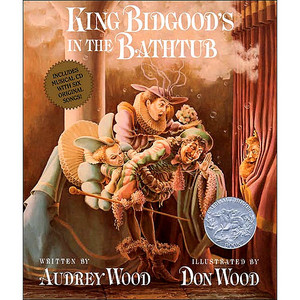
King Bidgood’s in the Bathtub by Audrey Wood with pictures by Don Wood.
It’s a delightful, sumptuously illustrated book . The king is in the tub and he won’t get out. Think of the king as our government. Lodged and immovable.
Oh, who knows what to do? is the question buzzing among the royals and courtiers. “I do” says the Knight. “Come in” says the King. “Today we battle in the tub.” No luck!
“Oh, who knows what to do?” The Queen knows. Time for lunch says she. Come in says the king “with a yum, yum, yum.” Today we lunch in the tub! In a scene reminiscent of Tom Jones’ erotic picnic albeit with an unwilling lady, the Queen leaves in a wet huff!
A Duke is next. Time to fish, let’s go, your Majesty! We fish in the tub, says the king. Next, the courtiers take a turn: It’s time for a masque’d ball. Dance in the tub! The nude King gets down.
What can be done? wails the court. I know, says the page and pulls the drain plug. Glub, glub – and the bare bottomed King skips off.
----------------------------
Where’s a page when we need him or her the most – to pull the plug on the bloated debt crisis. If King Bidgood’s was cannily looking for someone to solve his “problem”, he finds him, the least powerful of those present. The page is an effective follower. We ask, who empowered the page? The page did. You see, after all have failed, rank matters less. When things are desperate enough, we will ask others for help and we will accept unusual, and often, very simple actions. Effective followers all have courage, the courage to stand forth and take action. Effective followers often have the most to lose for taking action. The page was incredibly brave; he could have lost his head.
I hope King Bidgood is having frequent, private chats with that page.
_____________________
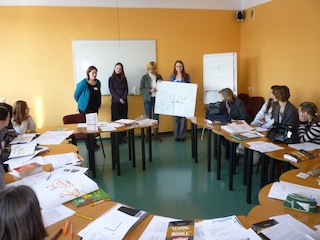
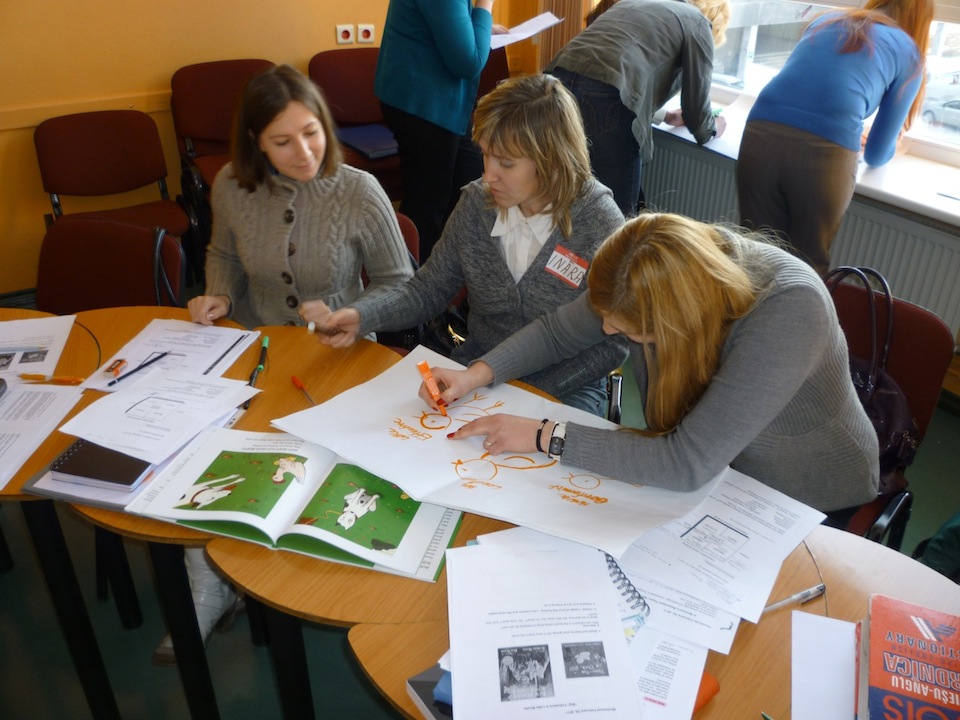
Addendum: I wanted to show you what my Latvian students thought of the King Bidgood book. On the third day of class, I asked* the class to draw posters to represent their “takeaway”; that most important thing they got out of reading selected children’s books in class. 20110817-readingkingbid.jpeg Here is the small group reading King Bidgood. And, this is their poster for reporting out to the class. 20110817-posterkingbid.jpeg They linked the page and his actions to the concept of the effective follower, deeming the heroic page the “Unofficial Boss”! And they saw the courtiers as pretty much YES people, not the most effective followers. What pleasantly surprised me was the students’ opinion that King Bidgood had ulterior motives in his staying in the tub: he was looking for a capable problem-solving follower. He's “The Tricky Boss.”

*My Instructions for using children’s books in management class about the concept of followership:

1. Read out loud to your group (as in story time!) one book.

2. Discuss:
Who are followers in this book? What kinds of following do you see?

What is the learning, the take away, the “So what?” the “Now what?” from this book?

3. Create: a page of your key finding – use crayons and flip chart paper.

4. Present your group drawing to all.


Followers With the Most to Lose

Posted by jlubans on January 24, 2012  •  Leave comment (4)

20120124-piedpiper.jpeg
I collect stories about followers – good and bad – in the business world and on campus. For example, I’m intrigued by the Olympus Corp’s $1.7 billon fraud. My interest is piqued less by the magnitude of the deception and more by the corporation’s firing of the person (the CEO, Michael Woodford – a recent hire) who uncovered the fraud.

And then, there’s the curious case of the celebrated social psychologist Diederik Stapel. He’s the researcher who concluded with certainty that prejudicial thinking (of a certain kind) was not prejudicial. It was on target and he had the evidence! For example, you (a vegan) might believe that eating meat makes the carnivore aggressive. Herr Professor Stapel “proved” it! (And, in the process, confirmed just how insightful you are.) Well, if the proof is in the pudding, Stapel’s dozens of published puddings have been putrid for over a decade. He admits he regularly made up the numbers to fit his desired outcome.

My question is about why Stapel’s peers (his faculty colleagues and other researchers) did not catch the phoni-ness? Instead,

“The (investigating) committee concludes that the six young whistle-blowers (researchers) showed more courage, vigilance, and inquisitiveness than incumbent full professors. ”

Do you find that an astonishing statement? The people who have the most to lose were the ones who caught the scam, who fingered the forger. The “incumbent full professors” who have the least to lose either were clueless or did not want to hinder the agenda, the shared world view. I suspect they also did not want to go up against Stapel and his admirers. The investigating report says “colleagues or students who asked to see raw data were given excuses or even threatened and insulted.” Similarly, Bernard Madoff, we are told, would go on the offensive when confronted with his criminal behavior. If not for the economic downturn, he’d probably still be stepping high, wide and handsome.

So, just like in the King Bidgood story,
the question becomes, how did junior lab members have the courage to question Stapel? (The same question can be asked of the junior researchers who spotted and reported the exalted Marc Hauser’s dubious research.)

When like-minded peers agree with your agenda – they really, really want what you say to be true - they may turn off their stink detectors. Here’s a telling quote from the investigative report: “Among Stapel's colleagues, the description of data as too good to be true "was a heartfelt compliment to his skill and creativity!" (Emphasis added.)

My geese picture suggests that when we surrender our critical thinking to someone’s agenda we become docile; we go along to get along. Sheep-like, we are ineffective followers. Some of us may even go so far as to enable the fraud. And, once we are complicit, we might even punish the people who uncover the fake facts. Academe has several stories about the impaired careers of graduate students who found and reported plagiarism by tenured professors.

Good followers are important to an organization because they do not suspend their disbelief just because they like the messenger or the message. They don’t go along to get along – the people that exposed Stapel did not go along to get along. Effective followers think critically for themselves. An effective follower ascribes to some higher purpose or personal philosophy outside and beyond the immediate work place.

When I talk about types of followers in my Leading from the Middle workshops, I underline why effective followers are different: They tell the truth. (You can see how that might get you in trouble. Effective followers lead proactively, and do not behave like someone in need of direction.)

Leaders empower effective followers. Warren G. Bennis, writing about leadership: “Nothing serves an organization better than leadership that knows what it wants, communicates those intentions accurately, empowers others and knows how to stay on course and when to change.” It comes out in times of “agonizing doubts and paralyzing ambiguities.” It is in times like that when the organization’s effective followers – if the leader has empowered and protected them – avoid suborning values and keep the organization on course.

"Kids" books and teaching leadership

Posted by jlubans on February 28, 2011  •  Leave comment (0)

Hardly "kids" books! I used these two children's literature titles in teaching my Latvian library management students about strong followers, sheep, yes men, survivors, & nodders, too.

20110228-king-bidgoods.jpg King Bidgood’s in the Bathtub. (Audrey Wood, illustrated by Don Wood).
This richly illustrated book demonstrates not only how the least among us can be the most effective follower, it also demonstrates that the simplest –yet bravest - solution is often the best. It’s Occam’s razor made explicit: “When you hear hoof beats, think horses not zebras.” Who empowered the page, the follower who pulled the plug in the king’s bathtub?

After all have failed, rank matters less. When things are desperate enough - the king won't get out of the tub - we will ask others – the quiet, unnoticed staffer - for help or they will speak up on their own. Of course, the plug pulling page has the most to lose. The rich kow-towing nobility have name, fame, fortune, The page could be dismissed or worse. Why did the page speak up? Where did his courage come from? What if the King really liked being in the tub. Is the page brave or foolhardy? He could have lost his head - just like we could lose our jobs if we take on a toxic boss in public! Here the class listens to a team presentation on the king and the heroic page:
20110303-presentation king.jpeg

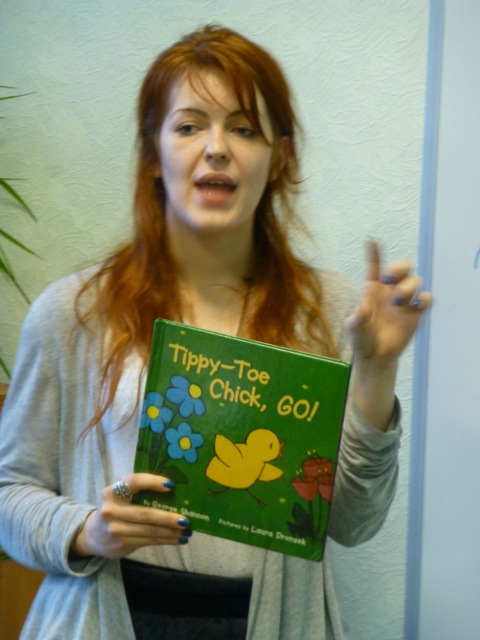
20110228-tippy toe.jpgTippy-Toe Chick, GO! By George Shannon, illustrated by Laura Dronzek
The story: Hen takes chickens daily to garden to snack on bugs. Little chick is a wanderer and adventurer, not willing to settle for the daily routine. One day a chained-up dog keeps them from the garden. We’re hungry, whine –if chickens can whine - the chickens. Hen says, We’re out of luck, we’ll never get past the dog. Big Chicken says I’ll take care of it. Dog barks. Big Chick runs back to Mom. Middle Chick scolds the dog. The dog barks and Middle Chick takes shelter behind Momma Chick. Little Chick runs at dog, stopping short when she feels his breath. Little Chick runs sideways and the poor dog runs around tree and ties himself up. Time to eat, says little chick. The effective follower concept was clearly demonstrated by this student team:
20110303-follower work book1.JPG

Here's another team's more literal match up of this book to Kelley's follower chart:
20110303-literal follower.jpeg

Competitors or collaborators?

Posted by jlubans on August 25, 2011  •  Leave comment (0)

Thirty-two years ago pictures of the Yarborough-Allison fight from the 1979 Daytona went national – the pictures, some say, made NASCAR what it is today.
20110826-brawl1.jpeg
However much we might like to observe competition – even the road rage exhibited by Messrs. Allison and Yarborough - competition is not always the best way for groups to solve problems. We win or we lose. Losers wait to get even, winners are only as good as their last win. And, we have temper tantrums.

Collaboration – the type espoused in my book - is usually a better way to problem solve – you win, I win. Often, when we genuinely collaborate, we come up with a better answer than either of us might have had to start with. Note that I said genuinely. Collaboration for many is the same as cooperation or consensus. It is not. When we cooperate, we give a little and get a little. We do not try to reach a best solution, we settle for less – we may even accommodate others to get past the problem. Consensus building is even more delusional – everyone agrees to a solution, whether it is best or not. Without rigorous debate among all participants – a feature of genuine collaboration – some agreed upon solutions might not be the best.

I had high hopes that a 2009 film recommended to me by one of my Latvian students might illustrate a group collaborating its way out of a problem. The student saw in this movie the elements I had been stressing in class – collaboration and group dynamics – the forming, storming, norming and performing elements of successful teamwork. That movie, Exam is well done, no question. It’s got suspense, crisp dialogue, a plot and some moments - early in the film - of people reaching out to help each other, but that’s only the beginning. We soon realize this film is about 8 people who are in competition with each other - each of them wants to be the survivor – the one that answers the one question set by the Invigilator – (British for exam proctor) to the group locked in a windowless classroom with a deadline ticking down. Unless I am mistaken, there is no answer to the question, What’s the question? Cerebral, yes.

Exam is Darwinist, no holds barred, raw emotion, much of it less than admirable, with some bits of despicable human behavior. However, it does offer a surprise heroine, the observer, coolly detached, who – well I won’t spoil it. In a way, Exam, would help illuminate what collaboration is – the opposite of much of what you see in this film!

Exam echoes Donald Trump’s, The Apprentice. Both offer moments of happy collaboration among aspiring executives, but in the end there’s only one winner. Only the one “best” leader, according to the Donald and the Invigilator, survives. It’s King Bidgood with the Executioner in the wings stropping his axe!

Each of Exam’s 8 - apparently the survivors among hundreds of applicants for a huge job at a mysterious enterprise - can and will be fired. An armed guard oversees the group, as does the Invigilator, off screen. If you mess up, you are escorted out, always ignominiously and sometimes forcefully tossed out the door. Soon the group is down to 4 and it only gets nastier.

It seems, in this exam room, your trusting someone, your behaving decently, may get you expelled. So, the message seems to be “Trust No One” or “Trust Everyone” but verify.

How would I end Exam? Probably with a group effort. Like crossing the finish line holding hands. But is that the way to get the best? If you want only one survivor, only the “best”, probably not, but if you are willing to settle for a different solution, then why not?

Experiential learning – pretty much my pedagogy – offers group activities from which participants can derive principles of collaboration. I have led and been part of groups with given problems to solve, from erecting tents in the dark to emptying out a gallon of nitroglycerine (pretend) to save a city from ruin, all within a deadline with the clock ticking. These are “games” but they have the potential to illustrate just how much or how little people will do to achieve a positive outcome. Some people do more than expected, others do less, and others do what they can to stymie the outcome if it is not going to make them look good.

So, maybe there is something to be said for using Exam since it tears off the mask, tells it all, shows the worst and the best, and finally, the champion who in the movie will get to make God-like decisions.

Big Followers in Little Books

Posted by jlubans on March 04, 2014  •  Leave comment (0)

One of the most engaging activities in my teaching involves children’s books.* I put the students into small groups (4 or 5) and give each group a blank piece of paper and a box of crayons. Then I have each team choose a children’s book from the several I’ve brought to class, and I tell them to go to it!
Why this assignment? Two reasons.
One is for the students to feel more comfortable with each other. Last week, I deliberately selected the just-appointed project teams to do the children’s book assignment. The project teams need to become effective groups as quickly as they can, so this is a low-risk way to begin the process of team-formation. I wanted them to see early on who on their project team has ideas (or not), who draws well, who synthesizes the assignment well, who takes initiative (or does not), and who keeps the group on task or not? Most of these questions got answered in this 20-minute activity.
And my second reason, equally important as the first, is to get the students thinking about the class topic – following and leading. All four of the children’s books included a few if not all of these stereotypical followers: The Yes Man, the Sheep, the Star, the Pragmatist and the Alienated follower. And, each book almost always has a least likely hero stepping up and succeeding. It’s a group dynamics’ concept well worth re-stating; the solution to a problem may come from the quietest member of the team or that the most creative person on the team may be the one perceived as the most different. These are workplace lessons worth repeating and where better and safer than class to make it manifest?
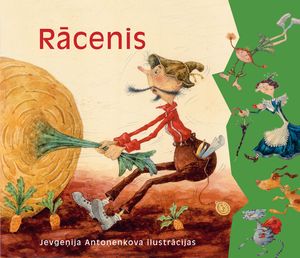
20140304-Racenis88.jpg
Caption: Rācenis (Turnip) Illustrated by Jevgeņija Antoņenkova.
20140304-3drawing*8.jpeg
Caption: Three hands drawing.
And, so it is that the mouse in the giant Turnip story adds his miniscule weight to the struggle, just enough to wrench the turnip free!
And, it is the humble page in “King Bidgood's in the Bathtub” that pulls the plug (an Occam’s Razor solution, no less) and gets the King out of the tub.
20140304-Menesim robs8.jpg
Caption: Mēnesim robs : Liels un mazs. By Ojārs Vācietis.
20140304-robsteam*8.jpeg
Caption: Reporting out to the class.
And, it is the little boy who among all those with good excuses to do nothing challenges the Putin-esque monster to give back the moon.
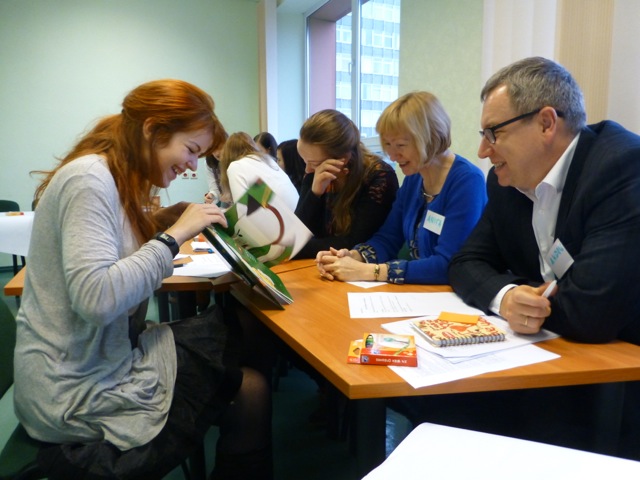
20140304-laugh*8.jpeg
Caption: Sharing a laugh.
And, finally it is the little chick in “Tippy-Toe Chick, Go!” that displays the most bravery when all others cower at the barking dog. The little guy is brave and resourceful enough to confront the dog and get everyone to the potato bugs!
20140304-Sanita explain*8.jpeg
Caption: Reporting out.
So, how effective is this teaching technique? Is this over-simplifying a complex topic?
Not really if the students have done the several background readings prior to the assignment. The group work encourages creativity in their presentation and to draw the connections among the books, the drawings, the readings and the lectures. Could I not just let them read Kelley’s classic “In Praise of Followers” and leave it at that? Could I not just add my two-cents-worth in a lecture and let that suffice? Perhaps.
For me, the assignment helps the students better understand the concepts and, to form initial relationships within the team. This is clearly influenced by each team’s having to present their interpretation – their group work - of the story to the class; in most cases with everyone participating.

* The idea comes from Frances R. Yates, Director of the Indiana University East Library; it’s one she presented at the ALA conference in DC June 2010.

Leading from the Middle Library:


Copyright John Lubans 2014