I was going to entitle this blog. “Missionaries of Imperatives!”, but then, most readers will agree, it was a good choice not to. A bit too many syllables and unhappy memories of diagramming sentences.
OK, to what do I refer? Those injunctions/mandates to: Smile! Enjoy! Have a Nice Day! Co-Exist! Be Happy!
And, finally, Pay It Forward!
How did PIF become my topic?
Well, it goes back several years to being in my birth-city, Cesis, Latvia. I was in a general story at the checkout. A little girl was in front of me and was having trouble coming up with the cash. I told the cashier I’d pay for her. The cashier frowned but went along.
The little girl’s half smile suggested to me she had not experienced much kindness from anyone. According to PIF proponents (those “Missionaries of Imperatives!” do co-exist!) I should have told the girl to pay my kindness forward.
I did not for obvious reasons. I left it as a gesture of the Golden Rule and with no expectation of repayment. If I were that child struggling to pay – for whatever reason – I hope someone would help me out.
My gesture was out of kindness and that was it. I was not trying to motivate anyone to do something nice in the future. They might, but it is not quintessential to me.
Which brings me to the quoted imperatives.
All have an exclamation point! Isn’t that a bit of coercion going on? If so, it is easily ignored but still it is there. What’s the motivation behind the command, the directive?
One of the AI robots told me PIF started in 1784 with Benjamin Franklin. Loaning a friend some money, he is alleged to have written, “When you […] meet with another honest Man in similar Distress, you must pay me (Franklin) by lending this Sum to him; enjoining him to discharge the Debt by a like operation….
Not exactly free of conditions and, please note that the “debtor” is known to the lender.
Since then PIF has come to mean offering to pay for the person, a stranger, behind you for their coffee in hopes that your kindness will spark a chain reaction of goodness across the globe.
The penultimate mandate was expressed by Lily Hardy Hammond (1916): “You don’t pay love back; you pay it forward.” Heavy, man, if only I knew what that means.
I prefer the Golden Rule, like holding the door for someone, or helping a mother with a stroller down the subway steps.
Yes, you hope kindness is catching, but that’s not the reason to do it.
Now let me tell you of a failure. A missed opportunity which bothers me still.
One winter, a decade ago, I was teaching in Riga and my wife and I, after work, often stopped in the Muffins & More bakery on our walk home. It’s a tiny space – appropriate for cupcakes. An older man and an adolescent girl came in and looked enviously at the frosted cakes. I suspected they might not have the cash to buy anything. After looking over the delectables, they left.
On reflection, I should have declared to the cashier that it was my birthday and their cakes would be on me. The birthday claim would have forestalled embarrassment – it’s my birthday so I’m stepping high, wide and handsome. The cakes are on me. Alas, I did not do that. Next time, I will. No, I will not ask them to pay it forward!
It really does come down to the implicit mandate in PIF, telling another person how they are to behave. Is this not stealing choice?
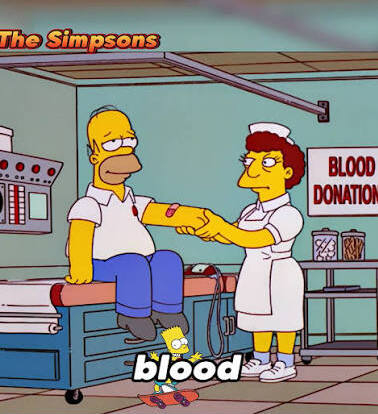
Giving blood is a far better example of PIF than buying someone’s cheeseburger or coffee. By donating blood, I’m not just being nice; I’m sustaining a lifesaving system that others (and possibly me) will use.
Appendix: Paying It Backwards:
Hal, the Petulant.
I worked with Hal. In his thirties, he held a responsible professional position and was regarded, in spite of a pugnacious aspect, as a competent member of the staff.
One winter day Hal told me what happened to him after a late-night sporting event in a distant city.
Following the game, Hal went to his parked car to find his battery stolen.
Now, what would you do in this case?
Probably what most of us would do.
But not Hal. He noticed the car parked behind him was of the same make, and he proceeded to filch the battery!
I assume he drove contentedly home.
Maybe, since he told me what he had done, he was having second thoughts.
But, when I expressed astonishment (You did what?), he denied he had done anything wrong.
He assumed – most cynically – that everyone else would do the same. He was paying it backward!
About Good Deeds.
Ye olde cliché, “no good deed goes unpunished” is verified daily by the Oregon chapter of the Red Cross.
The good vibe – the afterglow – after donating blood – soon dissipates. Not long after my philanthropy, I began receiving urgent appeals to give more. Now, daily, I receive a text, a voice mail, and an email with an urgent request – even tempting me with cash rewards – for more blood. “Supplies are running out!” “Blood demand is outpacing supply!” “People are dying!”, No, only politicians – you know who – say that.
Saying no mas, changes nothing. The spam keeps spamming.
I give blood once a year, rain or shine. The next time, I will have an ultimatum for the receptionist. No blood unless the RC agrees to no contact.
A Latvian take on paying it forward: My cousin shared a quote from Rainis, Latvia’s poet laureate, in his play Zelta Zirgs (Golden Horse): “Gūt var ņemot – gūt var dodot! Dodot gūtais neatņemams!” Translated: “Gain comes from taking — gain comes from giving! What is gained by giving can never be taken away!” So, biblically, it is better to give than to receive.
A final footnote which may turn into a blog in its own right: Apparently, AI content (mostly or totally written by a robot, some call it “slop”) now makes up over 40% of new content on the Internet. That percentage is growing. Leading from the Middle (the blog you are reading) has never been written by AI robots. I use AI for background, as I would an encyclopedia, but never ask it to write for me. I have my own style and take on things; and I enjoy keeping it that way.
***************
My book, Fables for Leaders, about how ancient stories apply to today’s workplace, can be purchased here. The link will take you to BookBaby, the well established and reputable company that prints and fills orders for Fables for Leaders.
My other book, Leading from the Middle, with essays on team building, followers, leaders, innovation and several case studies of exceptional leaders and organizations, can be purchased here at Amazon.
N.B. For other essays on numerous topics on leadership and literature and fables go to my Nucleus archive from 2010-early 2025.
© Copyright all text by John Lubans 2026