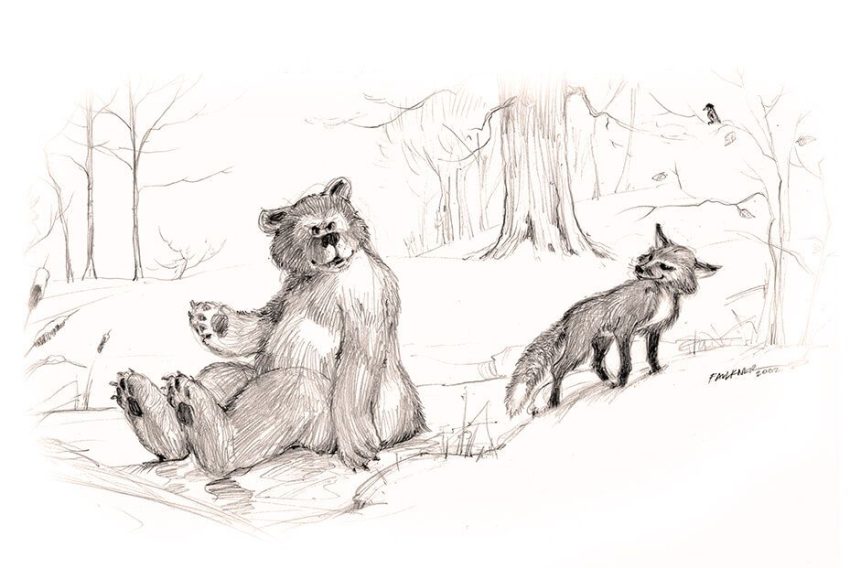
AT first all the Bears had long tails.
One winter day the Bear met the Fox, who had a fine lot of Crawfish. Being hungry the Bear wanted some too: so he asked the Fox where and how he got his Crawfish.
The Fox replied:
‘Go and stick your tail down in the water and let it stay there until it pinches you. The more it hurts, the more fish you will have.’
This was what the Bear had in mind to do: so he proceeded down to the lake and made a hole through the ice.
Sitting over it, he let his tail hang in the cold water.
When it began to freeze, he felt a pain; but as he wanted to catch lots of fish, he did not stir until his tail was frozen fast in the ice.
The Fox’s instructions were not forgotten: so he suddenly jumped up in the expectation of getting heaps of fish; but he merely broke his tail off near the body instead.
And ever since the Bears have had short tails.
______________
One might think this Native American story has nothing to do with cubicle-land. How could the duped bear’s frozen tail offer any lessons for the workplace?
Well, who’s that slyly smiling in the background? Mr. Fox, Reynard, Br’er Fox.
My first “professional” job in the late 1960s – with the title of “Junior Science Librarian”! – was at America’s first engineering school, the prestigious Rensselaer Polytechnic Institute in Troy, NY. (How an English major was hired by an engineering school is another story.)
RPIs president (a “bench”/ slide rule engineer with little use for books and journals) was convinced automation was a way, once and for all, to control those pesky library costs, indeed to reduce the payroll.
The library was not the only group he belabored. Each annual presidential report to the faculty started with: “I see that once again, we have no Noble Prize.”
Yes, he was that kind of guy and he imposed on the library a former systems analyst (Mr. Fox) from an abrasives company who proceeded to tell us about scientific management and how easy it would be to move from print to full electronic text.
It sounded really good and like the bear in the fable we were convinced we’d have more than our share of “crayfish” if we automated.
Cluelessly, we began a huge project of automating the scientific journals. We worked overtime flowcharting, coding forms, punching cards, running tallies, and producing reams of printouts. Please remember that the time was pre just about everything except mainframe computers; pre-email, pre-AOL, pre-Mosaic, pre-data processors, etc!
Ye olde manually typed list would have accomplished just as much in one percent of the time!
That the IBM corporation – the Apple of its day – was just around the corner was not a plus; it was in their interests back then to promise and promote automation of everything.
They had supplied RPI with a huge computer that sat nearby on an elevated floor in the air-conditioned mathematics building.
Soon, we realized just how big a job it was. (It would be a decade or two before genuine automation would begin to produce limited benefits anywhere.)
Ellsworth Mason, a future boss and colleague, was one of a few to call out the exaggerated promises and the many failures to deliver in his classic article in 1971, The Great Gas Bubble Prick’t; or, Computers Revealed by a Gentleman of Quality.”
Our foxy consultant was hired away by the New York Public Library to head up their automation effort – with the same result!
We were left with rolls of flexowriter paper tape, stacks of punch cards and piles of alphabetical printouts. Other than the experience, we had little to show for the thousands of hours of effort.
We kept our tails, but at least two of us had our tails kicked out the door;
one deservedly, one very unfairly.
I went west, literally, to the University of Colorado in Boulder, to a new administrative job somewhat wiser and less likely to stick my tail into icy water. I began to ask questions. While at RPI, I somehow found the time to co-author a book, edit two others and write and present a few scholarly papers. Which probably helped me get the Colorado job.
A decade later, illustrative of how bizarre organizational life can be, RPI in 1976 named its new library building after the former president!
***************
My book, Fables for Leaders, all about how ancient stories apply to today’s workplace, can be purchased here. The link will take you to BookBaby, the company that prints and fills orders for Fables for Leaders.
My other book, Leading from the Middle, with essays on team building, followers, leaders, innovation and several case studies of exceptional leaders and organizations, can be purchased here at Amazon.
N.B. For other essays on numerous topics on leadership and literature and fables go to my Nucleus archive from 2010-early 2025.
*Source: Myths of the Cherokee, by James Mooney in “An argosy of fables; a representative selection from the fable literature of every age and land”, New York: Frederick A. Stokes Company. 1921. This fable first appeared in the blog in 2017. Here it is again with a revised and expanded commentary.
© Copyright commentary text by John Lubans 2017 & 2026