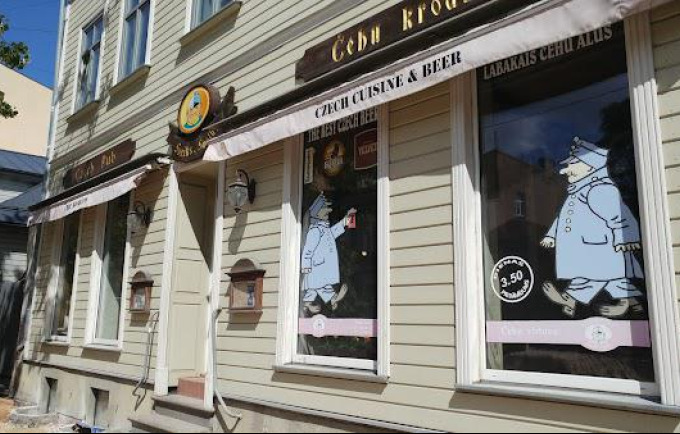
A week ago, a friend invited my wife and me to a Czech pub, Sveiks, Švejk! Ads proclaim the restaurant is inspired by the ‘Good Soldier Šveik’, the not so “simple”, good-humored, hero of the epic novel, The Adventures Of Švejk.
That restaurant inspired me to revisit and then revise extensively my 2015 blog about the “Good Soldier”.
I’ve been re-reading (as is my custom) The Adventures Of Švejk, the comic (and literary) masterpiece by Jaroslav Hašek, anarchist and highly influential Czech writer.
The story tells of Josef Švejk, an infantryman (and former seller of stolen dogs) and his First World War mis-adventures.
Švejk is not an insubordinate, yet he gets the better of each situation in which he finds himself, escaping being hung or shot, simply by agreeing with his accusers. When a choleric official calls him an idiot for walking in the opposite direction to which Švejk’s regiment is marching, he replies, innocently, “Humbly report, sir, Yes, I am an idiot.”
And then he launches into page-long explanatory (and often bawdy) anecdotes – from an apparent eidetic memory – that may or may not have anything to do with the current circumstance. This invariably drives the questioner to distraction and finally exasperation – roaring, “You bastard, get the hell out of here!”
Literary theorists term Švejk an “Everyman.” I am not so sure. Each of us is a mosaic made up of many tiles, some with which we are born along with many others acquired along the way.
Another critic views him harshly, an amoral, self-serving scoundrel. For me, Švejk is Švejk; not Sancho Panza, nor Gargantua or any other picaro. Just Josef Švejk, infantryman. And that’s a tribute to the author’s genius.
In the book’s 750 pages of dark humor and satire, Hašek makes a strong case against man’s killing man.
He lampoons each and every of the petty reasons we use to glorify war.
So, what does Švejk have to do with the workplace?
Unlike Sancho Panza, he lacks a foil like the certifiably quixotic Don.
But, when I read his interactions with his two bosses, Oberleutnant Lukáš and 2nd Lieutenant Dub, I begin to see an interesting type of follower.
Lukáš is a company commander, but he shows democratic tendencies. Whatever the SNAFU Švejk gets him into, the lieutenant shows a kindness rarely seen among any of the other mega-arrogant and imperious officers.
On the other side is a classic Prussian autocrat, 2nd Lieutenant Dub. He can’t resist imposing himself (and his book of rules) on subordinates, nit-picking at every behavior. His ultimate hope is to catch Švejk in a mutinous act.
He warns every soldier, “You don’t know me. You don’t want to know me!” Impotent and officious, Lt. Dub is a pathological portrait of an officio-crat.
What type of follower is Svejk? (See my most recent Flow blog for a refresher on Followership)
Star? Sheep? Yes man? I’d have to say he is somewhere between an Alienated Follower (independent thinking and actively, if clandestinely, opposed to the leadership) and a Survivor, keeping his head down and above water. Remember, Hašek was a self declared anarchist,
He also reminds me of the Lovable (and not so lovable) Fools I have known in my careen, one was a young Czech immigrant. He came to us out of the blue with novel insights and a significant talent for the work team of which he was a member.
He would knock on my door and guilelessly offer up anecdotes and ideas for the organization. We’d engage in some idle gossip – not a good idea on my part, In welcoming him into my office, I was too much like the democratic Oberleutnant Lukáš and too little like the hardnose, 2nd Lieutenant Dub.
Looking back, I doubt if his currying favor with me was for anyone’s benefit other than his. I suspect that some of our gossip leaked out. Švejk-like, he gamed the system and survived. Like our hero, he was not a team player.
Once I asked him to draw for me a chart of his work team. He put himself in the middle with other team members as satellites. When I asked him if he was a team player, he said of course he was, as captain. “Humbly report, sir, Yes, I am a team player.”
I never could get him to accept the notion that he should collaborate and cooperate with others, at all times, not just when collaboration would be to his benefit. As a result, his work team never became a high performing team; instead, one in which each team member did his job but never achieved the group’s potential.
*First posted on March 03, 2015, Revised June 4, 5, 29 2026
N. B. New English translation:
Hašek, Jaroslav. The Fateful Adventures of the Good Soldier Švejk During the World War: The Centennial Edition. 3-volume English translation. Translated, edited, and annotated by Zdeněk “Zenny” K. Sadlon. Keenan, Sadlon & Lord, Inc., 2026.
Available here:
https://www.amazon.com/dp/B0DG
The analytical companion essays accompanying the translation are here:
https://svejkcentral.com/Analy
***************
My book, Fables for Leaders, all about how ancient stories apply to today’s workplace, can be purchased here. The link will take you to BookBaby, the company that prints and fills orders for Fables for Leaders.
My other book, Leading from the Middle, with essays on team building, followers, leaders, innovation and several case studies of exceptional leaders and organizations, can be purchased here at Amazon.
N.B. For other essays on numerous topics on leadership and literature and fables go to my Nucleus archive from 2010-early 2025.
@Copyright all text by John Lubans, 2015 & 2026
I enjoyed reading your revised reflections on Švejk. One of the things that struck me over the years of translating the novel was how readily it lends itself to leadership, management, political, psychological, and literary readings simultaneously.
I recently completed a three-volume Centennial English Edition with extensive analytical essays exploring some of those structural questions, including why Švejk continues to speak to modern institutions rather than merely to the First World War. You may find some of those companion essays interesting: https://svejkcentral.com/Analyses
Thanks for reading the blog. And, for the links and citations you provide. I’ll be checking them out. And, of course, I’ll keep in mind to read your “Centennial Engish Edition”. I have one translation from several years ago but it is not with me. I am in Latvia and will returnn to USA on Oct 26. Best wishes!
Please send me the citation to your Centennial English edition and I wlll add it with the link to Amazon to the blog.
Thanks, John! I appreciate it.
Citation:
Hašek, Jaroslav. The Fateful Adventures of the Good Soldier Švejk During the World War: The Centennial Edition. 3-volume English translation. Translated, edited, and annotated by Zdeněk “Zenny” K. Sadlon. Keenan, Sadlon & Lord, Inc., 2026.
The easiest reference is the complete three-volume Centennial Edition series:
https://www.amazon.com/dp/B0DGBQ1DXV?binding=paperback
It contains all three volumes together, along with the series description.
If your readers are interested in the analytical companion essays accompanying the translation, they’re also available here:
https://svejkcentral.com/Analyses
Thanks again for your interest, and I’m glad you found the post worth revisiting after all these years.