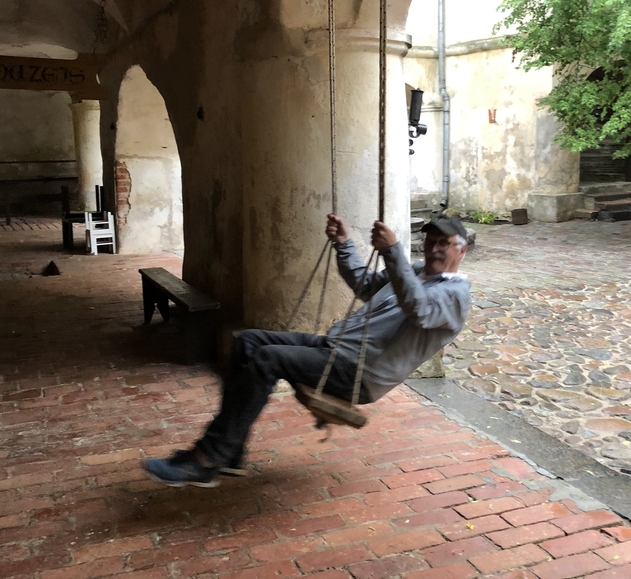
On Riga city streets – which is where I am right now – it’s easy to glimpse many faces, young and old, bemused or blank.
Waiting to cross the street, I scan the faces assembled on the other side. When the green light goes on, we cross and get a closer, if surreptitious, look.
Born in Latvia, I have often thought to myself that “everyone here looks like me”.
Well, not everyone.
There are exceptions, especially in Latvia, a small country of less than 2 million people and which was forced to absorb during an occupation after WWII some 400,000 ethnic Russians, many with a different physiognomy from native Latvians. Some look just like Latvians – perhaps through intermarriage – but many have a darker, more Slavic look.
Anyway, when I see a Latvian-appearing person, I try to imagine what they looked like as a child. Some, showing the effects of a hard life, reveal nothing of their childhood. They remain a unique person, but their child is not discernable to me in a few passing moments.
All that by prologue. In 2013 I blogged about this very topic. Here it is again, with extensive modifications:
In the early 2000s, I went to my first high school reunion – the 50th. I moved out-of-state after graduation and never returned. And, I had lost touch with a very good friend, someone who was in sports with me; I was hoping to re-connect –after half a century. *
The venue was a seaside hotel in Plymouth, MA. I entered the back door, wandered down a long hallway, and found myself in an open space full of old people.
I recognized no one; frankly, I thought I was in the wrong place or maybe the re-union was not until next week.
Well, after twenty minutes, and a couple glasses of truth serum, I started to pick up glimmers of recognition, of remembrances. A few people, blurry to start with, came into focus; others never did. If I’d been looking at a pool of water, I’d have to say it was all roiled up.
Eventually, things calmed down and the face of someone I’d been talking to would reveal itself – an “Aha!” moment . The nametag helped! The wrinkles dissolved and I was able to get past the dress-up suit and cocktail dress, the gray hair – what there was of it – and the extra pounds.
This is by way of introduction to a little mind exercise I have been
doing.
When I look at a person, a stranger – someone I am meeting for the first time – I try to envision what he looked like as a child. Is the child revealed in a gesture, in a smile or other expression? I’ve had bosses that I could imagine as children and then I have had one or two who were caught up in adulthood – the child was hidden away, presumably to better rule others.
So, what’s my point for the workplace? Seeing the child in someone helps me identify in a sympathetic way with that person. As a child, they are not a threat to be avoided, or someone with whom I cannot be myself; someone with whom I too must maintain adult-ness.
If I want to be playful, some people won’t play. In others, even with years of life experience written in their face, I still see the child.
There’s a bit of a sparkle in the eye. A shade of a smile, an expectation in the look. An unawareness – an innocence, if that is not exaggerating – something that takes me back to when this person was a child with a child’s potential for mischief and a spontaneity for fun.
To borrow from the French and PG Wodehouse, they have an espièglerie, an inclination to the whimsical.
And, as that child, they won’t see our meeting as transactional, or think, “What’s in it for me?”
Reading this far, you know that I am not blubbering about “The Child Within” or about a secret society of us vs. them, of kids vs. grownups.
We’ve all grown up, most of us have had to work and we’ve done the best we could, and so my little exercise is not about resistance or childhood pathology.
Rather, it’s about my gravitating toward a person who retains some endearing quality, some fleeting aspect that she had in kindergarten, a facial expression, or a child-hood mannerism. When I see that quality, I usually like that person, I know not why.
Someone who’s paved over who he was when, charms me less. (There is, of course, the strong possibility that person does not want to charm me!) Perhaps they never were child-like; instead from 4 years on they were boss-like in charge of their destiny.
Yes, like what happened at my 50th re-union, I am drawn closer to someone when I can envision a youthful quality, when a sidelong glance stirs memories of carefree days. When I can hear an echo of something not given up along the way, not sacrificed to be someone else, someone other.
Another friend of many decades with whom I have managed to stay in touch annually, has never lost his playful rascality. More recently, a newly made friend of my age, still has his mischievous scampish-ness. He’s written good humored books about growing up in the rural south; I see my friend as the child of whom he writes.
In spite of work experience – requiring them to be sober adults – both friends retain an impishness and willingness to have fun (I almost said, raise hell), within the law of course. And, when we are together we are candid – we don’t hold back – easily joking and cussing (if guys). We can make fun of each other and there’s no topic off limits. Much of the time, we are of a similar mind. If not, our differences do not result in a breakdown. I never have to pause with these friends and wonder how they fit into my “network” or how they can help me or what they might expect from me.
Alas, such is the assumed reciprocation prevalent among business “friends”.
*While I missed my friend and his wife (also a classmate of ours) at that 50th reunion, we connected via e-mail and have gotten together several times since. He’s always been more serious than me, but even now there are times when I catch an evanescent glimpse of those carefree days. In that regard, he has not changed very much at all.
***************
My book, Fables for Leaders, all about how ancient stories apply to today’s workplace, can be purchased here. The link will take you to BookBaby, the company that prints and fills orders for Fables for Leaders.
My other book, Leading from the Middle, with essays on team building, followers, leaders, innovation and several case studies of exceptional leaders and organizations, can be purchased here at Amazon.
N.B. For other essays on numerous topics on leadership and literature and fables go to my Nucleus archive from 2010-early 2025.
Copyright all text John Lubans 2013 & 2026
This was a great read, grandpa ♥️
That’s nice to hear when one labors under the long, long tail of the Internet! Cheers to you and to Tom, Sylvan and especially Ms. Ruby.