Democracy in the workplace has long been a theme in my research, teaching and writing, and for that matter, in my style of leadership. Typing Democratic Workplace in the search page for the blog’s archive, will get you to several mentions of the topic.
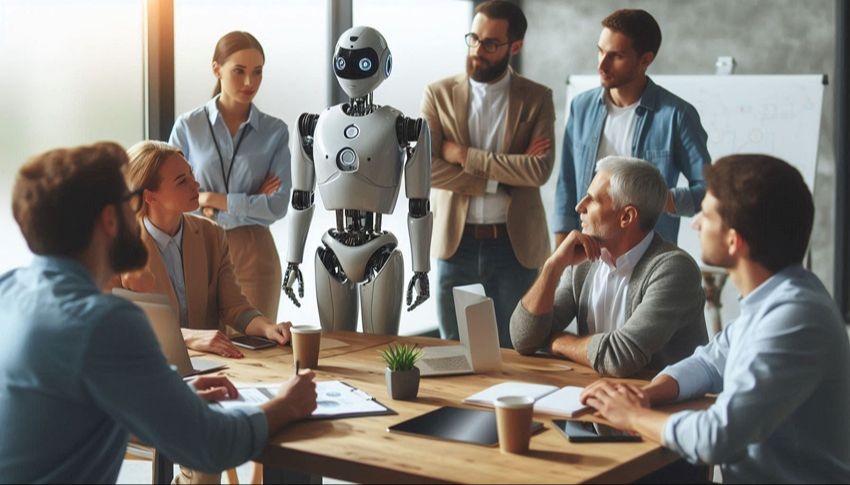
Many workplaces, we are told daily, are incorporating AI Robots, or soon will be, in the running of their business.
How will they, the robots, fit in with human teams? How will they promote democratic practices.
As for dress codes, since robots, as far as we know, wear no clothes, they won’t have to worry about Thong Thursday; and, the Clothing Optional office will feel like home.
Robots on teams will be, I presume, information gatherers, synthesizers, summarizers, and trend diviners. And each team’s robot will serve as a link among other Human-Robot Teams (HRTs). I use AI to summarize verbose grant proposals. What took me 30 minutes to summarize each “pitch” now gets done in under 5 seconds.
Apart from supporting its team, the robot will interconnect with multiple HRTs and track and share specifically what each is doing as it relates to the work of the robot’s team.
No information silos.
I’ve identified some common elements for democratic workplaces and I’ll try to explain the robot’s role in each.
Many leaders.
There is a human head leader of the democratic workplace, a boss, but leadership is expected, delegated and distributed throughout the organization.
Workers and robots take initiative and cross boundaries to improve services and production.
Team leaders meet with teams to set goals and iron out production needs.
Robots assist by providing real time analysis, along with consulting other robots and their teams. Problems are identified and the team responds to the robot’s suggestions on how to fix those problems. The team then fixes what needs fixing. The boss’s permission is not required.
De-centralized power.
Workers make decisions about their work. Units within the organization make decisions and spend money relevant to their work in concert with other units. Robots guide these processes with analyses of pros and cons including consulting with other HRTs to catch overlaps and redundancies. If the teams cannot resolve differences, then the organizational leader decides.
Open “books” (finances and personnel).
There are few secrets in the AI-assisted democratic workplace. Workers literally see – via the robot – financial and personnel records and take part, as relevant, in personnel budget decisions and in the recruitment and hiring of new staff.
Planning involves everyone.
Workers and robots participate in planning; they are stake-holders. Decisions are made in a collaborative process with or without anonymous voting. Robots provide scenarios and red and blue team recommendations with ranked analysis (what are the top directions and consequences of each), including what happens if the team decides to do nothing.
Team-based, flat organization.
Everyone on the HRT works. Team members, including team leaders and robots, do their fair share of real work. With increased worker responsibility there’s less need for supervison, hence fewer managers. Managers take part in doing what needs to be done and take the lead in thinking about trends, improvements and challenges for the organization.
Robots providing overviews shared among teams, diminishes that previous exclusive role for managers. Team leaders may take over the roles filled by managers. Or, increasingly, managers transition into the team leader role. A flat organization promotes communication across the workplace. The robot will go well beyond many advanced secretarial duties, taking minutes, synthesizing and distributing. More, the robot will serve as prompter for unfinished business and for other types of follow up. Indeed, the robot may do the follow up!
The robot may help enforce a democratic ethos: no back stabbing and no rumor mongering. The robot plays a role in conflict resolution by providing objective and reasoned explanations of what to do and how to get past conflict. Robotic facilitation could be of real help to teams made up of humans who avoid or accommodate or compromise when they really would like a different outcome. A robot, if endowed with high Emotional IQ (EQ) could facilitate conflict resolution.
Many effective (independent thinking and action-taking) followers.
While some workers are less-able followers, all have the freedom and peer-expectation to move from dependent and uncritical thinking to independence and action. The robot influences reluctant followers through open access to information, to speak up (or for the introverted, other ways of communication) and to become more active in group decision making. The robot serves as a set of “training wheels” as followers learn to lead and to express their ideas and concerns.
No doubt the robot’s ability to fact check in real time will need to be addressed. No one likes to be second guessed. I have observed that AI has found adroit ways, gently presented, at letting me know I am off target or plain wrong or a sloppy thinker!
No formal performance appraisal.
Annual performance appraisal is replaced by regular conversation and guidance among team members and managers. Do I hear cheering?
Robots provide feedback as to what is happening. Are projects on time? What is stopping the team and what can be done to clear bottle necks? As necessary, discipline and guidance is addressed immediately by leaders or peers including Ai robots. Annual goal setting – why are we here and what can we do better? – is a natural discussion among leaders, robots and other followers.
Will we see a diminution in using salary as a reward for high performance? Still, exceptional workers need to be recognized and the robot may have some say in this through its analysis of workloads, idea generation, collaboration, etc. The individual reward system may need to take a back seat to other ways of recognizing high quality work at the team level.
After each major team project, the robot provides an analysis of what went well, what could have gone better, and what learnings there are for the team and for its next project.
Less HR.
Workers, collaborating with team leaders, set fair salary levels and other compensation.The robot will take on what may have been an exclusive HR role, surveying and recommending best practices across the industry.
A proactive staff.
Most staff, including the team robot, act like owners. They look to improve what they do; they are alert to trends, new ideas and they are free to carry out new initiatives. The organization has the highly developed capacity – via the AI robot – to anticipate change and to take on new challenges. In my former career in research libraries, the robot would have anticipated search engines becoming the world’s information desk and how that shift would change existing roles in how readers find and use information. And, now, is AI the enemy or a significant helper in users finding and using information?
OK. How do you think HRTs will play out? How will team dynamics change? With robot participants, will teams get better or worse?
One study suggest having a robot in the room lowers team productivity. Why?
There are tensions in forming any any team and if those tensions are not addressed and resolved, the team will never achieve high-performance. Much will depend on the human-robot interaction. If the robot comes across as a “competent jerk”, a dickhead, well then you can imagine few people wanting to work with a judgmental, know-all, smartass, hotshot, show-off robot. Ditto for the human version of the competent jerk.
Early on there was legitimate criticism about AI’s “wokeness”, its baked in views on diversity, equity and inclusion. My own experience might help illustrate. While writing on literary cliches, I asked the robot why, in many novels, fat people are “surprisingly nimble”? Instead of an erudite, factual response, I got a lecture on “fat shaming”.
Those days are past. Rarely now does AI admonish or reprimand for straying off the DEI path. Far more likely is a sycophant-ic response praising me for an insightful question. Yes, AI will criticize me for my apparent fat shaming or any other perceived calumny agains DEI, but it will be nuanced and gently presented, vs. the early condemnation.
Still there is room for improvement. There are reports of AI facilitating suicidal thinking. Less seriously, AI used to answer customer service queries is often worse than speaking with a live human which was bad enough.
Since AI adapted away from hard core woke-ness, there is hope that a work team robot could get along with humans and our erring ways.
A new kind of symbiosis.
P.S. Homelife of an AI Robot.
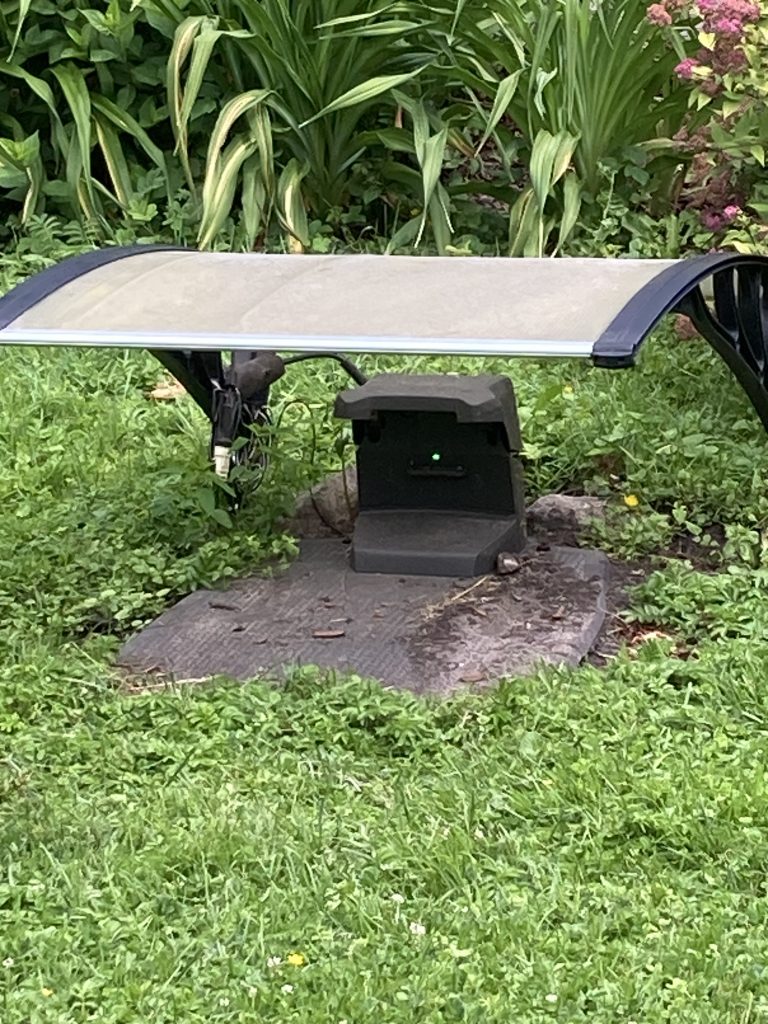
Caption: Lawn Robot’s “Home” with home light burning. Photo by author, 2026.
The past week in Riga, Latvia has seen booming electrical storms and drenching downpours. The nearby park, with a capacious lawn, has at least one robot grass cutter ambling along amidst sunbathers and frisbee players.
In stormy weather – like its human brethren – it seeks shelter and awaits sunny skies and puddle free lawns and walks. So, at workday’s end in the office, when humans go home, where does the workplace AI robot go? Unless we wish to humanize it, the AI robot has no home life. Like the lawn Roomba, the AI robot works and then goes to a charging station. We can fantasize about its happy-houring with other robots, but like all tools, even a very smart tool, it rests until next needed.
(Revised July 8, 2026)
***************
My book, Fables for Leaders, all about how ancient stories apply to today’s workplace, can be purchased here. The link will take you to BookBaby, the company that prints and fills orders for Fables for Leaders.
My other book, Leading from the Middle, with essays on team building, followers, leaders, innovation and several case studies of exceptional leaders and organizations, can be purchased here at Amazon.
N.B. For other essays on numerous topics on leadership and literature and fables go to my Nucleus archive from 2010-early 2025.
@Copyright 2026 all text by John Lubans