Three times now I’ve seen the Oscar and Golden Globe winning film, the enigmatic Flow/Straume. The last was an exceptional event with a full symphonic orchestra!
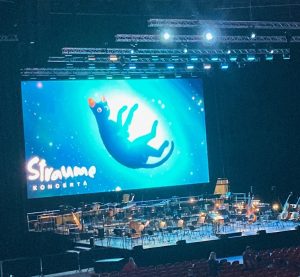
Caption: At the Riga Arena, May 23, 2026, the Latvian National Symphony Orchestra performed the film’s score, composed and conducted by Rihards Zaļupe.
Since I’m always on the lookout for leadership and team dynamics in literature and art, I puzzled over the characters in Flow. What kind of followers/leaders are they? More on that later.
Another question, do they become a self-organizing team surviving a doomsday flood, bobbing along through tempestuous waters in a dilapidated boat?
I’d be curious what some of my former Latvian students would say. For me, the answer is Yes.
Obviously, a life and death situation like a flood creates an urgency normally absent from workplace routine, but, the film offers clues on how a group of random individuals overcomes adversity and gain a high level of esprit de corps – an essential element akin to urgency for a high performing team.
In an interview, co-screenwriter/producer Matīss Kaža said that “Each of them (the characters) wants to belong in some form of society, and I think that’s what unifies all of (them).”
Is that not like an exceptional workplace team of different individuals who come together, and develop a camaraderie, to do more as a team than any one of them could do alone?
Who are the film’s characters?
Quoting Mr. Kaža, again – with bracketed comments by me – “We have a cat who is an individualist, (a loner, like most cats); a dog who is a follower (a most affable one, like most dogs), a capybara who is calm in all circumstances and a friend to everyone, … (and) there is a secretary bird who is a clear leader and has his own certain view of how everything should happen.
And then there is a lemur who simply creates chaos for the most part….”
Where do these five fit in Kelley’s well-known chart of followers?
The unaffected Labrador retriever circles playfully with his tail-a-wag in the “Yes-Man” box. According to Kelley, Yes followers are dependent thinkers, leery of challenging a leader’s premise. Importantly, they follow the leader’s lead – slavishly and literally. While Yes followers may not think for themselves, they are action oriented in supporting the leader and the team. I counted on Yes followers to help me bring about reforms, none of which I could have alone mandated with any success.
The imperturable capybara is a Survivor/Pragmatist, somewhat independent, somewhat action oriented – not “deadwood” or incompetent in any way. The pragmatist keeps a low supportive profile and does his job.
Along with our star cat, the secretary bird is an effective follower, independent-thinking, action-taking, and truth-telling. Interestingly, there is no conflict between the two leaders, in fact, the secretary bird is the cat’s protector – “despite being a predator by nature”.
Our lemur, the lovable fool, is an essential part of a team. While not on Kelley’s chart, the lovable fool plays an important part in the team, if nothing else, as a sort of jester, keeping humor alive and lowering tensions. The lemur is quirky, mildly competent, but well liked. He does not really fit Kelley’s sheep category of follower, dependent and un-thinking.
The cat is Kelley’s effective follower – a Lovable Star who happens to be highly courageous, curious and competent and manages himself well, yet is vulnerable. Effective followers (EF) require little supervision; and, they are committed to both the team and to “a purpose outside themselves”. EFs think for themselves.
Absent from the film is any sort of villain (alienated follower). Even the Leviathan whale, meant to be scary, saves the cat from drowning. At film’s end, as the water recedes, it is the cat who consoles the whale in his final moments. Alienated followers (AF) are the bête noire of any organizational change effort; as alienated, independent thinkers they are articulate opponents of change. The AF wants the star to fail.
At film’s end, the five stay together. For how long, we do not know.
Are there additional take-aways for the workplace? That’s another question for my students and for the reader.
Flow/Straume is available on multiple streaming platforms. One idea is to stream it at work for discussion, kind of like a book club meeting.
*At first take, one might think Mihaly Csikszentmihalyi’s psychological “flow” concept, has little to do with Gints Zilbalodis Oscar winning animated film, Flow (Straume in Latvian). But, maybe it does. Mr. Zilbalodis, the creative force behind the film, surely experienced creative flow. The American artist Robert Henri suggested what that might feel like: “Love your work as much as a dog loves to gnaw on a bone.”
***************
My book, Fables for Leaders, all about how ancient stories apply to today’s workplace, can be purchased here. The link will take you to BookBaby, the company that prints and fills orders for Fables for Leaders.
My other book, Leading from the Middle, with essays on team building, followers, leaders, innovation and several case studies of exceptional leaders and organizations, can be purchased here at Amazon.
N.B. For other essays on numerous topics on leadership and literature and fables go to my Nucleus archive from 2010-early 2025.
© Copyright all text and symphony photo by John Lubans 2026